
Speaker Power (Watt): Why “Real Power” Matters More Than Big Advertised Numbers
When shopping for a karaoke speaker or system, many customers ask why some models claim 3000W or 5000W, while others list only a few hundred watts.
The answer lies in how speaker power is measured and advertised. Understanding the difference between RMS power and peak power can help you compare products more clearly and avoid misleading numbers.
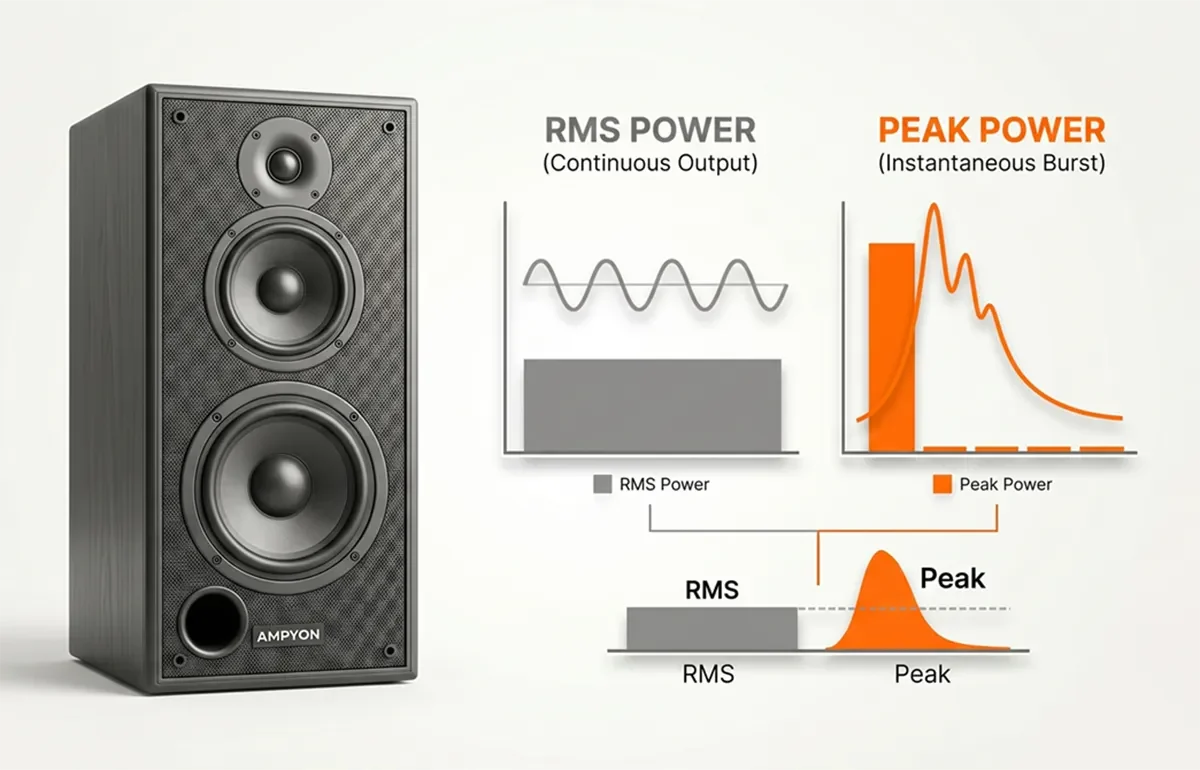
What Is Watt, and Why Are There Different Numbers?
RMS Watt
RMS watt refers to the actual power a speaker can deliver continuously and safely. It is the more meaningful number when you want to understand real listening performance.
Peak / PMPO Watt
Peak watt is the maximum power a speaker may reach for a very short moment. It is often used in marketing, but it does not reflect sustained performance.
Why It Gets Confusing
Two products can show very different advertised wattage numbers even when their real-world performance is much closer than the labels suggest.
What Matters More
For home karaoke, real usable power, sound quality, and system balance matter more than a large advertised number on paper.
RMS Power vs. Peak Power
RMS Power (Real / Continuous Power)
The actual power a speaker can deliver continuously and safely.
Measured using recognized technical standards.
More closely reflects real-world performance and everyday use.
Peak / PMPO Power (Marketing Power)
The maximum power for a very short moment.
Often used for marketing purposes.
Does not represent sustained listening capability.
Why Big Numbers Can Be Misleading
Large advertised numbers like 3000W–5000W may look impressive, but they do not automatically mean the system will sound better, cleaner, or more stable at home.
Is Lower RMS Wattage Enough for Home Karaoke?
Yes — When It Is Real Power
A properly designed karaoke speaker or system with realistic RMS power can play loud and clear in living rooms, handle family karaoke sessions, and maintain sound quality without sounding harsh.
Sound Quality Depends on More Than Wattage
Speaker drivers, enclosure design, amplifier stability, and signal processing all affect how a system sounds in real use.
Better for Real Comparison
Looking at RMS power helps customers compare products more accurately and avoid unrealistic expectations.
More Useful for Home Buyers
For most home karaoke setups, a balanced system with honest power ratings is usually a better choice than one that only advertises a huge peak number.
Does Higher Wattage Always Mean Better Sound?
No. A speaker with a very high advertised wattage can still sound harsh, distort easily, or become tiring to listen to if the drivers, enclosure, or amplification are not well balanced.
In many real home situations, a system with realistic power ratings can sound cleaner, more comfortable, and more reliable than one that simply advertises a much bigger number.
What Should You Really Look For?
Should I focus only on watt numbers?
No. Wattage is only one part of the picture. Sound clarity, comfort at higher volume, and overall system balance matter more in real use.
Why do some speakers show huge watt numbers?
Many brands highlight peak or PMPO power because the number looks more impressive in marketing, even though it does not reflect continuous performance.
Is RMS power the better number to compare?
Yes. RMS power is usually the more meaningful number when you want to understand how a speaker or karaoke system will perform in everyday listening.
What is the best way to choose a karaoke system?
Whenever possible, listen in person. Real listening experience tells you much more than watt numbers alone.