
The easiest way to host a karaoke party at home is to keep the setup simple, make the song queue clear, and give the night a light structure so guests always know how to join without feeling managed.
Who this guide is for: Home hosts planning a casual karaoke night for family, friends, mixed-age guests, or small groups who want the party to feel fun without becoming loud, confusing, or hard to manage.
How this guide was prepared: This article was rebuilt as the broad hosting guide for home karaoke parties. It focuses on guest flow, room comfort, song queues, turn-taking, microphone use, and a reusable party timeline, while leaving deeper playlist, etiquette, lighting, and buying decisions to their own guide pages.
Hosting karaoke at home sounds simple until everyone arrives, people are not sure who sings next, and the room starts to feel louder than it needs to be. Most stressful karaoke parties do not fail because the songs are bad. They fail because the flow is unclear.
A good home karaoke party does not need a complicated theme or a perfect schedule. It needs a room that is easy to understand: where people sit, where singers stand, how songs get added, and how the night moves from one turn to the next. If you want the broader collection of party themes and hosting angles, start with Karaoke Party Ideas. This guide stays focused on the core hosting plan.
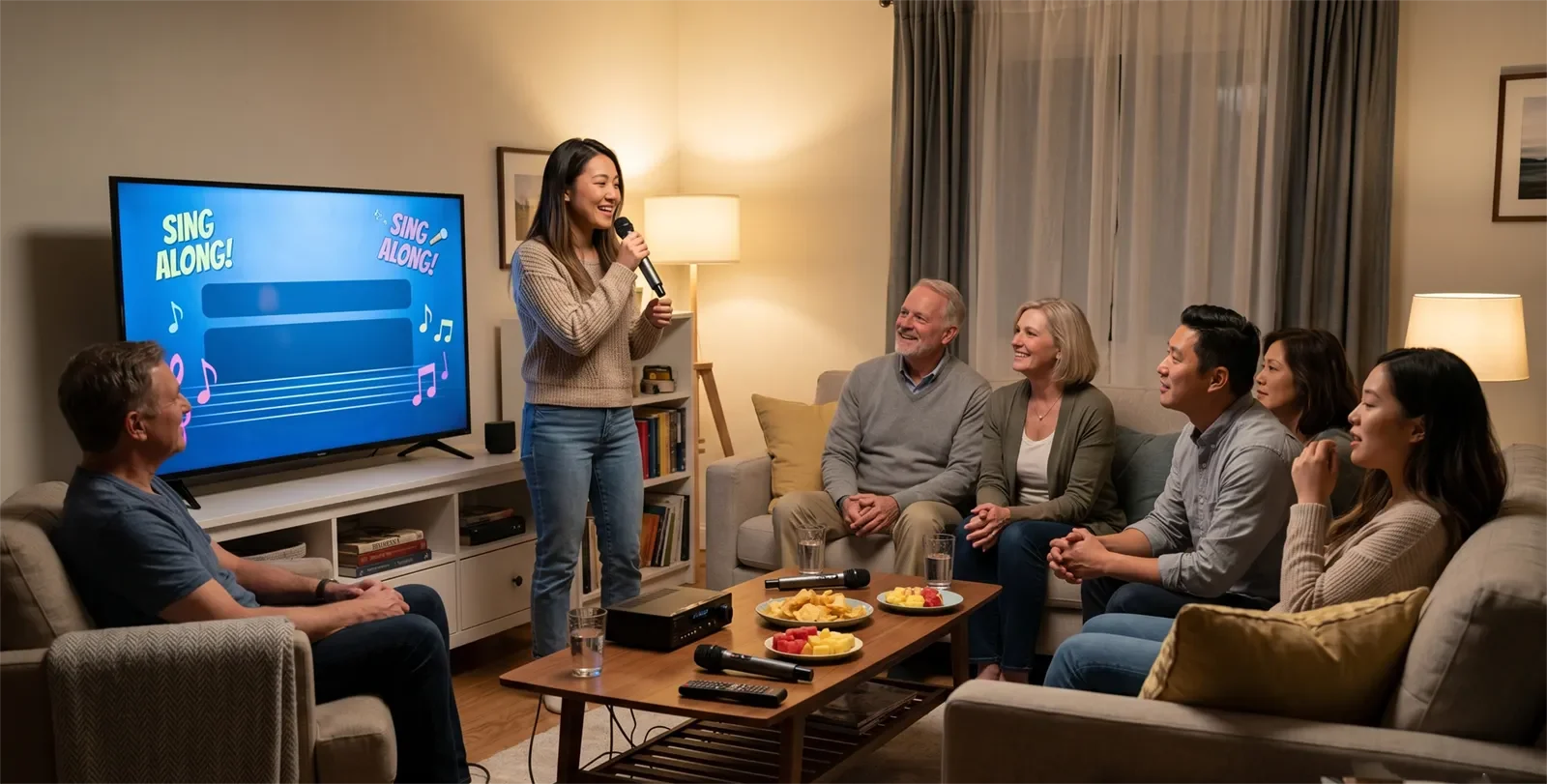
Table of Contents
Start with a simple party plan
The easiest karaoke party is the one guests understand within a few minutes of arriving. They should know where to sit, where to stand when they sing, how to add a song, and whether the night is relaxed, energetic, or somewhere in between.
Think of your plan as a frame, not a script. You do not need to control every moment. You only need enough structure to prevent confusion. For most home karaoke parties, that means one main singing area, one clear lyric screen, one simple song queue, and one easy way to pass the microphones.
It also helps to decide what kind of room you are hosting. A family-style karaoke night may need softer pacing and more group songs. A friend gathering may move faster. A mixed-age party usually works best when the first round feels easy, familiar, and low-pressure.
The goal is not to impress people with planning. The goal is to make participation feel easy. When guests do not have to guess what happens next, they are more likely to sing, laugh, stay engaged, and enjoy the night even when they are not holding the microphone.
Choose a guest count that fits your room
A home karaoke party can feel stressful when the room gets crowded faster than the host expected. The right guest count is not just about how many people you want to invite. It is about how many people can sit comfortably, see the lyrics, move around, and hear the singers without the room becoming chaotic.
In many homes, a moderate group feels better than a packed room. Guests need space to watch, sing, wait for their turn, grab food, and talk between songs. If people are constantly stepping over each other or blocking the lyric screen, the party starts to feel harder to enjoy.
For mixed-age gatherings, comfort matters even more. Older guests may not want to stand for long. Kids may move around often. Shy singers may need a little space before they feel ready to join. A practical room layout makes all of that easier.
Before the party starts, look at the room as a guest would. Can people see the screen from the main seats? Is there a clear place for the singer? Can the next person get ready without standing in the middle of the room? These small details make hosting feel smoother.
Set up the room so the flow feels obvious
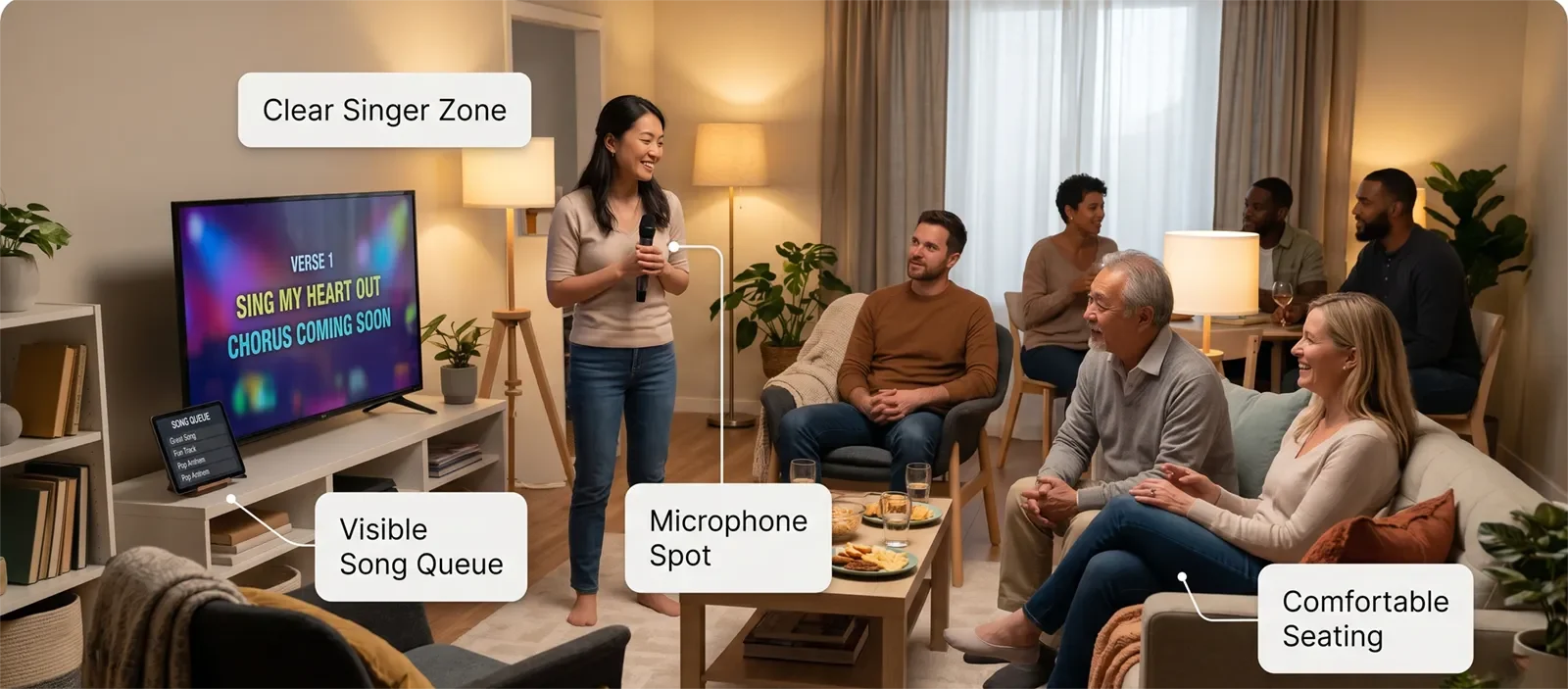
The room should quietly show people what to do. You do not need signs or a formal stage. You need a layout that makes the singing area, seating area, and waiting area easy to understand.
A simple home karaoke layout has three zones:
- Singing zone: the spot where the active singer stands without blocking the screen.
- Waiting zone: a small nearby area where the next one or two singers can get ready.
- Seating zone: the main area where guests can watch, talk, and enjoy the room.
The waiting zone is especially useful. It keeps transitions short and prevents the awkward moment after a song ends when nobody knows who is next. It can be as simple as one open spot near the singer or a chair close to the screen.
Microphone placement matters too. Keep the microphones in one obvious place when they are not being used. Two microphones are enough for many home karaoke parties because they support solo turns, duets, and easy handoffs without making the setup feel complicated.
The room does not need to feel like a karaoke lounge. It just needs to reduce friction. When people know where to go and what happens next, the party feels more relaxed right away.
Use a visible song queue
The song queue is what keeps a home karaoke party from feeling messy. If guests do not know when their turn is coming, they either stop paying attention or keep asking what is next. A visible queue solves that problem.
The queue can be simple. Use a phone note, a whiteboard, a tablet, or one person managing the order near the screen. What matters is that guests can see there is a fair flow.
Early in the night, let people add one song at a time. This prevents one confident singer from loading the queue before others have joined. Once the room feels comfortable, you can loosen the structure.
Song order also matters. Try not to stack too many slow songs, difficult songs, or high-pressure solos at the beginning. The first few songs should help the room warm up. Familiar songs, easy choruses, and duets usually work better than demanding solo performances right away.
For a deeper music-flow guide, read How to Build the Perfect Karaoke Playlist for Home Parties.
Keep turn-taking fair without making it rigid
Turn-taking should feel fair, but not stiff. If the host runs the room like a formal program, shy guests may feel nervous. If there is no structure at all, the loudest or most confident singers can take over.
A good middle ground is gentle rotation. Give early space to different types of guests: one confident singer, one duet, one easy group song, one guest who has not sung yet, then another open request. This keeps the room shared without making people feel forced.
Avoid putting guests on the spot too directly. Instead of saying, “You have to sing next,” try softer invitations like, “This one is easy if anyone wants to join,” or “Two people can do this one together.” That keeps participation open without turning it into pressure.
If your group includes many first-time or mixed-confidence singers, it also helps to keep basic etiquette clear. Guests should not cut the queue, mock weaker singers, hold the microphone too long, or pressure someone who already said no. For more on the social side, see Karaoke Etiquette for Group Singing That Keeps the Night Fun.
Avoid awkward pauses between songs
Awkward pauses usually happen when the room loses momentum between decisions. A song ends, nobody knows who is next, someone is searching for lyrics, one microphone is missing, and the energy drops.
The fix is not to become a strict host. The fix is to remove the common points of friction. Keep the next singer roughly ready. Keep the microphones in the same place. Keep the queue visible. Choose a few backup songs in case the room stalls.
It also helps to protect the first 20 minutes. The opening stretch should feel easy and welcoming. If the first songs are too difficult or too serious, the room may become passive. If the first songs are familiar and low-pressure, guests usually loosen up faster.
Non-singers should still feel included. Give them a clear view, comfortable seating, and room to react. A karaoke party is not only for the person holding the microphone. The audience energy is part of the night.
The best home karaoke parties feel steady, not perfect. People can sing, laugh, rest, talk, and rejoin without the night falling apart every few minutes.
A reusable home karaoke party timeline
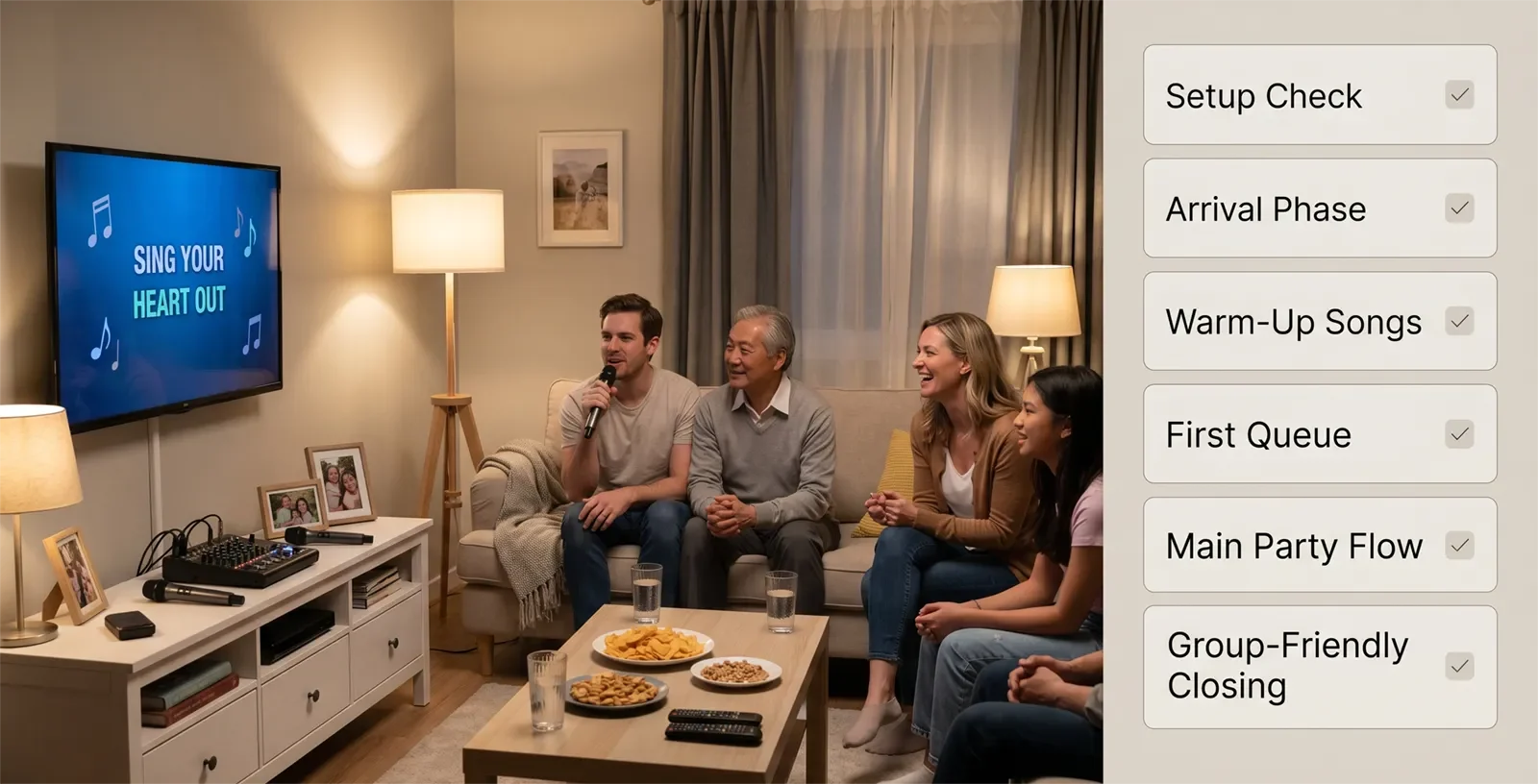
You do not need a strict schedule, but a simple timeline helps the night feel easier to host.
- Before guests arrive: Turn on the system, test the lyric screen, check the microphones, clear the singing zone, and decide where the queue will be managed.
- Arrival phase: Let guests settle, talk, eat, and get comfortable before pushing karaoke too hard.
- Warm-up phase: Start with easy, familiar songs. Duets and group-friendly songs work well here.
- First queue phase: Open a simple song queue and let guests add one song at a time.
- Main party phase: Mix solos, duets, and group moments. Keep transitions short and adjust the order if the room needs more energy.
- Closing phase: End with a few familiar or group-friendly songs instead of letting the party fade into confusion.
This timeline works because it gives the host fewer decisions to make under pressure. It also makes the party repeatable. Once you know the rhythm, you can use it again for birthdays, holidays, family visits, or casual weekend gatherings.
Final Thought
A stress-free home karaoke party is not about doing everything. It is about removing the small problems that make people hesitate: unclear turns, crowded rooms, missing microphones, hard opening songs, and awkward pauses.
When the room is easy to understand, the queue is visible, and the first songs feel welcoming, guests relax faster. That is what makes karaoke at home work. Not a perfect plan, but a simple flow people can join without overthinking.
Contact Tittac for help choosing a karaoke system that fits your room, guest style, and budget.
Frequently Asked Questions
How many guests are best for a home karaoke party?
The best number depends on your room size, seating, and screen visibility. A moderate group usually works better than a packed room because guests can see the lyrics, move comfortably, and hear the singers without the space feeling chaotic.
Do I need two microphones for a home karaoke party?
Two microphones are ideal for many home karaoke parties. They make duets easier, speed up handoffs, and help shy guests sing with someone else. One microphone can work, but two usually creates a smoother flow.
Should I plan every song before the party?
No. Prepare a few easy opening songs, then let the rest of the night stay flexible. A fully locked playlist can feel too controlled, while no plan at all can create awkward pauses. A small starting list plus a visible queue is usually enough.
How do I keep guests from feeling pressured to sing?
Use duets, group songs, and soft invitations instead of forcing solo turns. Let guests know they can sing, join a chorus, or simply watch. Karaoke feels more fun when participation is available but not required.
How should I end a karaoke party at home?
End with a few familiar songs or one final group-friendly round. It is better to close while the room still feels warm than to let the party drag until people lose energy and the ending feels unclear.