
Karaoke signal flow means the path sound takes through your home system, from the music source and microphones to the mixer or karaoke amplifier and finally to the speakers. Once you understand that path, the system becomes much easier to adjust because you know where music and vocals enter, where they combine, and which controls affect each stage.
Written by Toan Ho — Tittac editorial team
Who this guide is for: Home karaoke users who feel confused by where the TV, source app, microphone receiver, mixer or amplifier, and speakers each fit in the full sound path.
How this guide was prepared: This guide was written from a home-use perspective, focusing on how audio moves through a typical karaoke system and how that signal path affects real adjustment decisions.
Many home karaoke users do not struggle with singing first. They struggle with understanding where the sound is going. The TV shows lyrics, the app or YouTube provides music, the microphone receiver handles vocals, the mixer or karaoke amplifier has a row of controls, and the speakers do the final playback. When all of that sits in one room, it is easy to lose track of what each part is actually doing.
That is why signal flow matters in home karaoke. It gives you a simple mental map of how music and vocals travel through the system, where they meet, and where controls actually affect what you hear. This is not a setup guide. It is a plain-English way to understand the bigger technical picture. For more articles in this category, see our Karaoke Technical Guides.
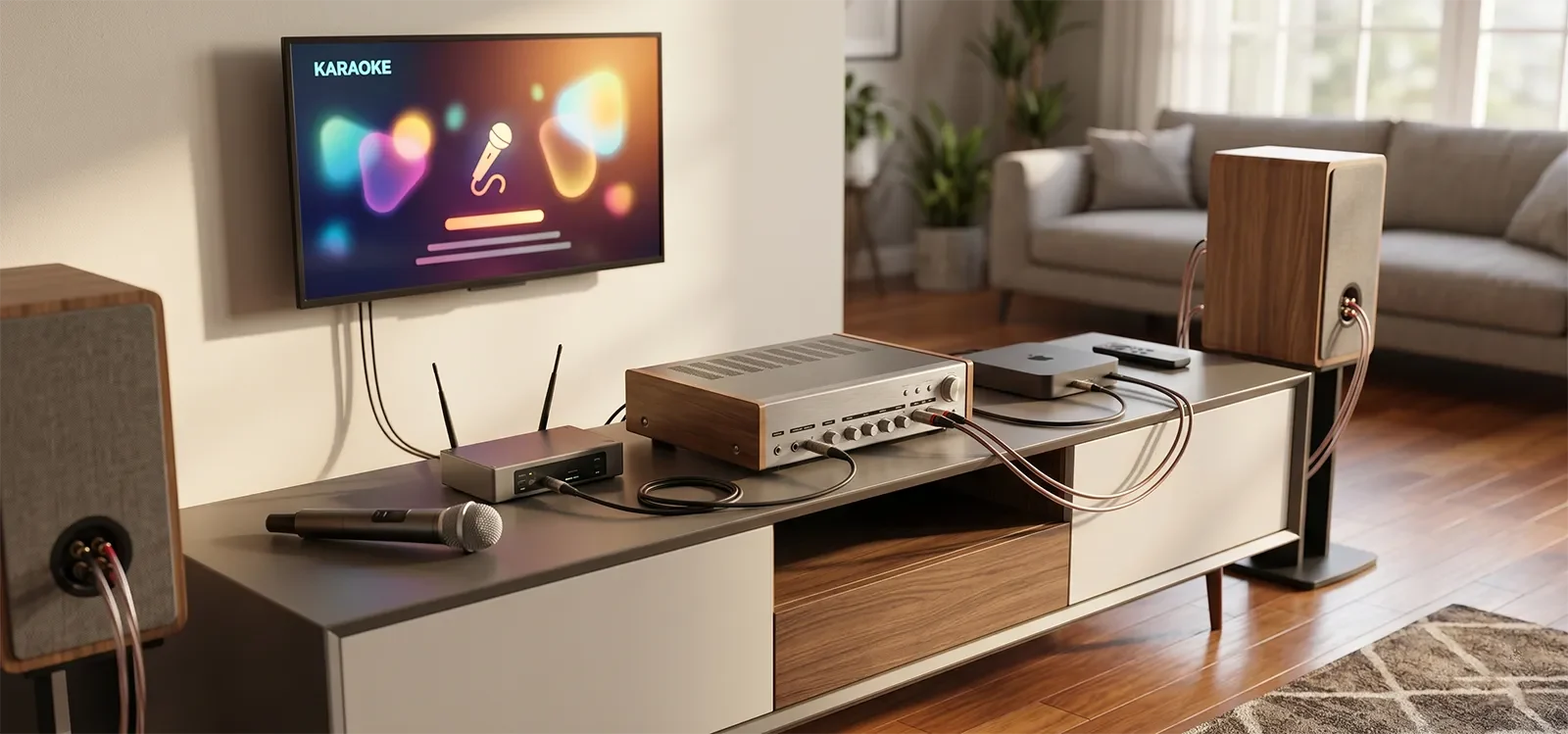
Table of Contents
Quick Answer
Karaoke signal flow means the path audio takes through your home system, from the music source and microphones to the mixer or karaoke amplifier and finally to the speakers. Understanding that path helps you make better decisions because not every control affects the sound at the same point. Music and vocals do not always start in the same place, and they do not always get processed in the same order.
Once you understand where signals enter, where they combine, and where output happens, the system becomes easier to adjust. You stop guessing, and small changes start making more sense.
What karaoke signal flow actually means
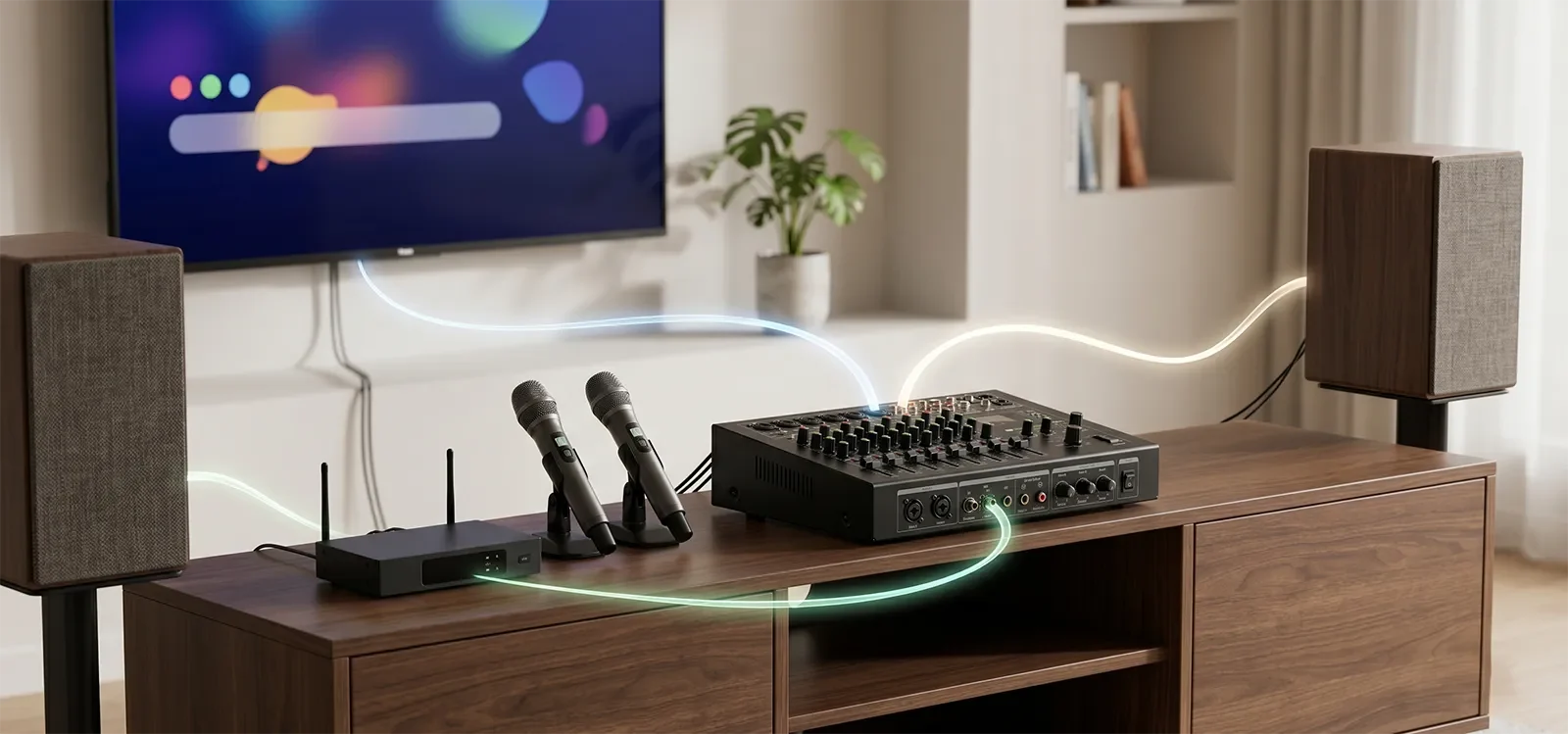
In plain English, signal flow is the order in which sound travels through the system. Music usually starts at the source, such as YouTube, a karaoke app, or another playback device connected through the TV or directly into the karaoke system. Vocals usually begin at the microphone, then pass through a wireless receiver if one is being used.
From there, both signals move into the mixer or karaoke amplifier, where they are shaped, balanced, and sent out to the speakers. The important idea is that sound does not appear everywhere at once. It moves in stages. Some controls affect the signal early, some affect it after music and vocals are combined, and some only matter close to the final output.
That order matters because a change made early in the chain often influences everything that happens later. Signal flow is not about memorizing technical labels. It is about knowing where sound begins, where it gets changed, and where it finally becomes what you hear in the room.
What signal flow changes in system behavior
Understanding signal flow changes how you read the system. Instead of seeing the karaoke setup as one box with many knobs, you start seeing it as a sequence. That makes the system easier to understand. If vocals and music feel out of balance, you stop assuming every control can fix the problem. You begin thinking about where in the chain that balance is actually being shaped.
This also helps explain why some adjustments feel clean while others feel confusing. A change made at the source does not behave the same way as a change made after the signal reaches the mixer or amplifier. That is one reason What Gain Structure Means in Home Karaoke is a useful companion article. Once you understand where sound travels, it becomes easier to understand why level staging across that path matters so much.
Signal flow also helps explain why some problems are really timing or processing issues rather than simple loudness issues. If music and vocal paths are handled differently inside the system, their behavior can feel less connected than users expect. That is why the order of the signal chain matters conceptually, even in normal home karaoke use.
What users hear at home
At home, understanding signal flow usually improves the sound indirectly. The system does not magically become better just because you know the path, but your adjustments become smarter. You are less likely to make random changes that create new problems. You also become more aware of where music and vocals meet, which helps the whole mix feel more controlled.
This matters most in real living-room setups, where the chain is often mixed together: TV for lyrics, app-based music source, wireless microphones, a karaoke amplifier or mixer, and speakers in a room with reflections and family seating. In that environment, confusion about the signal path often leads to confusion in the sound. Users may think the system is inconsistent when the real issue is that they are adjusting the wrong stage.
Signal flow also helps users understand why delay sometimes appears between what they sing and what they hear. The issue is not always “the microphone” or “the TV” by itself. Sometimes it is about where processing happens in the overall path. That is why Why Audio Delay Happens in Karaoke Systems is the direct next step from this topic.

What people misunderstand about signal flow
The biggest misunderstanding is thinking signal flow is only for professionals or installers. In reality, home users benefit from it because it makes the system less mysterious. You do not need studio knowledge. You just need a clear mental picture of where sound starts, where it combines, and where it leaves the system.
Another misunderstanding is assuming signal flow means connection instructions. It does not. A setup guide tells you what plugs into what. Signal flow explains what happens after that connection exists. It is about the behavior of the system, not a step-by-step wiring order.
People also tend to assume that if all the sound ends up in the speakers, then every control should affect everything equally. That is not how most karaoke systems behave. Some controls shape input, some shape the mixed signal, and some are closer to final output. Without understanding the order, users often over-adjust and end up chasing the sound instead of guiding it.
The practical listening and adjustment rule
The practical rule is simple: before adjusting anything, ask where in the signal path that control actually lives. Is it affecting the music source before it enters the system? Is it affecting the microphone side? Is it shaping the combined signal after music and vocals meet? That one question often prevents unnecessary confusion.
For home karaoke, the real goal is not technical perfection. It is knowing enough about the path to make calmer, more accurate adjustments. When you understand the order of the signal chain, you stop treating every knob like a universal fix. You begin making changes with more purpose, which usually leads to clearer vocals, more stable balance, and fewer “why did that make it worse?” moments.
That is the real value of signal flow. It gives structure to the way you listen and adjust.
Conclusion
Karaoke signal flow is simply the path sound takes through the system, but that simple idea changes how the whole setup makes sense. Once you understand where music starts, where vocals enter, where signals combine, and where final output happens, the system becomes easier to read.
The practical takeaway is clear. You do not need more jargon. You need a better map. In home karaoke, that map helps you make better adjustments, avoid chasing the wrong control, and understand why the system behaves the way it does.
Frequently Asked Questions
Is signal flow the same as a wiring guide?
No. A wiring guide shows how devices connect physically. Signal flow explains how sound moves through the system after those connections exist. This article is about understanding the path of music and vocals conceptually, not giving step-by-step connection instructions.
Why does signal flow matter if my karaoke system already works?
Because a working system can still be confusing to adjust. Signal flow helps you understand where music and vocals are being shaped, so you make better decisions when balancing levels, reacting to delay, or trying to understand why one change affects the sound more than another.
Where do music and vocal signals usually meet in a home karaoke system?
In many home systems, they meet inside the mixer or karaoke amplifier after the music source and microphone signal each enter the chain. The exact design varies, but the concept stays the same: separate signals come in, get combined, processed, and then sent out to the speakers.
Do I need technical knowledge to understand karaoke signal flow?
No. You do not need advanced audio knowledge. The useful part is simply understanding the order of the signal path in plain English. Once you know where sound starts and where controls sit along that path, the system becomes much easier to understand and adjust.
Need help understanding the right karaoke setup for your home? Call/Text English: 800-928-4331 | Call/Text Vietnamese: 800-640-5888.
Want to keep going into how karaoke processing works after the signal enters the chain?