
Wired and wireless microphones can both work well for home karaoke, but they do not behave the same way. Wired microphones usually offer a simpler, more direct signal path, while wireless microphones add freedom of movement along with extra transmission, battery, and receiver variables.
Written by Toan Ho — Tittac editorial team.
Who this guide is for: Home karaoke users who want to understand what really changes between wired and wireless microphones in everyday singing.
How this guide was prepared: This guide was written from a home-use perspective, focusing on signal path, stability, handling, timing perception, and practical trade-offs in real family-room karaoke setups.
Many home karaoke users think wired versus wireless microphones is mainly about convenience. One has a cable, the other does not. But once people start singing regularly at home, the real difference becomes more technical: one format usually feels simpler and more direct, while the other feels freer but adds more stages to the signal chain.
That is why this comparison matters. Wired and wireless microphones do not just change how the singer moves. They change how the voice travels into the karaoke system, what can affect stability, and how the microphone feels during real family use. This article explains those technical differences in plain English, not as a shopping guide. For broader category context, browse our Karaoke Technical Guides.
Quick Answer: A wired microphone usually has the simpler path because the signal travels through a cable directly into the karaoke system. A wireless microphone sends the voice to a receiver first, then the receiver passes that signal into the mixer, amplifier, or processor. Wireless adds mobility and convenience, but it also adds transmission stages, battery dependence, and more chances for signal behavior to change. In home karaoke, the real choice is not just cable versus no cable. It is directness versus movement, simplicity versus flexibility, and which trade-off matters more in your room.
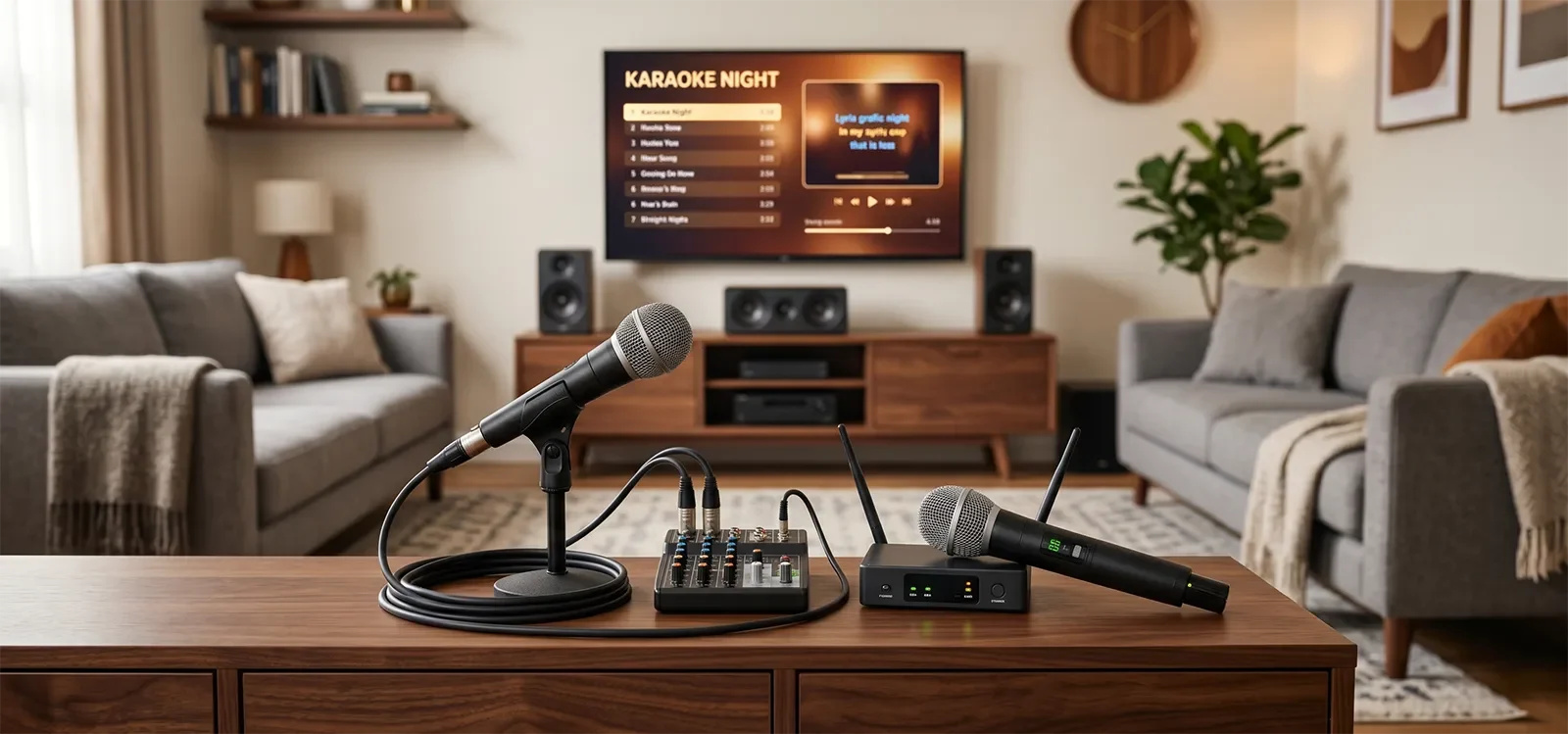
Table of Contents
What the technical difference actually means
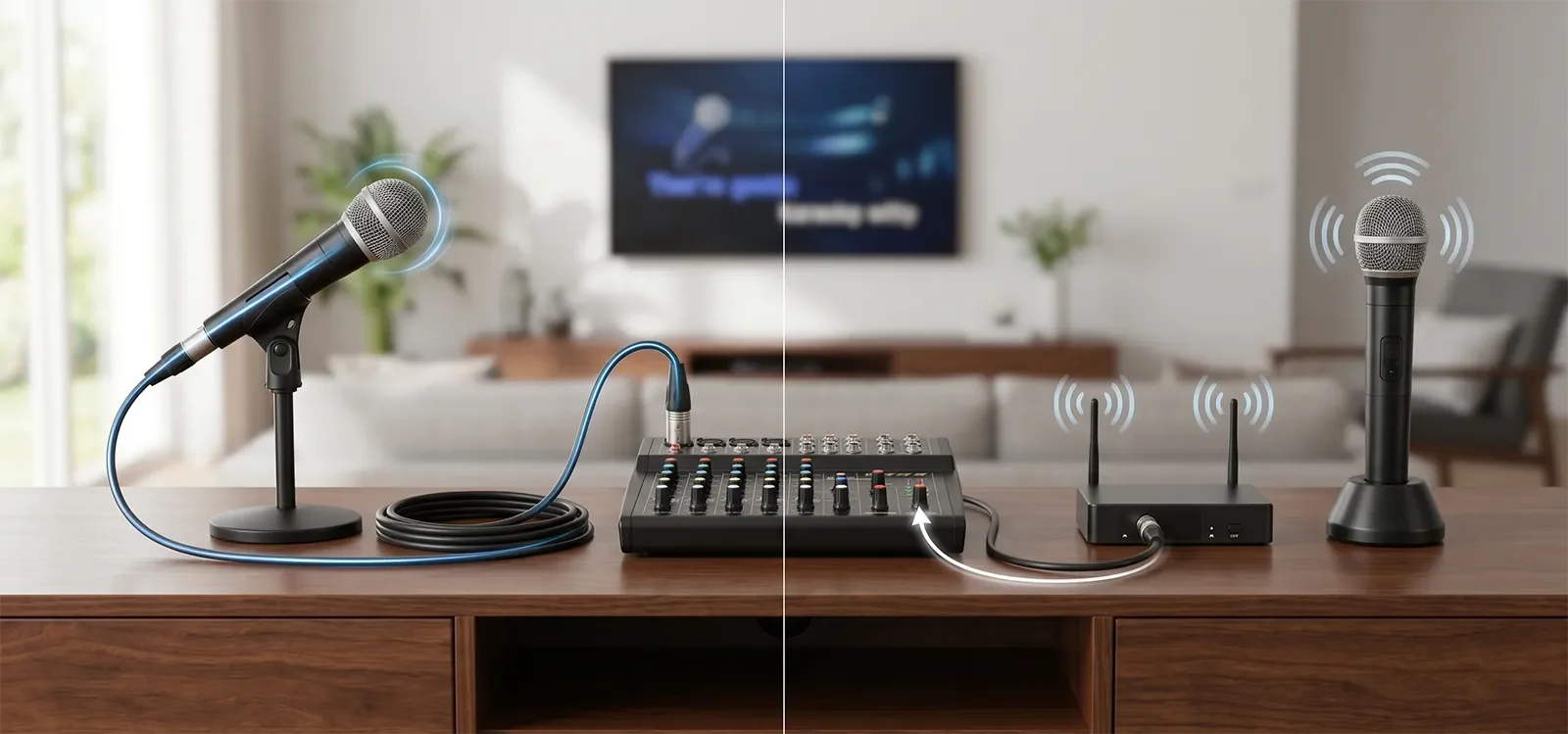
In plain English, a wired microphone sends the signal through a physical cable straight into the karaoke system. A wireless microphone sends the signal from the microphone to a receiver first. The receiver then passes that signal into the mixer, karaoke amplifier, processor, or speaker system.
That extra stage does not automatically make wireless bad. It simply means there are more pieces involved in carrying the singer’s voice into the room. More pieces can create more freedom, but they can also create more places where battery condition, transmission quality, receiver behavior, or timing perception may matter.
So the technical difference is not just physical convenience. It is path complexity. A wired mic is usually more direct. A wireless mic is usually more layered. That difference affects how the system behaves at home.
How the signal path changes
A wired microphone has a short and predictable signal path. The microphone captures the voice, sends it through the cable, and the karaoke system receives it. Because the path is simple, there are fewer technical dependencies between the singer and the system.
A wireless microphone has a longer path. The microphone captures the voice, converts and transmits the signal, the receiver picks it up, and then the receiver sends the signal into the rest of the karaoke chain. That added path is what gives wireless microphones their freedom, but it is also why wireless systems depend more on pairing, receiver quality, battery condition, and clean transmission.
For home users, this does not mean wireless microphones should be avoided. It means wireless microphones should be understood correctly. Their convenience is real, but it comes from a more complex chain.
What changes in system behavior
A wired microphone often feels predictable because there is no radio transmission stage, no receiver link, and no microphone battery to manage. In home karaoke, that can make the mic feel steady and immediate, especially for users who value simplicity more than freedom of movement.
A wireless microphone changes the experience by making movement easier. The singer can walk, pass the mic around, and avoid cables near chairs, tables, children, or portable speaker setups. That can make karaoke feel more relaxed in a family room.
Technically, though, wireless adds more variables. Transmission quality matters. Battery level matters. Receiver behavior matters. Timing may also feel slightly different depending on the system. Not every wireless microphone creates noticeable delay, but the signal path is different enough that timing can become part of the conversation.
That is why Why Audio Delay Happens in Karaoke Systems is an important related read. Even small timing differences can matter more once live vocals are involved.
Level behavior also matters. Because a wireless microphone reaches the system through a receiver, the gain and output level may need to be managed carefully. For that part of the chain, see What Gain Structure Means in Home Karaoke.
What users hear and feel at home
At home, the difference is often felt as much as it is heard. A wired microphone can feel stable, immediate, and uncomplicated. That does not mean every wired microphone automatically sounds better, but the experience often feels direct because the signal path is simple.
A wireless microphone often feels easier in real family use. There is no cable to drag across the room, no cord to step over, and no need to keep the singer close to one spot. For parties, family gatherings, and casual singing, that freedom can matter more than a small technical advantage on paper.
The trade-off is that wireless microphones depend on more hidden conditions. A weak battery, poor receiver placement, interference, or low-quality transmission can affect the experience. When everything works well, wireless can feel effortless. When something in the chain is weak, the issue may be harder for a casual user to identify.
Handling can differ too. A wired mic may feel more anchored because of the cable. A wireless mic may feel lighter and freer, but it also requires users to manage battery habits and avoid blocking or mishandling the transmitter area.

Common misunderstandings
The biggest misunderstanding is thinking wireless is automatically better because it feels more modern. Wireless is often more convenient, but convenience is not the same as technical simplicity. A wired microphone usually has the cleaner path conceptually because there are fewer stages between the singer and the system.
The second misunderstanding is assuming wired always means professional and wireless always means weaker. That is too simplistic. Good wireless microphones can work very well at home, and many families benefit more from movement and convenience than from the most direct possible signal path.
The third misunderstanding is thinking the difference is only about sound quality. In reality, the difference also includes stability, timing perception, handling, battery dependence, room movement, and how naturally people use the microphone during karaoke.
The better way to think about it is not “Which one wins?” It is “Which trade-off fits this room and this type of use?”
The practical rule
The practical rule is simple: choose the microphone format by how it affects real home use, not by which one sounds more advanced.
If your karaoke setup is used in a family room where people pass the mic around, move freely, and want less clutter, wireless may make the whole experience easier. If your priority is the simplest signal path, fewer variables, and a more direct connection to the system, wired may feel more reassuring.
For home karaoke, one format is not universally correct. Wired usually offers a more direct path and fewer signal variables. Wireless usually offers better freedom and easier movement, but it introduces more technical layers behind the scenes.
The useful question is this: what kind of stability matters more in your room — the stability of a simpler signal path, or the stability of a more comfortable, cable-free singing experience?
Conclusion
Wired and wireless microphones differ in ways that go beyond cable convenience. They change how the voice enters the karaoke system, how many stages are involved, how movement feels in the room, and what kinds of technical trade-offs come with everyday use.
Wired usually means a more direct signal path. Wireless usually means more freedom, with more signal complexity behind it. For home karaoke, the right way to compare them is not old versus new. It is signal simplicity versus movement, directness versus flexibility, and which trade-off makes singing easier in your home.
Frequently Asked Questions
Does a wired microphone always sound better than a wireless microphone?
No. A wired microphone usually has a simpler signal path, which can feel more direct and stable. But that does not mean every home user will hear a dramatic difference every time. The real technical difference is that wireless adds transmission stages and more system variables.
Can wireless microphones add noticeable delay in home karaoke?
Sometimes they can contribute to timing perception because the signal has to travel through a wireless stage before reaching the rest of the karaoke system. Whether that becomes noticeable depends on the full system chain, not only the microphone.
Why do many home users prefer wireless microphones?
Mobility matters in real rooms. Passing the mic around, moving naturally, and avoiding cable clutter can make karaoke feel easier and more enjoyable for families and guests. The convenience is real, even though the signal path is more complex.
Are wired microphones more reliable than wireless microphones?
Wired microphones are often simpler because they do not depend on wireless transmission or microphone batteries. Wireless microphones can still be reliable, but they depend more on receiver quality, battery condition, and clean signal transmission.
Is this article recommending wired or wireless microphones for everyone?
No. This guide explains the technical trade-offs, not one universal answer. The better choice depends on how your home karaoke system is used, how much people move, and whether your household values cable-free convenience or a simpler signal path more.
Want to keep going into the singing side of microphone use?
Continue with microphone technique here.