
The right karaoke mixing amplifier is the one that makes vocals clear, microphones easy to control, music balanced, and the whole system simple enough for the family to use. Do not choose only by wattage or the number of knobs. For home karaoke, microphone control, echo/reverb quality, speaker matching, feedback control, and ease of daily use matter more.
Definition: A karaoke mixing amplifier is the control center of a karaoke system. It powers the speakers, mixes the microphones with the music, and lets you adjust vocal effects such as echo, reverb, tone, and microphone volume.
Who this guide is for: This guide is for home karaoke buyers comparing mixing amplifiers, karaoke receivers, and component-style karaoke systems. It is especially useful if you want a system for a living room, family room, small party space, or Vietnamese-style home karaoke nights where clear vocals and easy controls matter more than complicated specs.
How this guide was prepared: This guide comes from the same amplifier-matching conversations Tittac has with customers every week — room size, speaker fit, microphone setup, TV or YouTube source, vocal clarity, feedback risk, and whether the system will be easy to use after delivery. A couple of service calls we've handled are included below because they changed what we now check before recommending a setup.
Table of Contents
- What Counts as a Karaoke Mixing Amplifier?
- What Actually Changes When You Choose the Right Amplifier
- The Controls That Actually Matter
- Mixing Amplifier vs. Regular Receiver
- Speaker Matching and Power
- Microphones and Wireless Support
- Common Buying Mistakes
- How to Choose in 60 Seconds
- Frequently Asked Questions
- Final Recommendation
What Counts as a Karaoke Mixing Amplifier?
A karaoke mixing amplifier is different from a basic music amplifier because it is built around live vocals. It does not only send power to the speakers. It also helps control the microphone sound, vocal effect, music level, and overall balance between the singer and the song.
That matters because karaoke is not passive listening. Someone is singing into a microphone in the same room where the speakers are playing. The system has to stay clear, stable, and comfortable without making the singer fight the music or the room.
What Actually Changes When You Choose the Right Amplifier
Vocal confidence
A good karaoke mixing amplifier makes the singer feel supported. The voice should sit clearly above the music without sounding harsh, thin, buried, or painfully loud. This is the first thing most families notice, even if they do not know the technical reason.
Room control
In a small room, the wrong amplifier can make the system feel too loud, too sharp, or too easy to feed back. In a larger room, a weak or poorly matched amplifier can make vocals feel small and music feel strained. The right amplifier helps the system stay balanced at normal family volume.
Ease of daily use
A home karaoke system should not require a technician every time someone wants to sing. Simple, predictable controls are valuable because most families use karaoke casually: turn it on, choose a YouTube song, pick up the microphone, and sing. We've had customers who originally bought a home theater receiver for exactly this reason — it looked simpler on paper — and came back within a month once they realized "simple" also meant no echo control and a vocal that always sat too far behind the music.
The Controls That Actually Matter
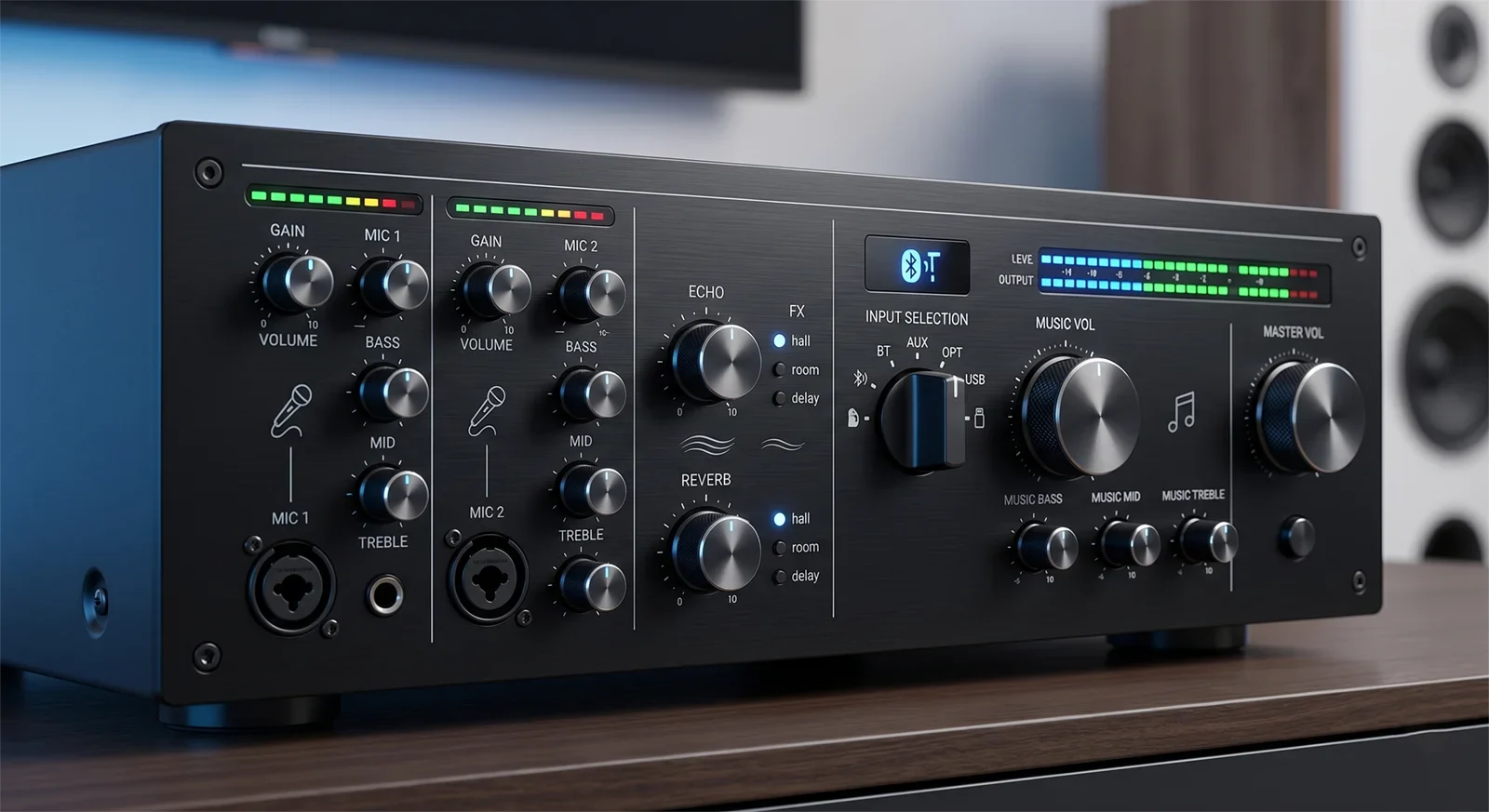
| Control | Why it matters | What to avoid |
|---|---|---|
| Microphone volume | Sets how clearly the singer sits above the music. | Vocals that are buried, harsh, or too loud. |
| Echo / reverb | Makes singing feel smoother and more forgiving. | Too much effect that blurs the lyrics. |
| Bass / mid / treble | Shapes fullness, vocal body, and brightness. | Thin vocals, boomy music, or sharp treble. |
| Feedback control | Helps reduce microphone howling when used correctly. | Expecting anti-feedback to fix bad placement. |
| Input control | Helps balance TV, YouTube, microphones, and music sources. | A setup that is hard for the family to operate. |
Mixing Amplifier vs. Regular Receiver
A regular receiver is mainly designed for movies and music. It can sound good for entertainment, but it usually does not give you the same microphone control, echo adjustment, or vocal balancing needed for karaoke.
A karaoke mixing amplifier is built around the singer. It helps the voice sit above the music, makes vocal effects easier to adjust, and gives the system more practical control when different family members sing.
If your main goal is home karaoke, a karaoke mixing amplifier is usually a better center point than a normal home theater receiver.
Speaker Matching and Power
Check compatibility before comparing wattage
- Identify the speaker type: Passive speakers need amplified speaker outputs. Powered speakers normally need a compatible line-level signal and their own AC power; do not connect an amplifier's speaker output to a powered speaker's line input unless the manufacturer explicitly supports it.
- For passive speakers, check the complete load: Compare the speakers' nominal impedance with the amplifier's supported load for the number of speakers and wiring plan you will use.
- Compare like with like: Read continuous per-channel power at the relevant impedance rather than comparing an unspecified maximum or peak number.
- Map every connection: Confirm how the TV or music source connects, how many microphone-receiver outputs require inputs, and whether any powered speakers or additional equipment need line-level outputs.
This compatibility check should come before judging vocal controls, effects, or convenience features. An amplifier can have useful karaoke controls and still be the wrong electrical or connection match for the rest of the system. This is the exact mix-up behind one of the more expensive support calls we've had: a customer wired an amplifier's speaker-level output straight into a powered speaker's line input because both used the same style connector. The speaker's internal amp took damage before anyone noticed the mismatch — a two-minute check against the manufacturer's connection diagram would have caught it.
Power matters, but only when it is matched to the speakers and the room. More wattage does not automatically mean better karaoke. In a compact room, too much uncontrolled output can make the system sound crowded or tiring. In a larger room, too little usable power can make vocals feel weak once the room fills.
If you are choosing both speakers and an amplifier, start with the room and the speaker size first. Then choose an amplifier that can control those speakers comfortably. You can compare Tittac's karaoke speakers and karaoke mixing amplifiers together instead of treating them as separate purchases.
Microphones and Wireless Support
Most family karaoke systems need at least two microphones. If your family sings duets, hosts gatherings, or passes microphones between singers, the amplifier setup should support stable microphone use without making the voice feel weak or unstable.
Wireless microphone quality also matters. Avoid unknown or outdated wireless systems when building a long-term setup. For general background on wireless microphone operation in the U.S., you can review the FCC wireless microphone guidance.
For compatible options, see Tittac's wireless karaoke microphones.
Common Buying Mistakes
Buying for wattage instead of control
High numbers can look reassuring, but a home karaoke amplifier has to control the room and the microphones. A system that is too aggressive for the room can become harder to enjoy in daily use.
Using a receiver when the real need is karaoke
A receiver may be fine for movies, but karaoke needs microphone control, echo or reverb, and better voice-to-music balance. If singing is the priority, choose equipment built for singing.
Assuming anti-feedback can fix everything
Feedback control helps, but microphone direction, speaker placement, room reflection, and volume still matter. If feedback is a major concern, read how to stop karaoke microphone feedback.
Choosing a system that is too complicated
If the family cannot use it easily, the system will not get used often. Daily usability is a real feature, especially for parents, seniors, and multi-generation households.
How to Choose in 60 Seconds
Two hypothetical setups that lead to different decisions
Setup A: A family already has passive karaoke speakers, uses a TV or YouTube source, and wants two wireless microphones with as few separate components as possible. The practical sequence is to verify the speaker load and wiring, confirm the TV and microphone-receiver connections, and then compare integrated mixing amplifiers that satisfy those requirements.
Setup B: Another family already has powered speakers. Amplifier wattage is not the starting point because the speakers contain their own amplification. The first question is whether the karaoke control device provides the required microphone mixing and compatible line-level outputs.
In both cases, the existing speaker format and connection path narrow the equipment category before features or power ratings are compared.
- Start with your room size, not the biggest amplifier you can find.
- Decide how many microphones your family actually uses.
- Choose an amplifier that matches your speakers, not just your wish list.
- Prioritize clean vocal control, adjustable echo/reverb, and stable microphone handling.
- Choose simple controls if parents, seniors, or casual users will use the system often.
If you only remember one thing, remember this: a karaoke mixing amplifier should make singing easier, not make the system more complicated.
Frequently Asked Questions
Do I need a karaoke mixing amplifier or a regular receiver?
For real home karaoke, a karaoke mixing amplifier is usually better because it gives you microphone volume, echo, vocal tone, and karaoke-specific control that most regular receivers do not provide.
Is more wattage always better for karaoke?
No. Wattage only matters when it is matched to the speakers, room size, and normal listening level. A clean, controlled system often sounds better than an oversized system in a small room.
What is the most important control on a karaoke amplifier?
Microphone control is the most important. If the voice is not clear, balanced, and comfortable to sing through, the system will not feel good no matter how strong the music sounds.
Can a mixing amplifier stop microphone feedback?
It can help, but feedback also depends on speaker placement, microphone direction, volume, room reflection, and singer distance from the speakers.
Final Recommendation
If you are building a home karaoke system, choose the mixing amplifier that fits your room, speakers, microphones, and daily use. Do not buy only by power rating. Buy for vocal clarity, control, and whether your family can use the system comfortably.
Want to narrow it down by your actual room, speakers, and microphone setup?
Start with Tittac's karaoke mixing amplifiers, compare your speaker options, or contact Tittac with your room size, TV source, and how your family sings.
Need Help Choosing a Karaoke Mixing Amplifier?
Send Tittac your room size, speaker plan, microphone needs, and TV or YouTube source. We can help match a karaoke mixing amplifier to your real setup, including customers buying online or outside the local showroom area.
Contact Tittac for help choosing the right karaoke mixing amplifier for your home