
Karaoke party games work best when they make the room easier to join, not harder to manage. For most home gatherings, the best games are simple themed rounds, duet moments, finish-the-chorus turns, and light team formats that increase participation without turning the night into a serious contest.
Who this guide is for: Home karaoke hosts who want simple game ideas that keep guests involved, reduce waiting, and make the night feel more social without adding complicated rules.
How this guide was prepared: This guide was written for real home karaoke gatherings, where guests may include confident singers, casual singers, kids, adults, shy guests, and people who mostly want to enjoy the room. The focus is on games that are easy to explain, easy to stop, and useful for normal living-room karaoke nights.
Karaoke games can make a home party feel more active, but only when they support the room. If the games are too competitive, too complicated, or too disconnected from how people actually sing at home, they can make guests feel watched instead of included.
The goal is not to turn karaoke into a contest. The goal is to give more people an easier reason to join. If you want the broader picture for planning different kinds of karaoke nights, start with Karaoke Party Ideas. This guide stays focused on karaoke party games and themed rounds that work well in home gatherings.
Table of Contents
Quick Answer
The best karaoke party games for home gatherings are simple, low-pressure, and easy to explain in one sentence. Strong options include finish-the-chorus rounds, duet challenges, theme rounds, team sing-alongs, and light crowd-reaction games. They work best when they help more guests participate without making weaker singers feel judged.
When Karaoke Games Help
Karaoke games help when the room needs a little structure. That usually happens when guests are waiting too long, the same confident singers keep taking every turn, or casual guests do not know how to join without choosing a full solo.
A simple game gives people a smaller entry point. Instead of asking someone to pick any song and perform alone, the host can give the room an easier prompt: sing one chorus, join a duet, choose a throwback song, or represent a team for one light round.
This is especially useful in home gatherings where people arrive with different comfort levels. Some guests are ready to sing immediately. Some need time. Some prefer singing with another person. Some only want to join the chorus of a familiar song. A good karaoke game gives those guests a way into the night without changing the whole party around them.
Games also help when the room starts to lose momentum. A short themed round can wake up the group, break a slow pattern, and give people something to react to beyond another normal solo turn.
When Karaoke Games Hurt the Party
Karaoke games hurt the party when they become the main event instead of a support tool.
If the rules take too long to explain, guests lose interest. If scoring becomes too serious, weaker singers may stop participating. If every turn becomes a challenge, karaoke can start to feel like pressure instead of fun.
Another mistake is adding games too early. At the beginning of a home karaoke night, many groups simply need a few easy songs and time to settle in. Starting with a complicated game can make the room feel awkward before people are ready.
Games also become a problem when one confident guest turns every round into a performance showcase. Home karaoke should still feel shared. If a game makes the same strong singers even more dominant, it is not helping the room.
The test is simple: does the game make participation easier for more people, or does it make the night feel more self-conscious? If it adds energy without adding stress, it belongs. If it makes guests feel judged, skip it.
Best Karaoke Party Games for Home Gatherings
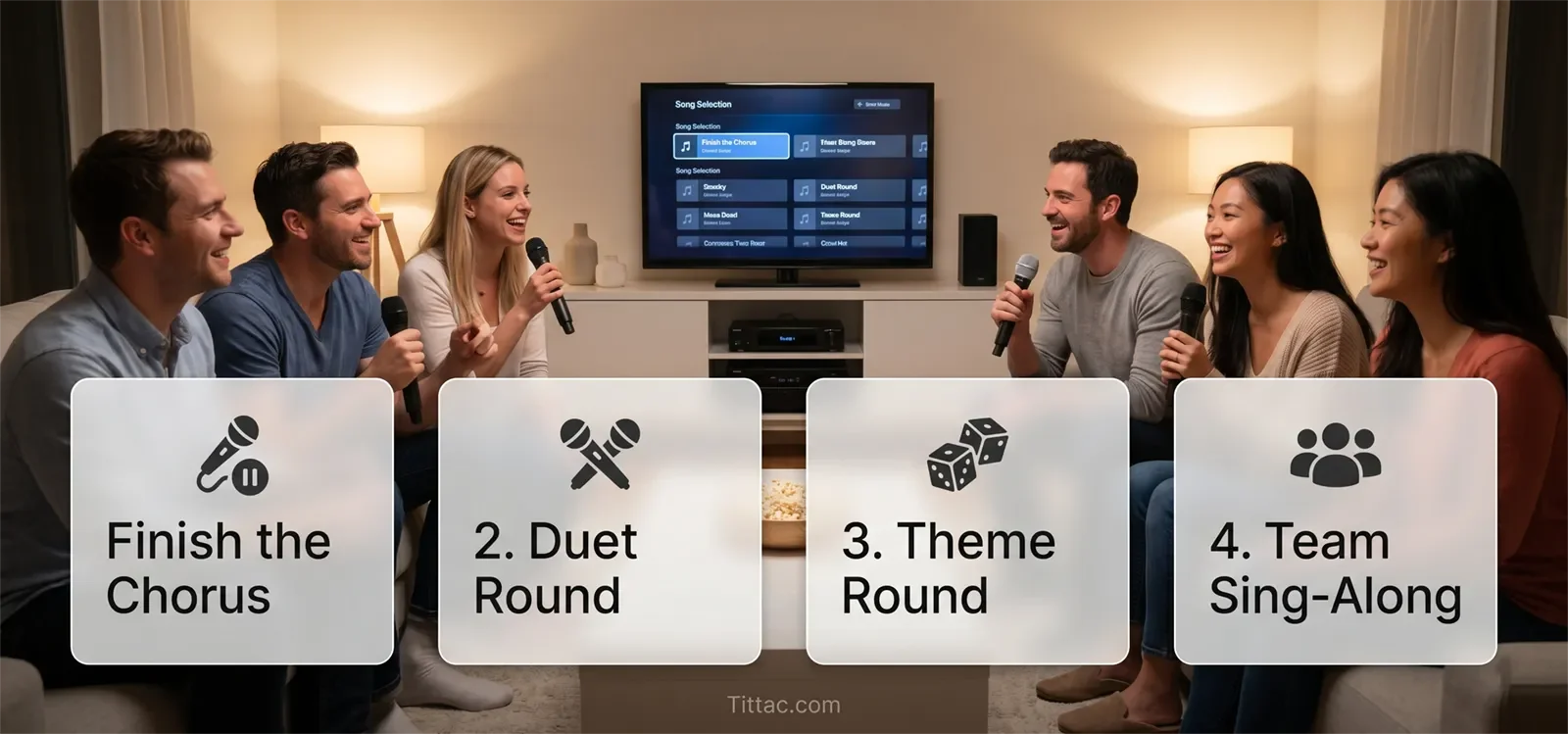
1. Finish-the-Chorus Round
Play a familiar song and let one guest, pair, or team take only the chorus. This is one of the easiest karaoke games because it lowers the commitment. Guests do not have to carry the whole song. They only need one strong, familiar section.
This works well for mixed-age groups, casual singers, and guests who want to participate but do not want a full solo turn.
2. Duet Challenge
Invite two people to sing together instead of asking one person to perform alone. The duet can be planned naturally, such as siblings, couples, friends, parent and child, or one confident singer with one casual singer.
The point is not to force awkward pairings. The point is to make the turn feel social. Duets share attention and help more people join without feeling fully exposed.
3. Theme Round
Choose one simple category and let guests pick songs that fit. Good theme ideas include throwbacks, movie songs, 90s songs, 2000s songs, family favorites, road-trip songs, or songs everyone knows.
Theme rounds work because they give the room direction without adding heavy rules. Guests still get to choose songs, but the choices feel easier and more playful.
4. Team Sing-Along
Split the room into two casual teams and let each team send a singer, duet, or small group for a turn. Keep the team idea light. The goal is not to find the best singer. The goal is to make the room feel shared.
This format works especially well when guests are sitting on different sides of the room or when you want more people reacting, clapping, and singing along.
5. One-Verse Challenge
Instead of asking guests to sing a whole song, let them sing only the first verse or one selected section. This keeps the pace quick and reduces pressure for guests who are nervous about long turns.
It is also useful when the queue is long and you want more people to participate without making the night drag.
6. Crowd-Reaction Round
Let the room react to fun categories instead of judging vocal quality. Examples include best song choice, funniest duet, strongest chorus energy, most unexpected performance, or best group participation.
This keeps the competition playful and protects guests who are not strong singers.
7. Mystery Song Pick
Write familiar song categories or song titles on slips of paper and let guests draw one. Keep this light and optional. If a guest pulls a song they truly do not want, let them trade or pass.
This game adds surprise without needing complicated setup, but it works best with a relaxed group that enjoys playful unpredictability.
8. Group Chorus Rescue
One person starts a song, and the room jumps in for the chorus. This is a good way to support shy guests or casual singers because they do not feel alone for the whole song.
If quieter participation is your main challenge, read How to Make Karaoke Fun for Shy Guests for a more focused approach.
How to Keep Competition Light
Competition can make karaoke more exciting, but it can also change the mood quickly. Once guests start worrying about who sounded best, who missed notes, or who is winning, the room may become less welcoming.
For home karaoke, avoid judging pitch, vocal strength, or technical singing ability too seriously. Most guests are not there to be evaluated. They are there to have fun with family and friends.
Use playful categories instead:
- Best crowd energy
- Funniest song choice
- Most committed performance
- Best duet chemistry
- Best chorus participation
- Most unexpected song
These categories reward participation instead of perfection. That keeps the room open for kids, adults, shy guests, casual singers, and people who are just joining for fun.
If the room starts to feel tense, drop the scoring completely. A themed round without scoring is usually better than a competition that makes people pull back.
How to Fit Games Into the Night
Karaoke games should support the flow of the night, not interrupt it.
In most home gatherings, the best time for a game is after the room has already warmed up with a few normal songs. That gives guests time to settle in before any structure is added.
Use a game when you notice a real need:
- The same few people keep singing.
- The queue is getting slow.
- Guests are watching but not joining.
- The room needs a quick energy reset.
- People seem ready for something playful.
Keep the round short. One pass through the room is often enough. A good game arrives, lifts the energy, and then gets out of the way before people get tired of it.
This is why games work best with a simple hosting structure. For the broader system behind guest flow, turn-taking, and pacing, read How to Host a Karaoke Party at Home Without Stress.
Simple Karaoke Game Sequence
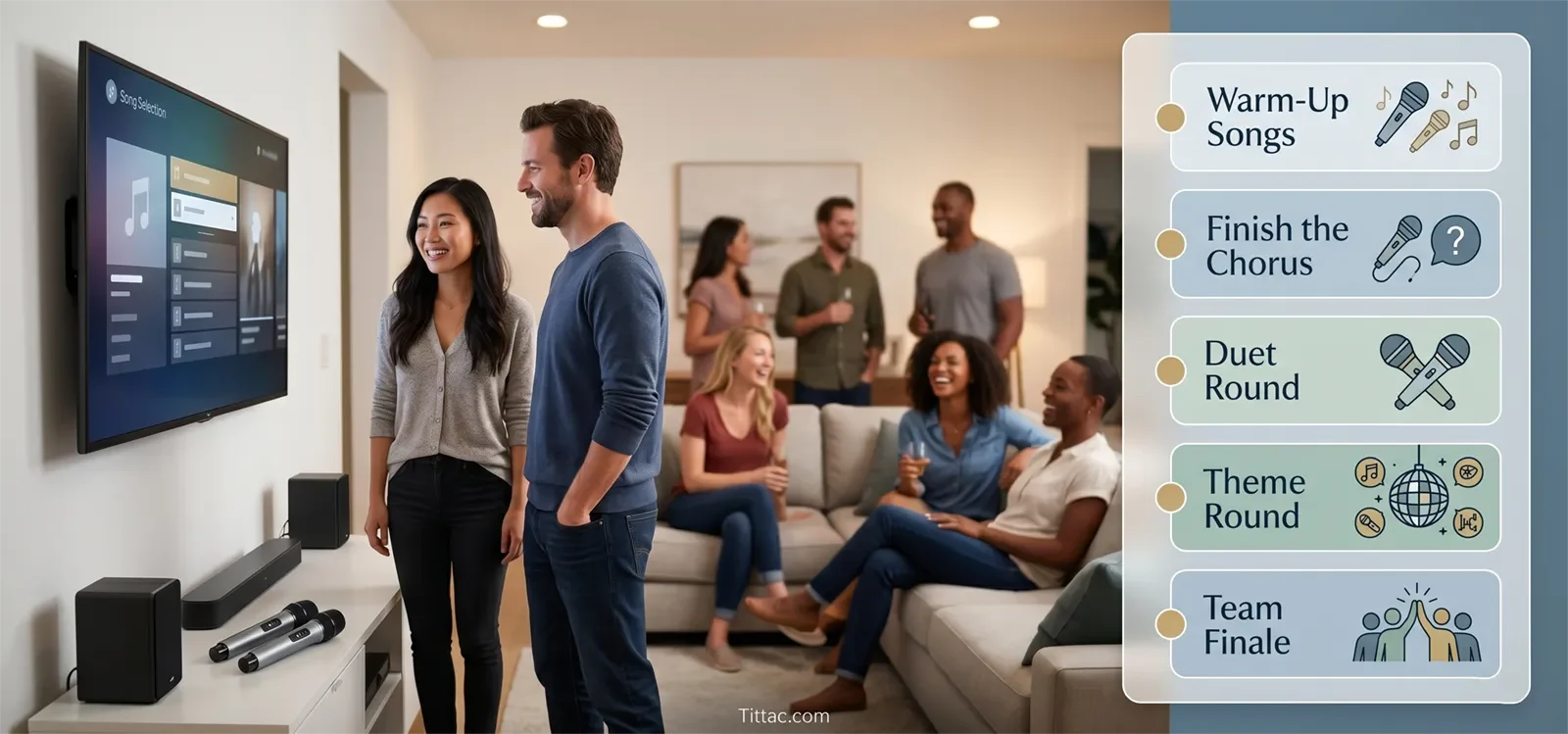
You do not need ten games in one night. A simple sequence is easier to manage and usually works better.
- Warm-up songs: Start with normal, familiar songs so the room settles in.
- Finish-the-chorus round: Use this when casual singers need an easier way to join.
- Duet round: Pair guests naturally to make the room feel more collaborative.
- Theme round: Choose one category, such as throwbacks, movie songs, or songs everyone knows.
- Light team finale: End with a shared round where energy and participation matter more than vocal skill.
You may only need two or three of these steps. For a calmer family gathering, use fewer rounds. For a playful group, lean more into duets and team formats. The structure should flex with the room, not control it.
Common Mistakes to Avoid
The biggest mistake is making the game too complicated. If guests need several minutes to understand the rules, the game is probably too heavy for a normal home karaoke night.
Another mistake is using games to pressure people who already feel nervous. A game should make participation easier, not make a shy guest feel trapped in a public challenge.
Do not overuse scoring. A little playful reaction can be fun, but serious judging can make the room feel colder. Keep the attention on participation, laughter, and shared energy.
Also avoid running too many games back to back. Karaoke still needs space for normal song choices. If every round has a rule, guests may feel like they are following a program instead of enjoying a party.
Finally, know when to stop. If the room is already singing naturally, you may not need a game at all. Good hosting means noticing when the party needs structure and when it needs freedom.
Final Advice
The best karaoke party games for home gatherings are not the loudest or most complicated. They are the ones that help more people join without making anyone feel judged.
Use games as small tools: a finish-the-chorus round when guests need an easier entry point, a duet round when solos feel too heavy, a theme round when the queue needs direction, or a light team finale when the room is ready for a shared finish.
Keep the rules short, the competition friendly, and the focus on participation. When games stay light, karaoke feels more inclusive, more active, and more fun for the whole room.
Karaoke games work best when the overall night already has a simple structure. For smoother guest flow, turn-taking, and hosting from start to finish, read How to Host a Karaoke Party at Home Without Stress.
Frequently Asked Questions
Are karaoke party games better than regular turn-taking?
Not always. Regular turn-taking is still the base for many home karaoke nights. Games work best when the room needs more participation, variety, or momentum. They should support the party, not replace the whole flow.
What is the easiest karaoke game for mixed-age home gatherings?
Finish-the-chorus rounds and simple theme rounds are often the easiest. They are quick to explain, low-pressure, and flexible enough for kids, adults, confident singers, and casual guests.
Should I keep score during karaoke games?
You can, but light scoring works better than serious scoring at home. Focus on fun categories like crowd energy, funniest duet, or best song choice instead of judging vocal quality.
How many karaoke games should I use in one night?
For most home gatherings, one to three short game rounds are enough. Too many games can make the night feel overstructured and slow down the natural karaoke flow.
What karaoke game works best for shy guests?
Duets, group choruses, and finish-the-chorus rounds usually work best because they reduce solo pressure. The guest can participate without feeling like the whole room is judging one full performance.