
A used karaoke system can be worth buying only when the savings are real, the seller can prove the system works, and the setup still fits your room, singers, and long-term use. If the discount is small, parts are missing, or the system cannot be tested properly, buying used often turns into repair cost, frustration, and wasted time.
Written by Toan Ho — Tittac editorial team.
Who this guide is for: This guide is for buyers considering a used karaoke system and trying to decide whether the savings are worth the added risk, missing parts, unclear history, and possible repair or upgrade costs later.
How this guide was prepared: This guide was prepared around the practical factors that matter most when buying used karaoke gear: room fit, ease of testing, seller transparency, hardware condition, missing accessories, total replacement risk, and long-term value.
Buying a used karaoke system can save money, but it can also create problems that do not show up in a listing photo. A setup may look complete at first glance and still have weak microphones, worn speakers, unstable controls, missing remotes, bad batteries, loose cables, or a history the seller cannot explain clearly.
That is why buying used is not just a price decision. The real question is whether the system still makes sense after you account for condition, completeness, repair risk, and whether the setup fits your room and singing routine.
If you want the bigger buying framework first, start with our complete home karaoke system guide. Then use this guide to decide whether a used karaoke system is a smart deal or a risk you should avoid.
Table of Contents
- Quick Answer
- What Matters Most When Buying a Used Karaoke System
- When Buying Used Makes Sense — and When It Does Not
- Budget, Room Size, and Risk Trade-Offs
- Common Used Karaoke Buying Mistakes to Avoid
- Used Karaoke System Inspection Checklist
- How to Decide in 60 Seconds
- Frequently Asked Questions
- Final Recommendation
Quick Answer
Buy a used karaoke system only if the discount is meaningful, the seller can demonstrate the full setup working, and the system still fits your room, connection needs, and comfort level with troubleshooting. A used deal is strongest when the equipment is complete, stable, easy to inspect, and priced low enough to justify the added uncertainty.
Skip the deal if the seller is vague, core parts are missing, microphones cannot be tested, speakers sound strained, the amplifier behaves inconsistently, or the savings are too small compared with a safer new or cleaner alternative.
The best used karaoke system is not the cheapest one. It is the one that still feels practical after you account for condition, missing parts, repair risk, and whether the setup will actually be easy to use at home.
What Matters Most When Buying a Used Karaoke System
Room Fit Still Comes First
A used system still has to solve the same problem as a new one: it needs to fit your room and the way your household sings. Buyers sometimes get distracted by the discount and forget that a “good deal” can still be the wrong setup.
A large used karaoke system may be too much for a condo, apartment, or small shared room. A smaller used setup may feel weak in a wide living room or open family space. If the system would not make sense for your home if it were new, the used price does not fix the mismatch.
Seller Transparency Reduces Risk
A good seller should be able to explain what is included, how old the system is, how often it was used, why it is being sold, and whether anything has been repaired, replaced, or damaged. Vague answers do not always mean the system is bad, but they do increase your risk.
Ask direct questions before you meet. If the seller cannot clearly explain the system, refuses a real test, or rushes you to buy based only on price, treat that uncertainty as part of the cost.
Hardware Condition Matters More Than Looks
Photos can hide a lot. Speakers may look clean but sound tired. Microphones may power on but drop signal. A mixer or amplifier may light up but produce noise, distortion, or unstable controls once used for a few minutes.
Do not judge a used karaoke system by appearance alone. You need to hear music playback, test each microphone, adjust the controls, and check whether the system behaves consistently during normal use.
Missing Parts Can Become Expensive Later
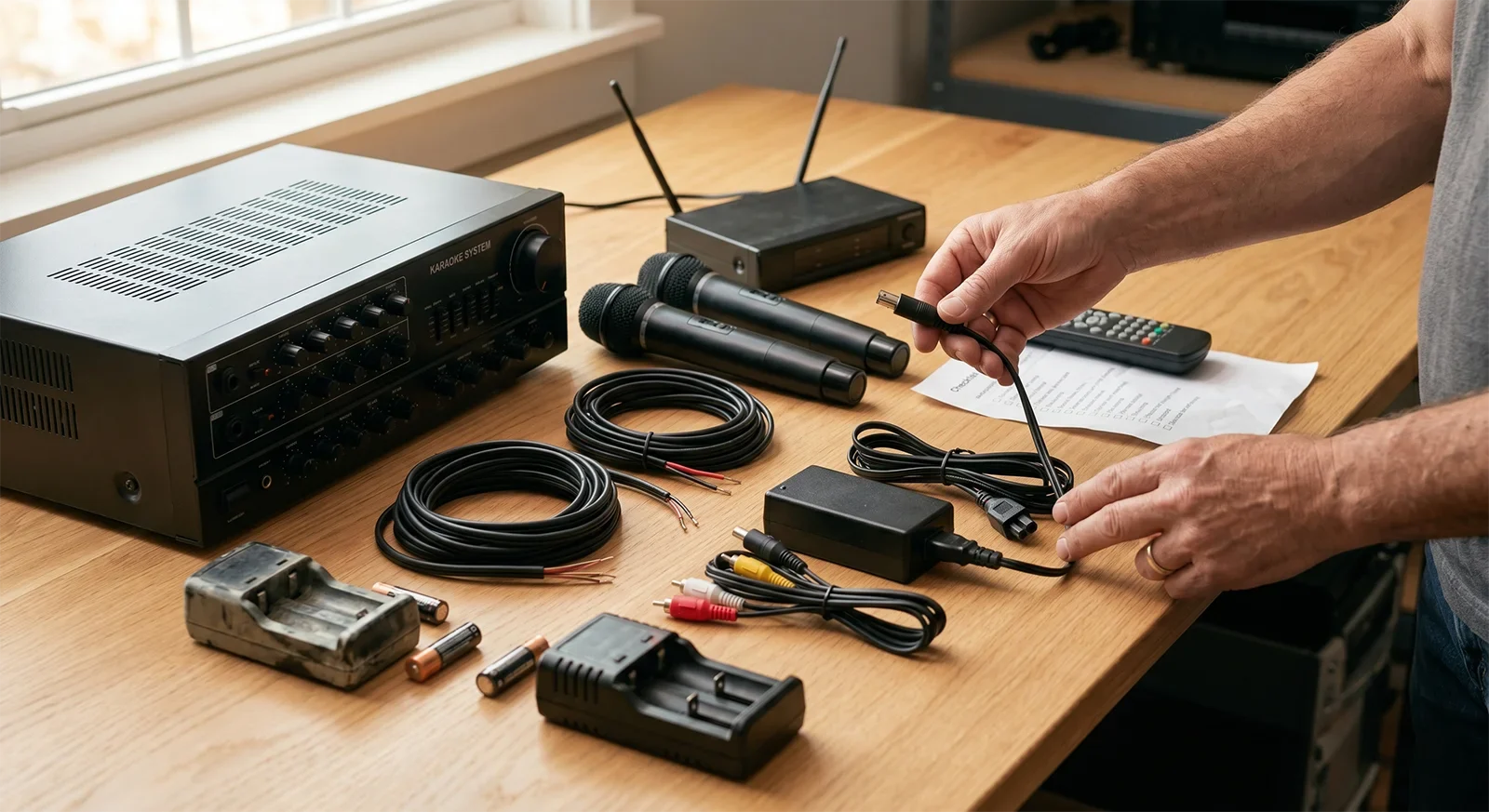
Missing accessories are easy to overlook during a fast used purchase. Remotes, wireless microphone receivers, charging cables, power supplies, adapters, speaker cables, manuals, mounting hardware, and batteries can all affect daily use.
Small missing items are not always deal-breakers, but they should lower the value of the deal. If a missing part is hard to replace, the used system may become more expensive and frustrating than it first appears.
Total Cost Matters More Than Sticker Price
The biggest mistake with used karaoke gear is confusing low price with real value. A cheap system is not truly cheap if you need to replace microphones, buy new cables, repair the amplifier, add a missing receiver, or upgrade speakers soon after bringing it home.
Used equipment makes sense only when the final cost still works after likely fixes and missing pieces are included. For a broader spending framework, our karaoke system budget guide can help you compare savings more realistically.
| Factor | Why It Matters | Common Mistake |
|---|---|---|
| Room fit | Prevents you from buying a cheap system that still does not suit your home | Buying by price before checking whether the setup fits the room |
| Seller transparency | Clear answers reduce uncertainty about wear, repairs, and missing parts | Accepting vague answers because the deal looks attractive |
| Hardware condition | Shows whether the system is usable, not just able to power on | Testing only the power button instead of real music and microphone use |
| Completeness | Missing accessories can create cost and frustration later | Ignoring remotes, chargers, cables, receivers, or power supplies |
| Total cost | Shows whether the deal is still worth it after repairs or replacements | Comparing only the listing price instead of the real final cost |
When Buying Used Makes Sense — and When It Does Not
Buying Used Makes Sense If You Can Inspect the System Carefully
Best for: Buyers who already know what kind of karaoke system they need, can test the setup in person, and are comfortable judging whether the microphones, speakers, amplifier, and controls still behave properly.
Not ideal if: You want a zero-hassle experience, do not know what normal karaoke performance should sound like, or feel pressured into buying without a proper test.
Used equipment works best for patient buyers who can stay objective. If you understand your room needs and can judge the full condition honestly, used gear can be a practical way to stretch your budget.
Buying Used Makes Sense If the Savings Are Large Enough
Best for: Buyers who want to save money, but only when the system is complete, the seller is transparent, and the discount is large enough to justify the risk.
Not ideal if: The price difference from a cleaner alternative is small, the gear already shows warning signs, or replacement parts may be needed soon.
The best used deals are usually not just dramatic bargains. They are lower-risk purchases where the seller can demonstrate the system working, answer clear questions, and show that the setup still makes sense as a practical home karaoke system.
Buying New May Be Better If You Want Simplicity
Best for: First-time buyers, families who want easy setup, or anyone who values reliability more than a modest discount.
Not ideal if: You are specifically shopping used because you already know what to inspect and are comfortable walking away from weak listings.
Sometimes the smartest used-buying decision is not buying used at all. If the system history is unclear, the room fit is questionable, or the listing only seems attractive because the setup looks big, buying new or choosing a cleaner option may save more frustration in the long run.
Budget, Room Size, and Risk Trade-Offs
Used gear makes the most sense when the savings are large enough to justify the risk and the setup still matches your room. A used karaoke system should not just be cheaper. It should still feel complete, stable, and practical once you imagine it in normal home use.
Spending a little more can be smarter when the better listing includes full accessories, clearer history, stronger condition, and a proper demo. The cheapest used system may become the most expensive one if it needs repairs or missing parts immediately.
Overkill can happen in both directions. Some buyers overspend on a used system that is still risky. Others underbuy and end up with something unstable, incomplete, or harder to restore than expected. The goal is not the lowest price. The goal is the best balance of savings, condition, and usability.
| Scenario | What Usually Works | When to Spend More | When Not To |
|---|---|---|---|
| Used listing with full demo and clear history | Lower-risk used purchase with meaningful savings | When the cleaner listing removes major uncertainty | When the price gap is tiny and risk remains high |
| System missing small accessories | Only worth it if replacements are easy and the discount is strong | When a complete alternative costs only a little more | When missing parts affect daily use or are hard to replace |
| Large used setup for a small room | Walk away unless the system genuinely fits your home | When your room and routine actually support the system | When you are buying size because the listing looks impressive |
| First-time buyer considering used | Safer purchase path with less condition risk | When you already know what to inspect and test | When you are still learning what normal karaoke performance should feel like |
Common Used Karaoke Buying Mistakes to Avoid
Mistake 1: Buying by Price Alone
A cheap used system can still be the wrong deal if it does not fit your room, your connection needs, or your tolerance for troubleshooting. Judge the total risk, not just the number on the listing.
Mistake 2: Thinking “It Powers On” Is Enough
Powering on does not prove the system is healthy. You need to test real music playback, each microphone, volume controls, speaker output, and basic adjustment behavior. A system that only “mostly works” is already warning you.
Mistake 3: Underestimating Missing Parts
Missing remotes, receivers, chargers, power supplies, cables, or battery covers can create more frustration than buyers expect. These items should be counted as part of the true cost, not treated as small details.
Mistake 4: Ignoring Unclear History
If the seller cannot explain the system’s age, use, repair history, or included parts, you are taking on more uncertainty. That does not always mean you should walk away, but the price should reflect the risk.
Mistake 5: Buying a System That Does Not Fit Your Room
A large system is not automatically better, and a compact system is not automatically safer. The setup has to match your actual space, singers, and volume needs. A wrong-size system is still wrong even if the discount looks good.
Used Karaoke System Inspection Checklist
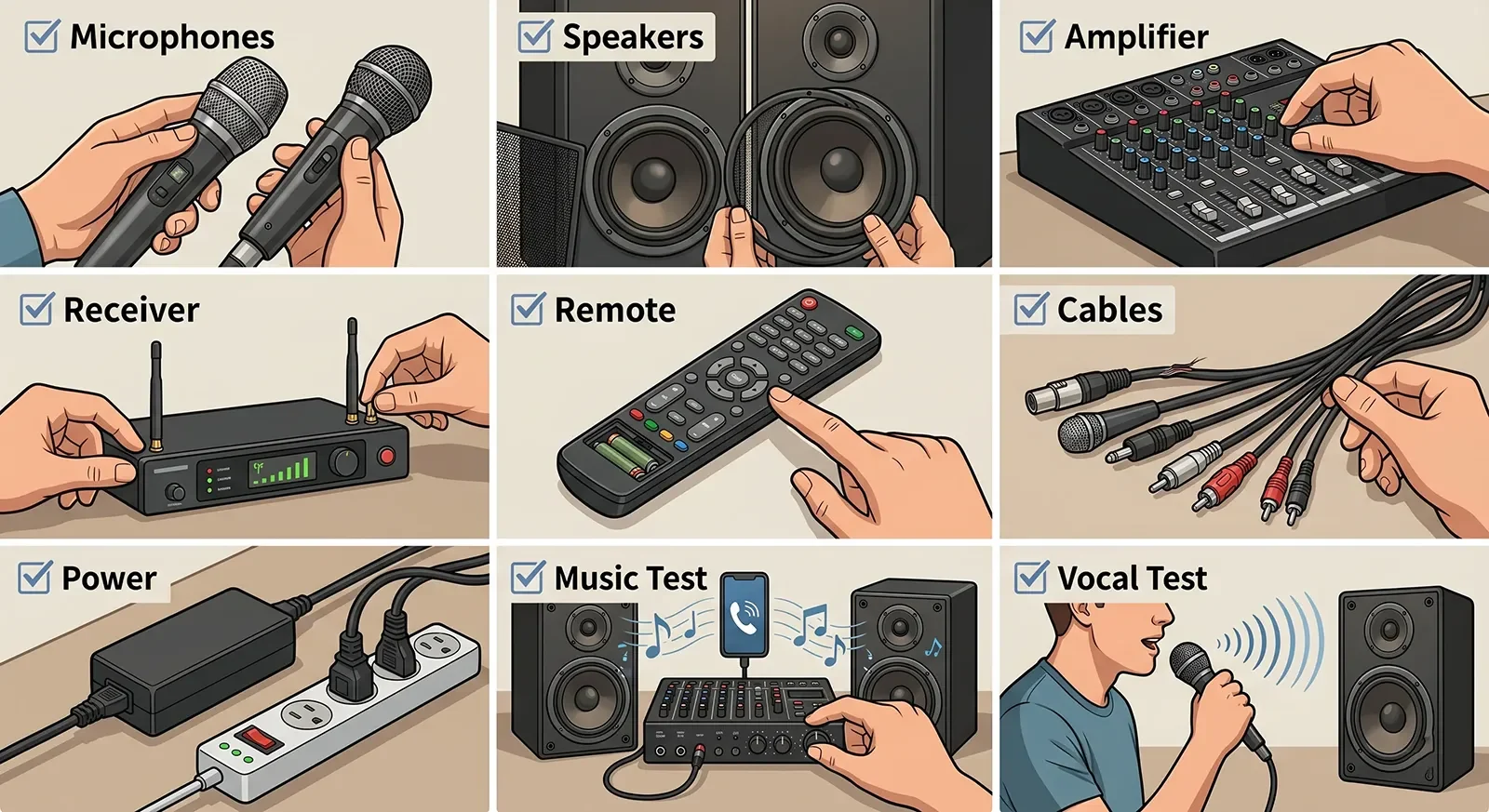
Before buying a used karaoke system, test it like you plan to use it at home. A quick power-on check is not enough.
- Test each microphone separately. Check for dropouts, weak sound, noise, loose battery doors, and unstable switches.
- Play music at normal home volume. Listen for distortion, rattling, weak bass, harsh highs, or speaker strain.
- Adjust the main controls. Turn knobs or use buttons slowly to check for crackling, dead spots, or inconsistent response.
- Confirm all included parts. Check remotes, receivers, power cables, speaker cables, chargers, adapters, manuals, and mounting parts.
- Check connection options. Make sure the system can connect to your TV, YouTube source, phone, tablet, or streaming device the way you plan to use it.
- Let it run for a few minutes. Some problems appear only after the system warms up or runs at real listening levels.
- Ask why it is being sold. The answer should feel clear, not evasive.
How to Decide in 60 Seconds
- Ask if the system fits your room. Would you still want this setup if it were new?
- Check if the seller can prove it works. If there is no real demo, the risk goes up.
- Confirm the system is complete. Missing parts should lower the value.
- Test music and microphones together. Karaoke is not just speaker playback.
- Calculate the true cost. Add likely replacement parts, repairs, and upgrade needs.
- Compare the savings to the risk. If the discount is small, used may not be worth it.
If you only remember one thing, remember this: a used karaoke system is only a good buy when the savings are real, the condition is clear, and the setup still feels practical after honest inspection.
Frequently Asked Questions
Is buying a used karaoke system worth it?
Buying a used karaoke system can be worth it if the discount is meaningful, the system is complete, the seller can demonstrate it working, and the setup fits your room. It is usually not worth it if the system cannot be tested, has missing parts, or is only slightly cheaper than a safer option.
How much discount should make a used karaoke system worth considering?
There is no single percentage that always works, but the savings should be large enough to justify added uncertainty. If the discount is small and the gear still has condition risk, missing parts, or unclear history, the used deal becomes much harder to defend.
What should I test first when checking a used karaoke system?
Start with the main control unit, speakers, and each microphone separately. Do not stop at “it powers on.” Test actual music playback and real vocal use at normal home volume so you can hear whether the system feels stable, balanced, and complete.
Are missing accessories a big deal?
They can be. Missing remotes, chargers, receivers, power supplies, cables, or adapters often create more frustration than buyers expect. Small missing items are not always deal-breakers, but they should be counted as part of the real cost.
Is buying used a bad idea for beginners?
Buying used is riskier for beginners because it is harder to tell the difference between normal behavior and warning signs. If you are still learning what kind of karaoke system you need, a used listing can add confusion before you know what “right” should feel like.
When should I buy new instead of used?
Buy new instead of used when the discount is small, the seller cannot demonstrate the system properly, important parts are missing, or your household wants a simpler and more dependable setup with less inspection and repair risk.
Final Recommendation
A used karaoke system can be a smart buy when the seller is transparent, the setup passes real-world testing, and the savings are large enough to justify the added risk. If you already know what type of system fits your room and you are comfortable inspecting it carefully, used gear can stretch your budget.
But the trade-off should stay clear: you are not only buying a lower price. You are also buying uncertainty. If the system is incomplete, unstable, vague in history, or only slightly cheaper than a safer option, it is usually better to walk away.
Need help deciding whether used really makes sense for your room and budget?
Start with the complete home karaoke guide, compare savings more realistically in our karaoke system budget guide, or see what to improve next in how to upgrade an existing karaoke system.
Contact Tittac for help choosing the right karaoke setup for your room, budget, and singing style.