
Karaoke feedback happens when a microphone hears the speaker, sends that sound back through the system, and the speaker plays it again in a reinforcing loop. The squeal is not random. It is the sound of the room, microphone, speaker position, and gain working together in the wrong direction.
Feedback often feels sudden, but it usually does not come from nowhere. A microphone picks up sound from the speaker, that sound gets amplified, and the speaker sends it back into the room again. If the loop keeps reinforcing itself at a certain frequency, you hear a ring, whistle, squeal, or sharp rising tone.
That is why feedback is best understood as system behavior, not just an annoying symptom. In home karaoke, microphone position, speaker direction, room reflections, and overall gain all affect how easily the loop begins. For broader technical context behind how karaoke systems behave, see our technical guide to karaoke system behavior.
Written by Toan Ho — Tittac editorial team.
Who this guide is for: Home karaoke users who want to understand why feedback starts before they begin changing settings, moving gear, or blaming one part of the system.
How this guide was prepared: This guide was written from a home-use perspective, focusing on the basic feedback loop and the room, mic, speaker, and gain conditions that make feedback easier to trigger in real living-room karaoke setups.
Quick Answer
Karaoke feedback happens when a microphone picks up sound coming from a speaker, sends that sound back through the system, and the speaker plays it again in a reinforcing loop. If that loop becomes strong enough at certain frequencies, you hear a squeal, ring, or sharp tone. In home karaoke, feedback becomes easier to trigger when microphones and speakers are too close, when the mic points toward the speaker, when room reflections bounce sound back into the mic, or when the system is being pushed too hard overall. The key idea is simple: feedback is usually a loop condition, not just one bad setting.
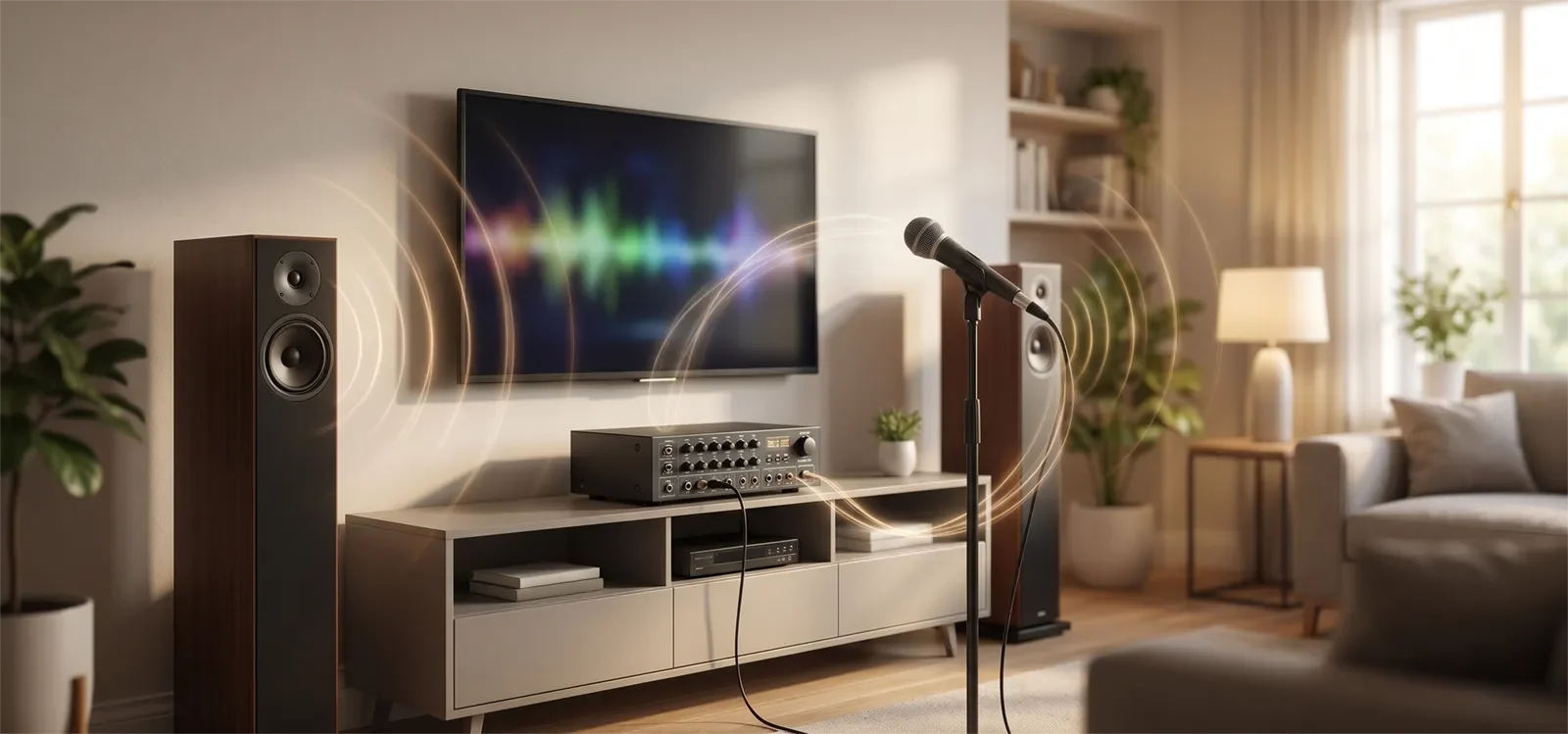
Table of Contents
What feedback actually means
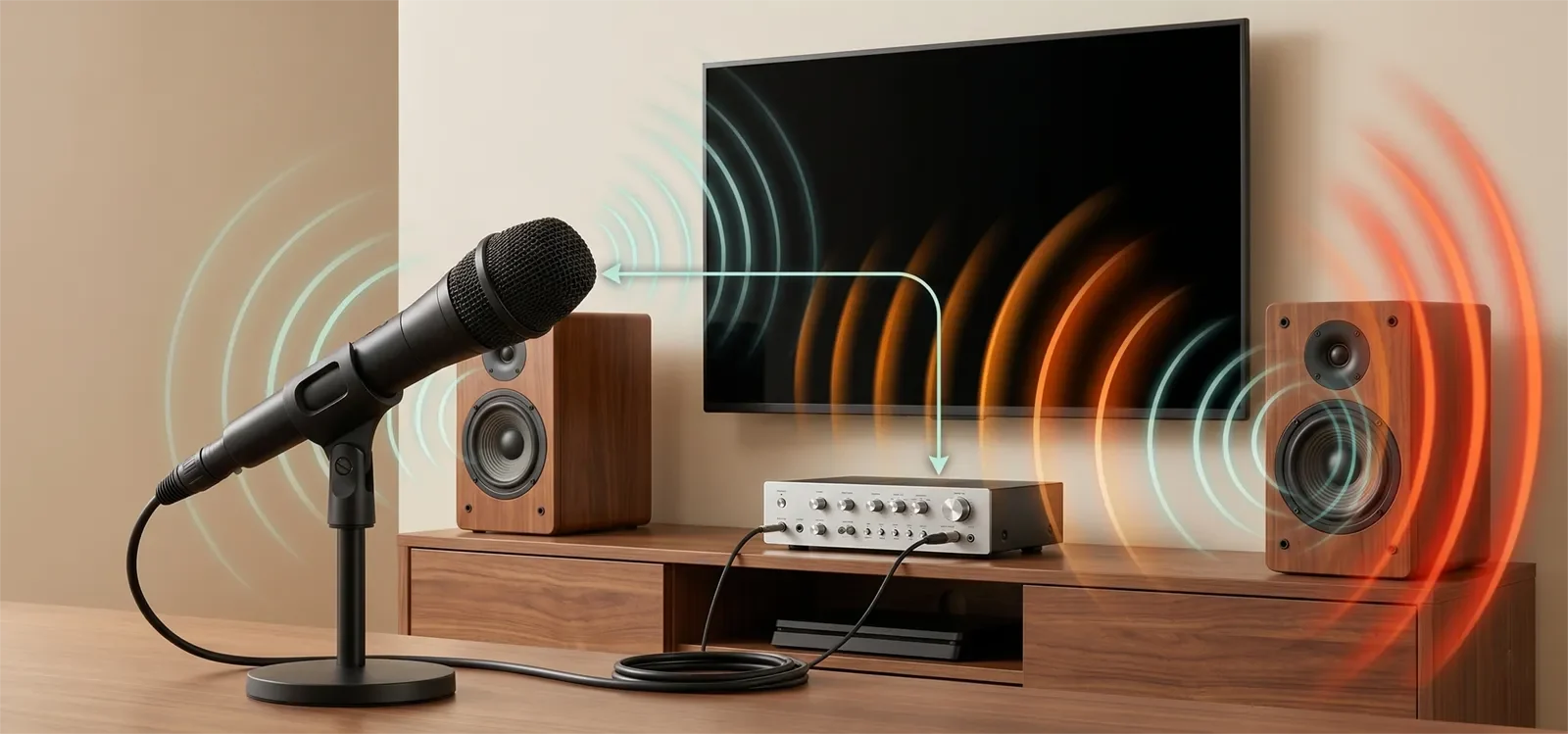
In plain English, feedback is sound feeding back into itself. A microphone is supposed to pick up your voice. But if it also picks up too much sound from the speaker, that speaker sound re-enters the signal path, gets amplified, and comes out of the speaker again.
Once that cycle begins reinforcing the same frequency range over and over, the sound rises very quickly. That is why feedback often sounds focused instead of broad. It may appear as one piercing tone, one ringing frequency, or one narrow whistle rather than general loudness.
Feedback is not random noise. It is a repeated loop that becomes strong enough to dominate what the system is doing.
Why feedback happens before the squeal
The loud squeal is only the final symptom. The conditions that create feedback usually exist before the obvious noise begins. The microphone may already be hearing too much speaker output. The singer may be standing in a risky spot. The speakers may be aimed too directly toward the microphone. The room may be reflecting sound back into the mic.
At first, the system may only feel slightly unstable. The microphone may seem too sensitive, too bright, or too “hot.” A small turn of the mic or a small increase in volume may suddenly push the system over the edge. That is because feedback is not only about how loud the system is. It is about how strongly the microphone and speaker are connected through the room.
This is why feedback control starts with understanding the loop. If the microphone hears the speaker too easily, the system becomes easier to trigger no matter how good the equipment is.
What feedback changes in system behavior
Feedback matters because it shows how tightly the microphone and speaker are interacting in the room. When the system is close to the feedback threshold, it often feels harder to control even before obvious squealing begins. Small level changes can feel too aggressive. A microphone angle that seemed fine one moment can become risky the next.
This is why feedback is about more than volume alone. Gain matters, but room reflections, speaker direction, microphone pickup, and singer position all change how stable the system feels. Anti-feedback features can help manage the result, but they do not erase the basic loop itself. Once you understand the core mechanism, what anti-feedback processing actually does becomes much easier to understand.
Room behavior also matters more than many home users expect. In reflective spaces, the microphone may not only hear direct speaker output. It may also hear sound bouncing off walls, floors, TVs, windows, and nearby surfaces. Those reflections can increase the chance of reinforcement even when the speaker is not aimed straight at the mic.
What users hear at home
At home, feedback does not always begin as one huge scream. Sometimes the first sign is a light ring, a narrow harsh tone, or a feeling that the microphone suddenly becomes touchy. The system may seem fine until the singer steps into a certain spot, turns the mic slightly, or raises the level just a little more.
This is especially common in family rooms and living rooms where singers and speakers share limited space. The microphone is often much closer to the playback system than it would be in a larger venue. That gives the microphone less separation from the speaker output, so the loop is easier to trigger.
Reflections can also make feedback feel inconsistent. It may happen more near one wall, one corner, one seating area, or one speaker angle. That does not always mean the equipment is defective. It often means the room is helping certain frequencies return to the microphone. For that side of the problem, when room treatment helps more than better equipment is a useful next read.

What people misunderstand about feedback
The biggest misunderstanding is thinking feedback comes from one defective piece of gear. Most of the time, feedback is not a single-product problem. It is a relationship problem between the microphone, speaker, room, and the amount of gain in the system.
Another misunderstanding is assuming feedback only happens when everything is extremely loud. Higher volume raises the risk, but feedback can still happen at moderate home volume if the microphone is pointed toward the speaker, the room is highly reflective, or one frequency range is being reinforced too easily.
People also tend to jump into fixes too early. They reduce treble, change several settings at once, switch microphones, or blame the speaker before understanding the loop itself. Those actions may sometimes help, but they are easier to judge when you first understand why the system is allowing feedback to build.
The practical listening rule
The practical rule is simple: think about the loop before you think about the fix. Ask what is helping the microphone hear the speaker too easily. Is it direct speaker aim, close distance, room reflection, too much overall gain, poor mic handling, or a combination of those conditions?
For home karaoke, the goal is not to memorize a long troubleshooting sequence. The goal is to recognize that feedback appears when reinforcement becomes stronger than separation. The more clearly the microphone can hear the singer instead of the speaker output around it, the easier the system becomes to control.
That is the useful mental model. Feedback is not just bad luck or one wrong setting. It happens when the loop becomes stronger than the system’s ability to stay stable.
Conclusion
Karaoke feedback happens because the microphone and speaker form a reinforcing loop. That loop becomes easier to trigger when room reflections, mic position, speaker direction, and overall gain all work against stability.
The practical takeaway is clear. Before trying to fix feedback, understand the mechanism behind it. In home karaoke, that basic understanding leads to calmer decisions, better control, and fewer moments where the system suddenly feels unpredictable.
Frequently Asked Questions
Does feedback always mean my microphone is bad?
No. Feedback usually does not mean the microphone itself is defective. In most home karaoke situations, feedback comes from how the mic, speakers, room, and overall level interact. A perfectly normal microphone can still trigger feedback if the system conditions make the loop easy to reinforce.
Why does feedback happen more in some spots in the room?
Because room reflections and speaker direction are not the same everywhere. Some positions let the microphone hear more direct speaker output or more reflected sound from walls and nearby surfaces. That changes how easily certain frequencies build up and makes the system feel less stable in specific areas.
Can feedback happen even if the volume is not very high?
Yes. Very high volume increases risk, but feedback can still happen at moderate loudness if the microphone is pointed toward the speaker, the room is reflective, or a certain frequency range is being reinforced too easily. The issue is the loop condition, not just the loudness number.
Is anti-feedback processing the same thing as fixing the cause?
No. Anti-feedback processing can help control or reduce the audible result, but it does not replace understanding the mechanism. The core cause is still the loop between microphone and speaker, shaped by room behavior, mic position, and how much reinforcement the system allows.
Want to understand the room side of feedback more clearly?