
Active speakers are usually better for home karaoke buyers who want a simpler, more self-contained setup with less amplifier matching. Passive speakers are better when you want more flexibility, separate amplifier control, and a system that can be upgraded piece by piece.
Written by Toan Ho — Tittac editorial team.
Who this guide is for: This guide is for home karaoke buyers choosing between active and passive speakers for a first karaoke system, a living-room setup, or a more flexible component-style upgrade.
How this guide was prepared: This guide focuses on real home karaoke buying factors: amplifier needs, wiring, room fit, portability, upgrade flexibility, troubleshooting, vocal clarity, and how easy each speaker type is to live with in a normal home.
Active and passive speakers sound like technical categories, but the real decision is practical. You are choosing whether the amplifier should be built into the speaker or handled by a separate amplifier or mixing amplifier.
That choice affects how many boxes you manage, how much wiring you need, how easy the system is to move, and how flexible the setup will be later. If you are still deciding what kind of speaker sound works best for karaoke, start with Karaoke Speakers vs Music Speakers before choosing active or passive.
Table of Contents
Quick Answer
Active speakers are usually the better fit for home karaoke when you want fewer separate components, less amplifier matching, and a cleaner setup that is easier to get running. Passive speakers are usually the better fit when you want more control over amplification, more upgrade flexibility, and a component-style system that can change over time.
Neither speaker type is automatically better for every home. Active speakers usually win on simplicity. Passive speakers usually win on flexibility. The right choice depends on whether your karaoke setup needs easy ownership first or long-term system control first.
The Basic Difference
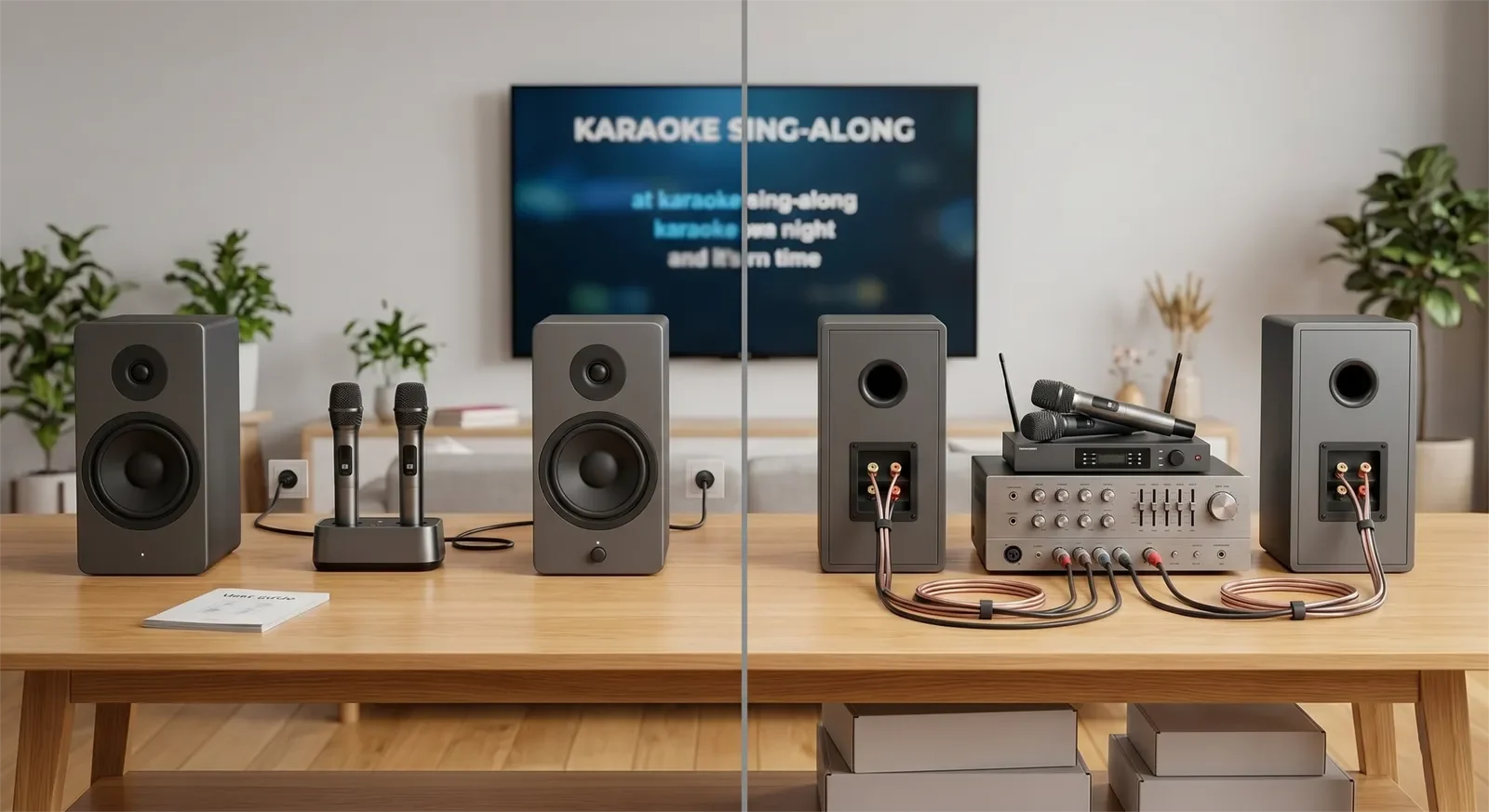
Active speakers have amplification built into the speaker. In practical terms, they do not need a separate power amplifier to drive them. This can reduce amplifier-matching decisions and keep the system more self-contained.
Passive speakers do not have built-in amplification. They need an external amplifier or mixing amplifier to power them. This creates more equipment planning, but it also gives you more control over how the speaker and amplifier are paired.
For home karaoke, this difference matters because karaoke is not only about playing music. The system also needs to handle microphones, vocals, echo or reverb, volume balance, and real room conditions. A speaker path that looks simple on paper still has to work smoothly in the room where your family actually sings.
When Active Speakers Make More Sense
Active speakers make more sense when you want a karaoke setup that feels direct, clean, and easier to manage. They are often a good fit for buyers who do not want to think too much about matching speakers with an amplifier.
This can be helpful in living rooms, family rooms, condos, and multi-use spaces where the system may need to stay neat or move occasionally. Because amplification is built in, active speakers can reduce the number of separate components you need to coordinate.
Active speakers are usually a strong fit if you want:
- A simpler speaker path with fewer separate components
- Less concern about amplifier matching
- A more self-contained setup
- Cleaner placement in a shared living space
- A system that feels easier for casual home use
The trade-off is that active speakers combine more responsibility inside the speaker itself. If you want to change the amplification path later, you may have less freedom than you would with passive speakers and a separate amplifier.
When Passive Speakers Make More Sense
Passive speakers make more sense when you want a more flexible component-style karaoke system. Because the amplifier is separate, you can choose, change, or upgrade the power side of the system independently from the speakers.
This route is often better for buyers who already have an amplifier, want a mixing amplifier, or expect to refine the system over time. It can also be a better fit when one person in the household is comfortable managing equipment and wants more control over the full setup.
Passive speakers are usually a strong fit if you want:
- More freedom to choose the amplifier or mixing amplifier
- A system that can be upgraded piece by piece
- More separation between speaker choice and power choice
- A component-style setup with more long-term flexibility
- More control over how the system grows later
The trade-off is that passive speakers need more planning. You must think about amplifier compatibility, cable routing, equipment placement, and how easy the system will be for other people in the home to use.
Active vs Passive Speakers for Karaoke
| Factor | Active speakers | Passive speakers |
|---|---|---|
| Amplifier need | Amplifier is built into the speaker | Requires a separate amplifier or mixing amplifier |
| Ease of setup | Usually simpler for home users | Requires more planning and matching |
| Wiring | Fewer speaker-amplifier connections, but each speaker may need power | Needs speaker wire from the amplifier to the speakers |
| Upgrade flexibility | More limited because amplification is built in | More flexible because speakers and amplifier are separate |
| Family friendliness | Often easier for casual home use | Better when one person manages the system |
| Troubleshooting | Fewer external components, but more built into each speaker | More parts to check, but each part has a clearer role |
| Best fit | Simple home setups, shared spaces, easier ownership | Component systems, future upgrades, more hands-on control |
Real Home-Use Trade-Offs
Simplicity versus flexibility
The biggest trade-off is simple: active speakers are usually easier to own, while passive speakers usually give you more system flexibility. Active speakers reduce the number of amplifier decisions. Passive speakers let you shape the system more deliberately.
For many home buyers, simplicity is more valuable than they expect. If the system is easier to set up, easier to understand, and easier to return to, the family is more likely to use it often.
Built-in amplification versus separate control
Active speakers keep amplification inside the speaker. That can make the setup cleaner, but it also means the speaker and amplifier path are tied together. If one part no longer fits your needs, you may have fewer upgrade choices.
Passive speakers keep amplification separate. That means more equipment, but also more control. If you later want a different amplifier, a different mixing amplifier, or a stronger component path, passive speakers usually give you more room to adjust.
Portability versus equipment planning
Active speakers can be easier to move as a self-contained speaker path, but they are not always lighter. Some active speakers are heavier because the amplifier is built in. They may also need nearby power outlets.
Passive speakers may be lighter as individual speakers, but they depend on an external amplifier and speaker wiring. That can make moving the whole system less convenient unless the setup is already planned well.
Room fit still matters
Active or passive is not the only decision. Room size, speaker placement, volume level, and how close people sit to the speakers can matter just as much. A passive speaker with the wrong amplifier can sound weak or harsh. An active speaker in the wrong room can still feel too loud, too small, or poorly placed. If you are comparing power needs more broadly, read How Many Watts Do I Need for Karaoke.
Common Buying Mistakes
Assuming active speakers are always easier in every way
Active speakers can simplify amplifier matching, but they still need proper placement, power access, and the right connection path. They are easier in many homes, but they are not automatically effortless.
Before choosing active speakers, make sure your room has the right power access and that the system still connects cleanly to your microphone and music source.
Assuming passive speakers always sound better
Passive speakers are not automatically better sounding. Their main advantage is flexibility. The final sound depends on speaker quality, amplifier matching, microphone quality, room layout, and how the system is adjusted.
A well-matched active setup can sound better at home than a poorly matched passive setup.
Buying for upgrade flexibility you will never use
Passive speakers can be a smart long-term choice, but only if you actually want to manage the system over time. If you do not plan to change amplifiers, tune the setup, or build piece by piece, the added flexibility may not help much.
In that case, a simpler active speaker path may be the more practical purchase.
Ignoring the full karaoke chain
Speakers are only one part of a karaoke system. Microphones, mixer or amplifier controls, room acoustics, song source, and speaker placement all affect the final result.
Do not choose active or passive speakers in isolation. Choose the speaker path that makes the entire karaoke system easier to use and better matched to your home.
Simple Decision Rule
Choose active speakers if you want fewer separate components, less amplifier matching, and a simpler speaker path for everyday home karaoke.
Choose passive speakers if you want more control over amplification, more upgrade flexibility, and a component-style system that can grow over time.
If you are torn, ask one practical question: do you want the speaker path to feel self-contained, or do you want it to stay open for future changes? For most home buyers, that question is more useful than comparing active and passive labels alone.
Frequently Asked Questions
Are active speakers better for home karaoke?
Active speakers are often better for home karaoke when the buyer wants a simpler setup, fewer separate components, and less amplifier matching. They are not automatically better for every home, but they are usually easier for casual or family use.
Do passive speakers sound better than active speakers for karaoke?
Not automatically. Passive speakers can offer more flexibility, but sound quality depends on the speaker, amplifier, microphone setup, room size, and tuning. A well-matched active system can outperform a poorly matched passive system.
Do active speakers need an amplifier?
Active speakers have amplification built in, so they do not need a separate power amplifier to drive the speaker. They may still need the right mixer, microphone receiver, or audio source depending on the full karaoke setup.
Do passive speakers need an amplifier?
Yes. Passive speakers need an external amplifier or mixing amplifier. Without proper amplification, they cannot produce sound correctly in a karaoke system.
Which speaker type is better for upgrading later?
Passive speakers usually offer more upgrade flexibility because you can change the amplifier or mixing amplifier separately. Active speakers can still be useful long term, but the amplification path is built into the speaker.
Which speaker type is better for family karaoke?
Active speakers are often easier for family karaoke because they reduce amplifier-matching decisions and can keep the setup more self-contained. Passive speakers can be better if one person manages the system and wants more control or upgrade flexibility.
Final Recommendation
For most home karaoke buyers who want a simpler setup, active speakers are the easier starting point. They reduce amplifier matching, keep the speaker path more self-contained, and often make the system feel less complicated in shared living spaces.
Choose passive speakers if you want more control, already have the right amplifier path, or plan to build a component-style karaoke system that can be upgraded over time. Passive speakers can be the better long-term choice for hands-on users, but they require more planning.
The real decision is not “active equals easy” or “passive equals better.” The real decision is simplicity versus flexibility. Choose the speaker path that matches your room, your comfort with equipment, and how you want to use karaoke at home after the system is installed.
Need help choosing between active and passive speakers for your home karaoke system? Tittac can help you compare speaker type, room size, amplifier needs, and microphone setup in English or Vietnamese.
Explore Karaoke Buying Guides · Compare Karaoke Speakers vs Music Speakers · Read the Step-by-Step Home Karaoke Setup Guide