









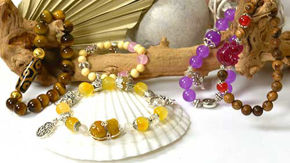
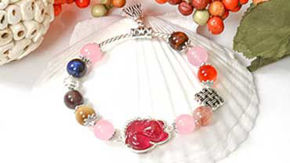



Dzi beads are patterned agate beads most closely associated today with Tibetan and Himalayan cultural use, where they are often discussed through symbolism, protection, good fortune, and auspicious pattern language. They are also one of the easiest bead categories to romanticize or misrepresent. A careful Dzi beads guide should help you understand the cultural context, respect the symbolism, and stay cautious about claims of age, rarity, or authenticity.
Who this guide is for: This guide is for readers who have heard about Dzi beads and want a grounded introduction before buying, wearing, gifting, or interpreting Dzi bead symbolism too strongly.
Cultural Respect Note
This guide discusses cultural symbolism with respect and caution. Meanings can vary by family, region, tradition, and personal belief. Tittac presents these pieces as meaningful jewelry and cultural objects, not as guaranteed sources of protection, luck, wealth, or spiritual power.
Important note: This article is a beginner cultural guide, not a museum catalog, appraisal, gemological report, or authentication service. Dzi beads can carry deep cultural and symbolic meaning, but modern market claims should be approached carefully.
If you want the broader background first, start with What Is Healing Jewelry? and The History of Healing Jewelry. This page stays focused on Dzi beads: what they are, where they are commonly associated, how symbolism is interpreted, and what buyers should avoid assuming.
Cultural Respect & Review Basis
This guide treats Dzi beads as culturally significant patterned agate beads, not as generic “lucky crystals.” The article was reviewed for cultural respect, buyer caution, and claim-safe language so that Dzi symbolism is presented as traditional, cultural, and personal meaning rather than a guarantee of protection, wealth, spiritual power, or good fortune.
Because Dzi bead age, origin, provenance, and authenticity can be difficult to verify, this guide avoids overconfident claims and encourages beginners to treat dramatic market stories with caution.
Table of Contents
Quick answer
Dzi beads are patterned agate beads commonly associated with Tibet and the Himalayan world. They are often described through symbolic meanings such as protection, fortune, clarity, blessing, spiritual support, or auspicious energy. Many Dzi bead designs feature circles or “eyes,” and those eye patterns are often interpreted as meaningful.
However, Dzi bead meaning is not perfectly fixed, and authenticity is complicated. Not every Dzi-style bead is ancient, rare, or traditionally old. Many beads on the market are modern. Some are sold honestly as modern Dzi-style beads, while others are marketed with stories that may sound more certain than the evidence allows. Beginners can learn warning signs, but they usually cannot confirm age or authenticity from photos alone.
What Dzi beads are
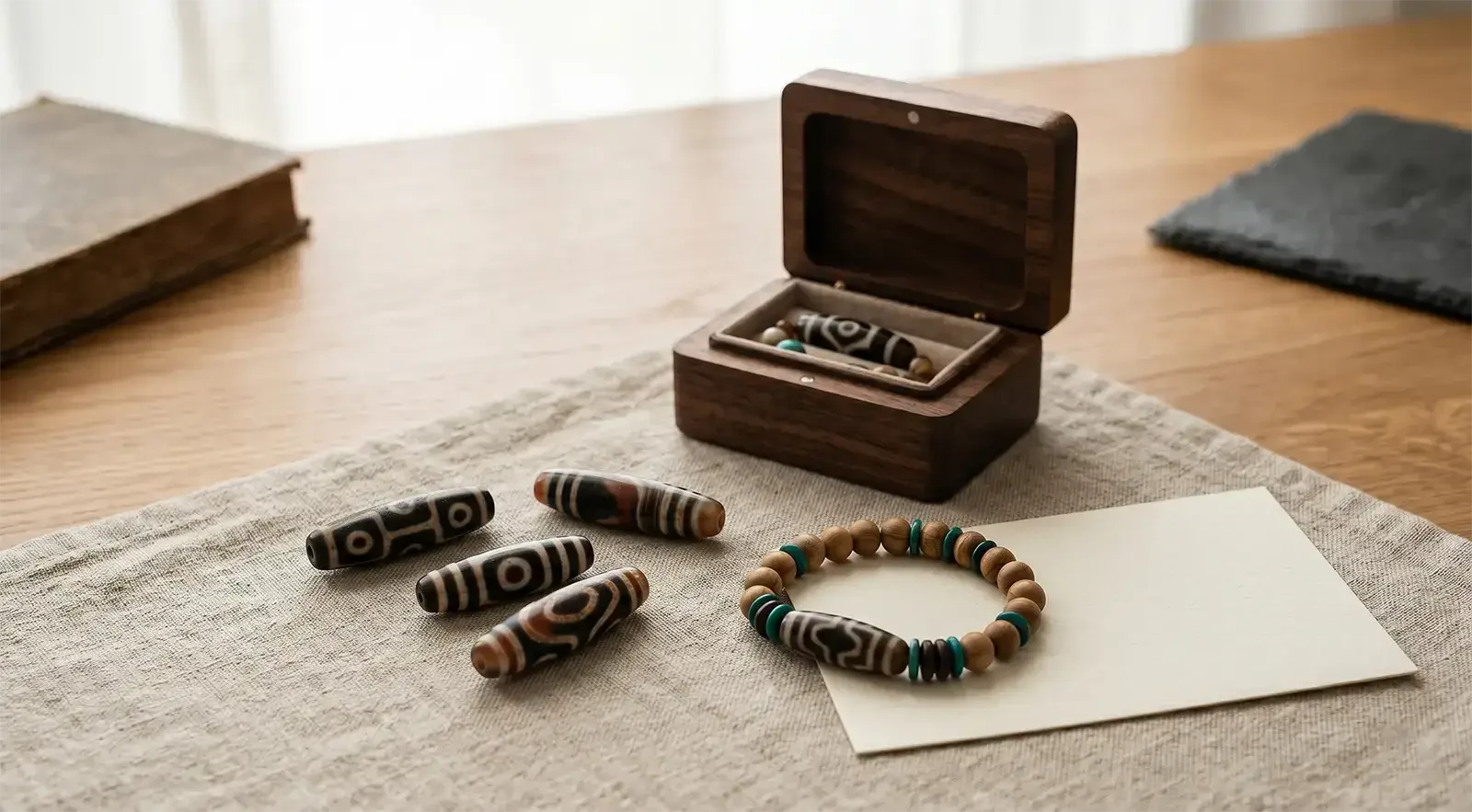
Dzi beads are usually understood as patterned agate beads, often marked with circles, bands, waves, stripes, or eye-like designs. The word may appear in different transliterations, including Dzi, dZi, or gZi.
Unlike ordinary decorative beads, Dzi beads are often treated as culturally significant and symbolically charged. In many modern descriptions, they are linked to protection, good fortune, spiritual support, and auspicious meaning. In Tibetan and Himalayan contexts, they may also be associated with heirloom value, personal blessing, or protective symbolism.
For beginners, the safest way to understand them is this: Dzi beads are not just “crystals with eyes.” They belong to a specific bead tradition with cultural weight, symbolic interpretation, and a complicated modern market.
If you need broader vocabulary first, read the Healing Jewelry Glossary.
Origins and cultural context
Dzi beads are strongly associated today with Tibet and the Himalayan region, but their deeper material history is not a simple one-line origin story. They are often discussed alongside wider traditions of etched, decorated, or patterned agate beads across parts of Asia.
That means two ideas should be held together carefully:
- Dzi beads are culturally meaningful in Tibetan and Himalayan contexts.
- The broader history of decorated agate beads is complex and not always easy to reduce to one exact origin.
This is why responsible language matters. A seller, article, or social media post may present a dramatic origin story as if it is settled fact. In reality, age, origin, provenance, and authenticity can be difficult to prove without expert context.
The best beginner approach is to respect the Tibetan and Himalayan associations while avoiding overconfident claims about every bead’s exact age, source, or spiritual status.
Dzi bead symbolism and eye patterns
Dzi bead symbolism is often discussed through pattern language. The most familiar designs include “eyes,” usually circular markings that may be interpreted as protective or auspicious. Some beads have one eye, two eyes, nine eyes, fifteen eyes, or other pattern arrangements. Bands, stripes, waves, and other shapes may also be interpreted symbolically.
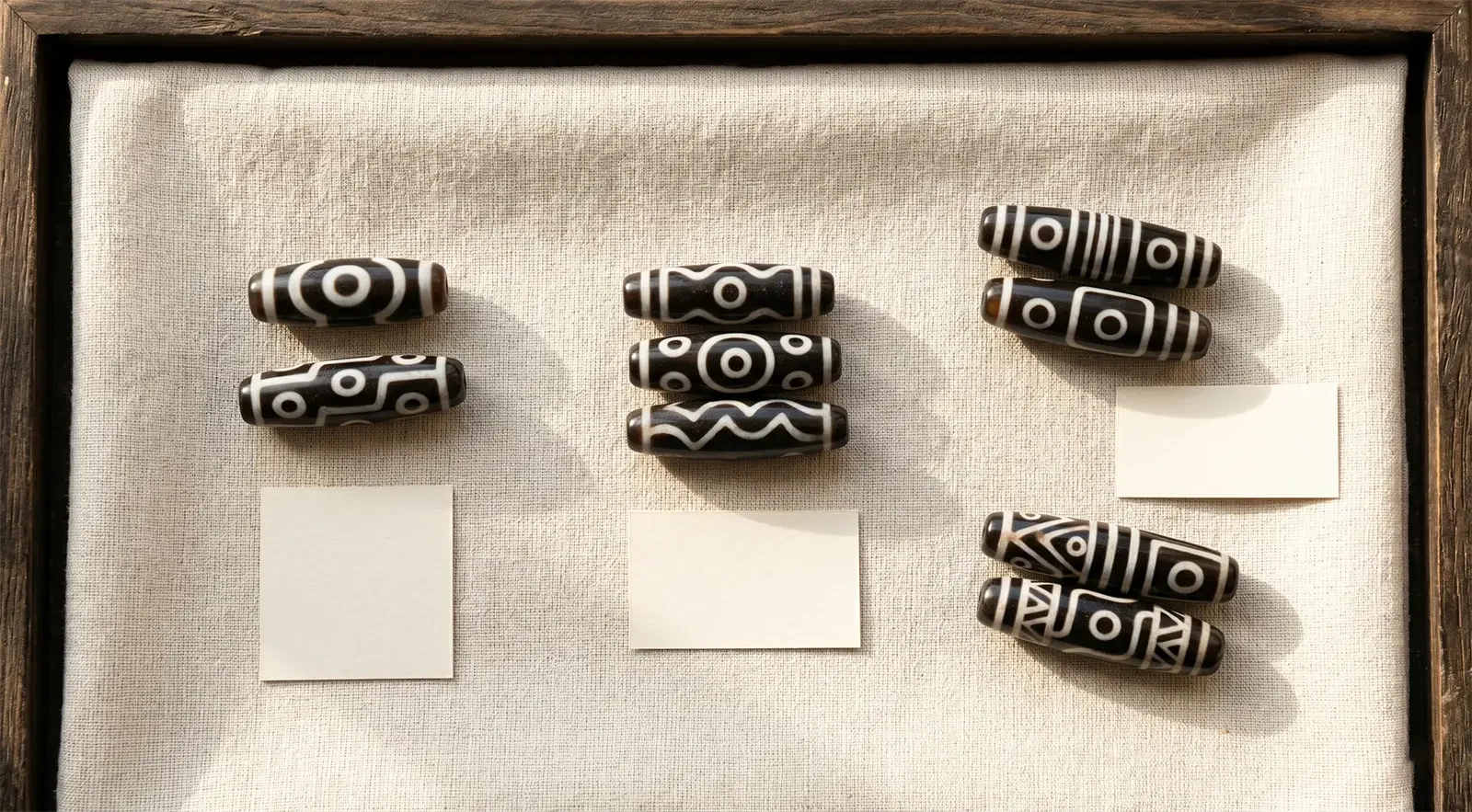
Many modern guides connect different eye counts with different meanings. For example, some interpretations link certain eye counts with protection, harmony, wealth, clarity, wisdom, health, or success. These meanings can be meaningful for wearers, collectors, and gift-givers.
But symbolism should be handled carefully. It is better to say that certain patterns are commonly associated with certain meanings than to claim that every eye count always means one exact thing in every context.
Meaning may vary by family tradition, seller tradition, regional framing, personal belief, and modern interpretation. A Dzi bead can be symbolic without every interpretation being universal.
Common symbolic themes
Although Dzi bead meanings are not perfectly standardized, several themes appear often in modern and traditional discussions.
- Protection: Many Dzi beads are associated with protective symbolism or warding off negative influence.
- Good fortune: Some designs are interpreted as auspicious or supportive of luck and opportunity.
- Clarity: Eye patterns are often connected with awareness, perception, and seeing more clearly.
- Prosperity: Certain beads are popularly linked with abundance, business luck, or material stability.
- Spiritual support: Some wearers treat Dzi beads as reminders of practice, blessing, or inner steadiness.
- Longevity and well-being: Some interpretations connect Dzi beads with wishes for safety, health, and long life.
These are symbolic associations, not guaranteed effects. A Dzi bead may remind someone of protection or good fortune, but it should not be presented as a promise of health, wealth, safety, or spiritual power.
For a broader guide to symbolic materials across jewelry categories, read Common Materials in Healing Jewelry & Their Meanings.
Common imitations and buyer caution
Dzi beads are one of the categories where buyer caution matters most. Not every Dzi-style bead is ancient, rare, naturally old, or traditionally significant. Modern Dzi-style beads are common, and some can still be beautiful, meaningful, and wearable if they are described honestly.
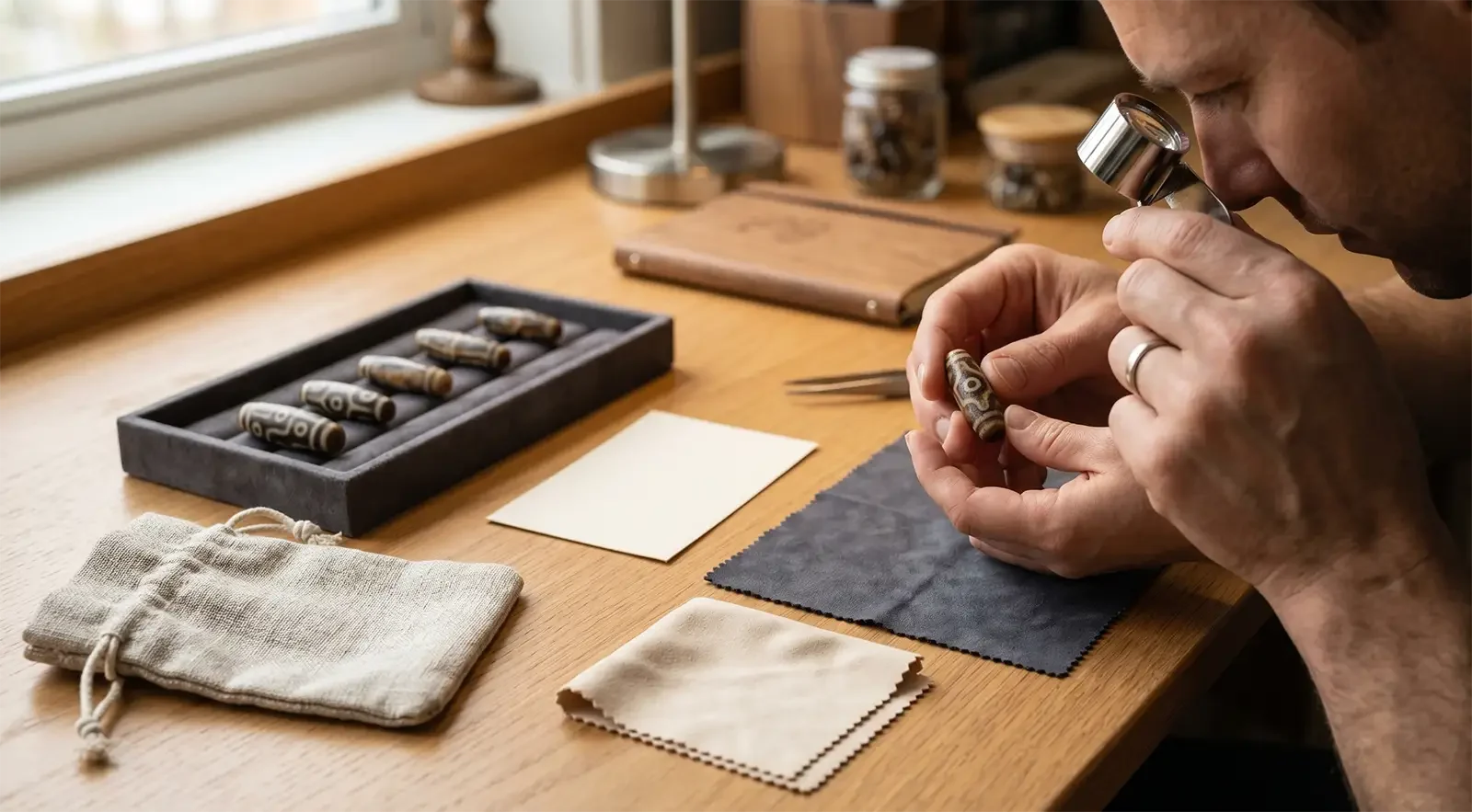
The problem begins when modern beads are marketed as ancient, rare, spiritually powerful, or museum-level without evidence.
Common caution points include:
- Photos are not enough. Surface appearance can be misleading.
- An “old look” does not prove age. Wear, patina, cracks, and surface character can be imitated, enhanced, or overstated.
- Eye count does not prove authenticity. Pattern language is easy to copy.
- Seller stories are not evidence. Dramatic origin stories can be used as sales tools.
- Agate can be treated or altered. Color, pattern, and surface appearance may not tell the full story.
- High price does not guarantee authenticity. Price can reflect marketing, not proof.
If you want a broader framework for stone treatment and imitation issues, read Natural vs. Synthetic Stones and Gemstone Treatments 101.
How to approach Dzi beads as a beginner
If you are new to Dzi beads, start with grounded questions before focusing on mystical claims or rarity language.
- What is the seller actually claiming? Is the bead described as ancient, antique, old-style, modern, treated, or inspired by Dzi patterns?
- Is there provenance? A serious claim should have more support than a dramatic product description.
- Is the price reasonable for what is being claimed? A modern Dzi-style bead and a rare old bead should not be described the same way.
- Is the language too absolute? Be cautious when a seller promises guaranteed wealth, protection, health, or spiritual power.
- Do you still like the bead if it is modern? If yes, it may still have personal value — as long as it is represented honestly.
For most beginners, the safest path is to buy for beauty, symbolic meaning, and honest representation rather than chasing unverifiable age or rarity.
What buyers should not assume
Before buying or interpreting a Dzi bead, avoid these common assumptions:
- Do not assume all Dzi beads are ancient. Many are modern or modern-style pieces.
- Do not assume every eye count has one fixed meaning. Symbolism varies across interpretation systems.
- Do not assume modern Dzi-style beads are worthless. They can still have decorative, symbolic, or personal value if honestly described.
- Do not assume beginners can spot every fake. Authentication may require expertise, provenance, and sometimes testing.
- Do not assume a bead gives automatic access to a culture. Wearing a culturally meaningful object requires humility.
- Do not assume “Tibetan” language in a listing proves origin. Cultural keywords are often used in marketing.
A cautious buyer is not cynical. A cautious buyer is respectful — of the culture, the object, and their own limits.
Respectful use and cultural awareness
Dzi beads deserve cultural humility. They should not be reduced to generic “crystal energy” language or used as props for a vague spiritual aesthetic. Their strongest modern appeal often comes from the combination of beauty, mystery, symbolism, and cultural depth. That depth should be respected rather than flattened.
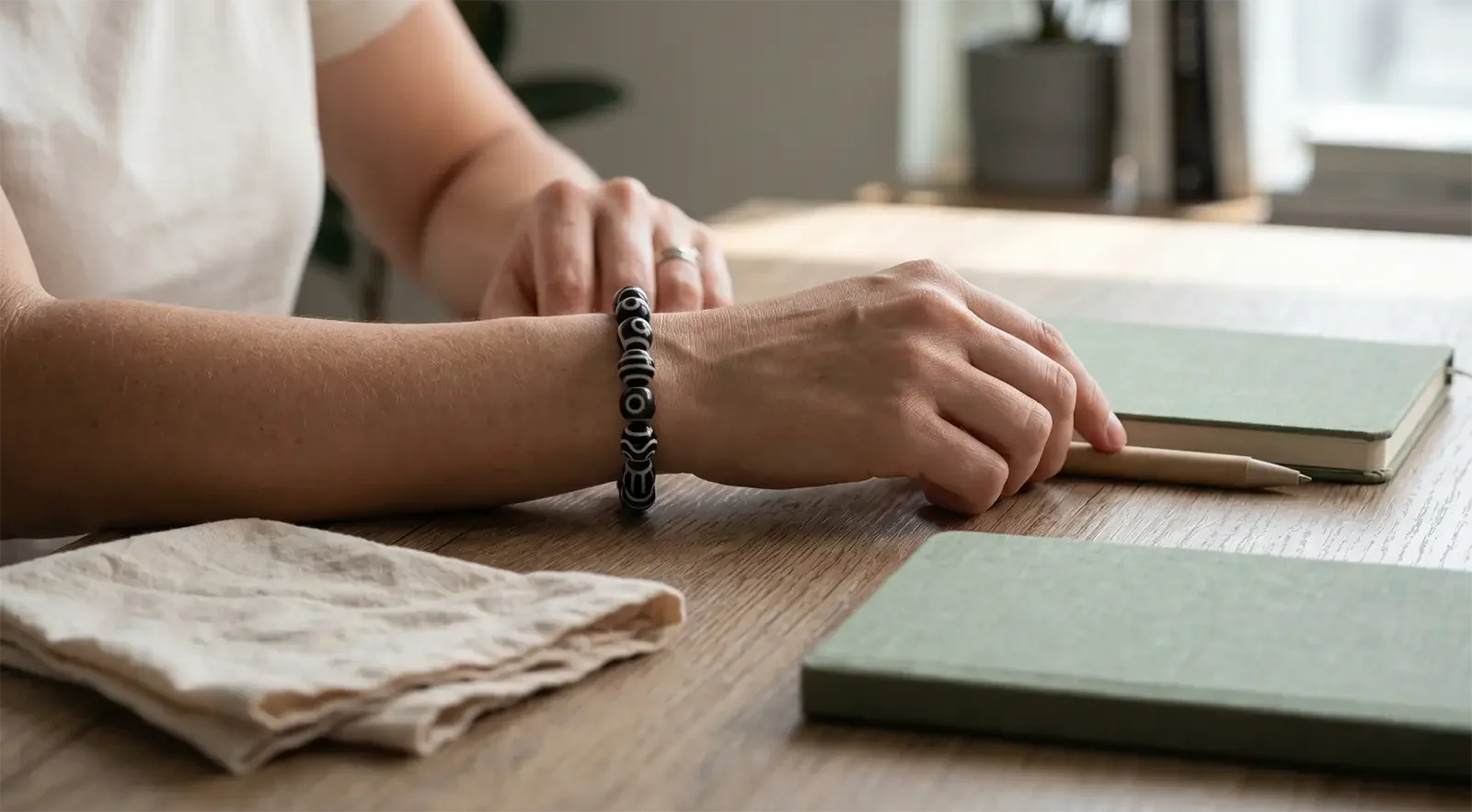
Respectful use can be simple:
- Learn the basic cultural context before wearing or gifting Dzi beads.
- Avoid making exaggerated claims about what the bead can do.
- Be honest if your bead is modern or Dzi-style rather than ancient.
- Treat symbolism as meaningful, not guaranteed.
- Choose pieces from sellers who describe materials and claims clearly.
- Do not use Tibetan or Himalayan language as decoration without understanding.
If you wear a Dzi bead as healing jewelry, let it be a reminder of protection, steadiness, clarity, or personal intention. That can be meaningful without turning the piece into a miracle object.
FAQs
What are Dzi beads?
Dzi beads are patterned agate beads commonly associated with Tibetan and Himalayan cultural use. They often feature eyes, bands, circles, or other designs and are commonly discussed in relation to protection, auspicious meaning, and good fortune.
Where do Dzi beads come from?
Dzi beads are strongly associated today with Tibet and the Himalayan region. Their deeper history is more complex and is often connected to broader traditions of decorated or etched agate beads across parts of Asia.
What does a Dzi bead mean?
Dzi bead meaning depends on pattern, tradition, interpretation, and personal belief. Many people connect Dzi beads with protection, fortune, clarity, prosperity, blessing, or spiritual support, but meanings are not perfectly universal.
What do the eyes on Dzi beads mean?
Eye patterns are often interpreted as symbols of protection, awareness, and auspicious energy. Different eye counts may be linked with different meanings, but those meanings can vary and should not be treated as fixed rules in every context.
Are all Dzi beads ancient?
No. Many Dzi-style beads on the market are modern. Some are sold honestly as modern pieces, while others are marketed in ways that blur the difference between old, antique, old-style, and newly made beads.
How can I spot fake Dzi beads?
Beginners can learn caution signs, such as exaggerated age claims, dramatic seller stories, suspiciously uniform “old” surfaces, or promises of guaranteed results. However, beginners usually cannot confirm authenticity from photos alone. Higher-value beads require provenance and trusted expertise.
Are modern Dzi-style beads bad?
No. A modern Dzi-style bead can still be beautiful, symbolic, and meaningful. The issue is not whether it is modern. The issue is whether it is represented honestly.
Can Dzi beads be used as healing jewelry?
Yes, some people wear Dzi beads as healing jewelry for symbolic support, protection themes, intention, or personal meaning. But they should not be reduced to generic wellness accessories or presented as guaranteeing outcomes.
Do Dzi beads guarantee protection or good luck?
No. Dzi beads may be associated with protection, blessing, fortune, or auspicious symbolism, but they do not guarantee health, wealth, safety, or life outcomes.
What should I ask before buying a Dzi bead?
Ask whether the bead is modern, antique, old-style, treated, or authenticated; what evidence supports the seller’s claims; whether the price matches the claim; and whether you would still value the bead if it were modern.
Dzi beads are meaningful because they carry beauty, symbolism, cultural association, and market complexity at the same time. The best beginner position is respectful and careful: learn the context, enjoy the symbolism, question exaggerated claims, and never confuse a powerful story with proof.