



Written by Toan Ho — Tittac editorial team.
Who this guide is for: This guide is for home karaoke buyers trying to figure out how much real power their room actually needs without getting distracted by oversized watt claims.
How this guide was prepared: This refresh follows Tittac’s current room-first buying framework and keeps the focus on realistic RMS power, clean headroom, speaker behavior, and everyday home use.
Need help matching power to your room? Visit our Garden Grove showroom or contact Tittac for help in English or Vietnamese.
“How many watts do I need for karaoke?” sounds like a simple question, but it is one of the easiest karaoke specs to misunderstand. Bigger numbers look safer on paper, yet wattage alone does not tell you how full, clean, or comfortable a system will sound once music and live vocals are actually filling your room.
For home karaoke, the better question is how much real usable power and clean headroom your room needs. That is why wattage only makes sense when you look at room size, speaker efficiency, listening distance, and how hard your household actually sings. If you want the full starting framework first, begin with The Complete Guide to Home Karaoke Systems.
Quick Answer
For many home karaoke setups, a practical starting point is roughly 80 to 200 watts total RMS for small rooms, about 200 to 400 watts total RMS for many medium rooms, and roughly 400 watts total RMS or more for larger home spaces. Those are not rigid thresholds. They are starting ranges.
The real goal is not “the highest watt number.” It is a system that stays clear, relaxed, and balanced in your room without needing to be pushed hard every time people start singing louder. In home karaoke, slightly more clean headroom is usually more helpful than a flashy number that does not reflect real-world use.
Table of Contents
What Wattage Actually Means in Home Karaoke
Watts describe electrical power, but they do not tell the whole performance story by themselves. In karaoke, wattage matters because it affects how easily the amplifier can drive the speakers without strain. More realistic usable power can help the system stay cleaner when the room is bigger, when the singers get louder, or when the speakers need more drive to feel full.
What watts do not tell you on their own is just as important:
- How loud the system will actually feel in your room
- How efficient the speakers are
- How clear the vocals will sit above the music
- How comfortable the system sounds once people are really singing
That is why wattage should be treated as one buying clue, not the final verdict. And when you compare products, compare like with like. RMS or continuous power is more useful than peak-style marketing numbers when you are trying to judge real home performance. For the deeper breakdown, read RMS vs Peak Power Explained.
Practical Watt Starting Ranges by Room Size
The simplest useful way to think about karaoke power is by room size. These are broad home-use starting ranges, not hard rules, and they make the most sense when you are comparing realistic RMS power instead of inflated headline numbers.
| Room Type | Typical Home Example | Practical Starting Range | Main Goal |
|---|---|---|---|
| Small room | Bedroom, apartment living room, compact den | About 80 to 200 watts total RMS | Clean sound at moderate volume without overpowering the space |
| Medium room | Standard living room, family room | About 200 to 400 watts total RMS | Balanced music and vocal presence with some headroom |
| Large room | Big family room, open-plan entertainment area | About 400 watts total RMS or more | Better coverage and cleaner output at distance |
Those ranges assume normal home karaoke use, not a commercial event setup. They also assume you want a system that feels comfortable, not one that lives close to distortion whenever the room gets lively. If your room is unusually open, reflective, or awkwardly shaped, the practical power need can feel higher because the sound spreads less helpfully across the space.
That is why room fit matters so much. A setup that feels perfectly balanced in a compact living room can feel thin in a large family room, while a bigger system can feel crowded and harder to tune in a tighter reflective space. For the room-first version of this decision, see Best Karaoke System for Small Rooms vs Large Rooms.
Why Headroom, Speaker Sensitivity, and Use Case Change the Answer
Two systems can show similar watt numbers and still behave very differently in real karaoke use. That is because the answer is not only about amplifier power. It is also about how the speakers use that power, how demanding the room is, and how much clean reserve the system has before it starts to feel stressed.
Headroom is the extra clean performance a system keeps in reserve before it starts sounding sharp, flat, or strained. In karaoke, headroom matters a lot because you are not only playing music. You are also blending live vocals into the mix. A system with enough reserve tends to feel more relaxed, easier to sing through, and less tiring over time.
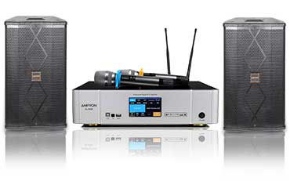
Speaker sensitivity changes the answer too. A more efficient speaker can sound fuller and more effortless with the same amplifier power than a less efficient speaker. That is why you should never compare watts in isolation. And use case matters just as much: casual family singing in a small room does not need the same margin as regular weekend gatherings in a larger open space. If you want to compare full systems through that real-world lens instead of just watt labels, read Ampyon Karaoke Systems Explained.
Signs a Karaoke System Is Too Small or Too Much for the Room
You usually do not need test equipment to notice when the match is wrong. In home karaoke, the clues show up pretty quickly during normal use.
Common signs the system is undersized
- The sound only feels alive when the volume is pushed hard
- Vocals disappear when the music gets fuller
- The system feels sharp or strained before the room is truly filled
- People farther away hear less energy and less clarity
- You keep boosting volume or bass trying to make the room feel bigger
Common signs the system is oversized for the room
- The room fills too quickly and becomes tiring
- Bass feels heavy or crowded even at moderate settings
- Tuning becomes more sensitive than it should be
- The system dominates the room physically and sonically
- You paid for more size and output than your daily use ever needs
In home karaoke, being underpowered is usually more limiting than being slightly overpowered. But badly matched overkill is still not ideal. The best result is a setup with enough reserve to sound easy and comfortable without feeling excessive. If your current issue is less about power and more about balance, feedback, or strain, the better next read is Common Karaoke Problems and How to Fix Them.
How to Buy the Right Power Level Without Chasing Numbers
If you want a cleaner buying framework, use these rules instead of shopping by the biggest number on the page:
- Start with the room, not the watt line. Small rooms reward control. Larger rooms need more coverage and reserve.
- Compare RMS or continuous power, not peak-style marketing claims. That gives you a more realistic baseline.
- Match the system to how you actually sing. Casual family sessions, frequent weekend singing, and larger group use do not need the same margin.
- Leave headroom. The goal is clean, relaxed sound at normal use, not a system that feels stressed when the room gets fun.
- Do not separate watts from speaker quality and efficiency. A better-matched system often outperforms a bigger number.
- Do not buy the highest watt system just to feel safe. Buy the one that fits the room and stays comfortable.
The best watt mindset is simple: treat wattage as a capacity clue, not a complete performance verdict. A strong karaoke system is the one that gives you enough realistic power, enough headroom, good vocal clarity, and a room match that feels right every time you use it.
Related Reading
- RMS vs Peak Power Explained
- dB vs Watts: What Actually Matters?
- Best Karaoke System for Small Rooms vs Large Rooms
- Ampyon Karaoke Systems Explained
Frequently Asked Questions
How many watts do I need for karaoke at home?
For many home setups, small rooms often do well with roughly 80 to 200 watts total RMS, medium rooms often land around 200 to 400 watts total RMS, and larger home spaces often benefit from around 400 watts total RMS or more. Treat those as starting ranges, not fixed buying rules, because room layout and speaker behavior still matter.
Is 100 watts enough for karaoke?
It can be enough in a small room for casual home use, especially if the speakers are efficient and your loudness goals are moderate. It is much less likely to feel comfortable in a larger room or in a more energetic setup where the system needs extra clean headroom once several people are singing and the room gets busier.
Should I buy the highest watt karaoke system I can afford?
Usually no. It is smarter to buy the system that matches your room and gives you enough clean reserve than to chase the biggest number on the spec sheet. Oversizing can make a small room harder to tune and less comfortable, while a well-matched moderate-power setup often sounds better in real family use.
Does higher wattage always mean a louder or better karaoke system?
No. Loudness and overall quality also depend on speaker sensitivity, room acoustics, listening distance, tuning, and how the whole system is designed. Higher wattage can help when it provides useful clean headroom, but wattage alone does not guarantee clearer vocals, better balance, or a more enjoyable karaoke experience at home.
Conclusion
The best way to think about watts is this: they matter, but only inside a bigger room-and-use-case decision. If you want the next step after wattage, Ampyon Karaoke Systems Explained is a useful follow-up because it helps translate power questions into real system choices by room, family use, and control style.
The short version is simple: buy enough realistic RMS power for your room, leave enough clean headroom so the system stays relaxed, and stop treating the biggest watt number like the safest answer. In home karaoke, comfort and control usually matter more than bragging rights.
Need Help Choosing the Right Power Level for Your Room?
If you already know your room size and how your household usually sings, the next decision gets much easier.
Browse our karaoke packages and compare real home-use options instead of shopping by watt claims alone.