
Off-axis singing changes karaoke tone because a microphone does not capture the voice the same way from every angle. In home karaoke, even a small shift in mic angle can make the same singer sound clear one moment, then duller, thinner, softer, or less focused the next.
Who this guide is for: Home karaoke users who want to understand why vocal tone changes even when the singer, microphone, room, and system settings are the same.
How this guide was prepared: This guide was written around real handheld karaoke behavior, where singers naturally move the microphone, turn their head, watch the screen, laugh, or change grip while singing. The focus is narrow: how off-axis singing affects vocal tone.
Many karaoke users notice a strange problem. The same singer can sound open and present during one line, then slightly muffled or less focused during the next line. The system did not change. The volume setting did not change. The microphone may still be close to the mouth. But the sound still shifts.
One common reason is microphone angle. Handheld karaoke microphones are not neutral from every direction. They are designed to capture the voice best from their main pickup area. When the singer moves away from that angle, the microphone may still hear the voice, but it does not hear it with the same clarity, brightness, and focus.
Table of Contents
Quick Answer
Off-axis singing means the singer’s voice is reaching the microphone from an angle instead of entering the mic’s most responsive pickup direction. In home karaoke, this usually changes tone before it causes a dramatic volume drop. The vocal may still be loud enough, but it can lose brightness, detail, presence, and focus. That is why the same singer can sound full and clear one moment, then duller or thinner the next.
What Off-Axis Means in Karaoke
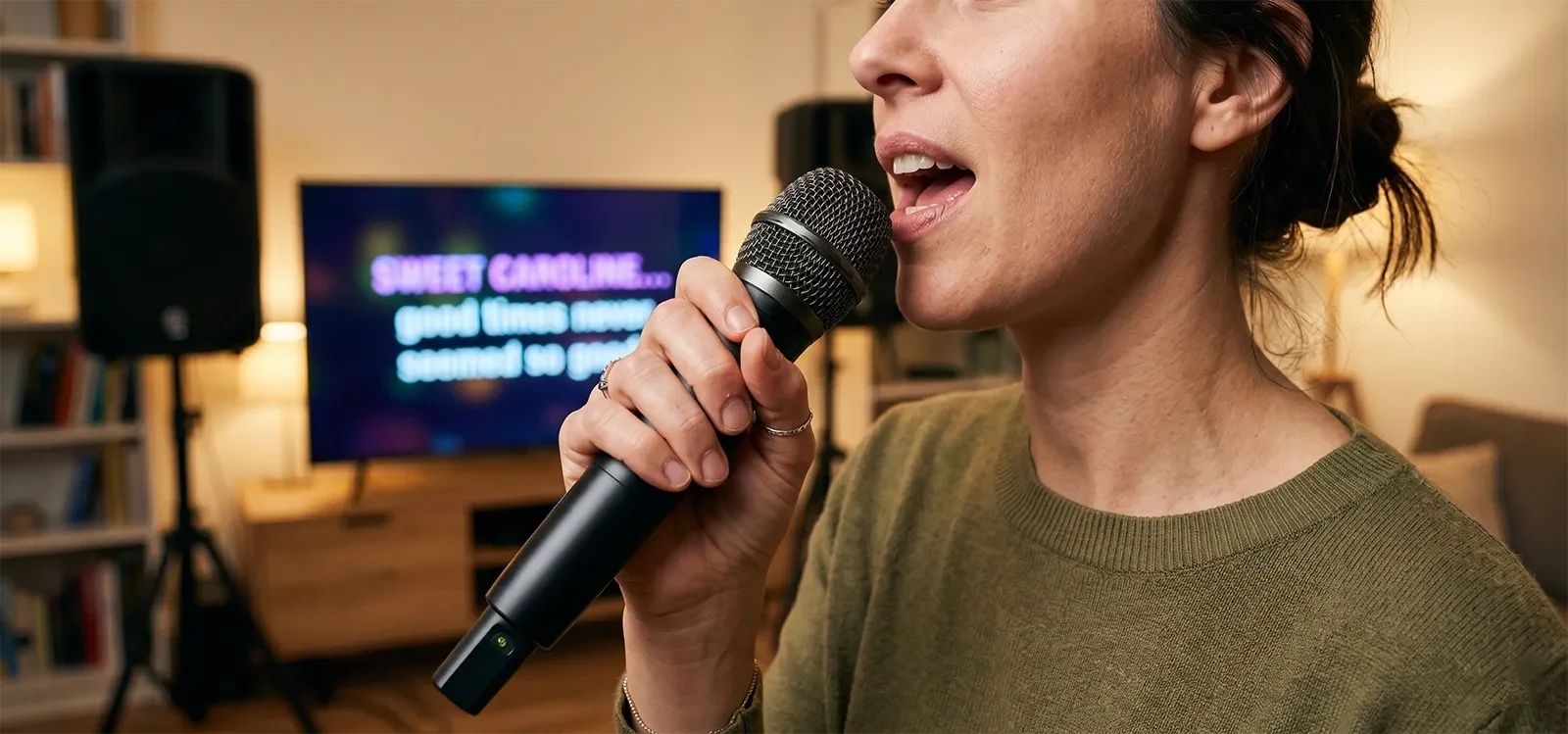
Off-axis means the sound source is not aimed directly into the microphone’s main pickup direction. In karaoke, the sound source is the singer’s voice. When the singer sings straight into the front of the mic, the voice is closer to on-axis. When the mic is turned sideways, lowered too far, pointed away, or held at a steep angle, the voice becomes more off-axis.
This happens constantly in real home karaoke. People do not sing like studio vocalists standing still in front of a fixed microphone. They hold the mic casually, look at the lyrics screen, move around, pass the mic to someone else, and change position without thinking about it.
The important point is simple: off-axis singing does not always make the vocal disappear. More often, it changes the quality of the voice first. The microphone still hears the singer, but it no longer hears the voice from the angle where it sounds most natural and direct.
Why Mic Angle Changes Vocal Tone
A karaoke microphone does not capture all frequencies equally from every angle. The front of the microphone is usually where the voice sounds most direct. As the singer moves off-axis, the microphone may capture less vocal detail, less upper clarity, and less presence.
That is why off-axis singing often sounds like a tone problem, not just a loudness problem. The vocal may still have enough level, but the shape of the sound changes. Consonants can soften. The top end may feel less alive. The voice may stop cutting through the music as cleanly.
This matters because karaoke vocals need clarity more than raw volume. A voice that is loud but dull can still feel buried. A voice that is slightly softer but properly aimed can sound more natural, more intelligible, and easier to sing with.
In practical terms, off-axis singing makes the vocal less stable. The system may be working correctly, but the mic is receiving a slightly different version of the singer’s voice every time the angle changes.
What Users Actually Hear at Home
At home, off-axis singing usually shows up as inconsistency. The singer sounds clear during one phrase, then less clear during the next phrase. The change may be subtle, but it can make the performance feel uneven.
Common signs include:
- The vocal sounds full, then suddenly thinner.
- The voice becomes dull or slightly muffled without a system change.
- Words become harder to understand even though the singer is still audible.
- The vocal blends into the music more than before.
- The singer sounds less confident even though their actual voice did not change.
This is why off-axis behavior can be confusing. People often blame the microphone quality, mixer setting, speaker, or room. Sometimes those things matter, but if the vocal tone keeps changing while the singer moves the mic, angle is the first thing to notice.
Off-Axis Singing vs Microphone Distance
Off-axis angle and microphone distance are related, but they are not the same thing. Distance is about how far the singer’s mouth is from the microphone. Off-axis angle is about whether the voice is aimed into the microphone correctly.
A singer can be close to the mic and still sound inconsistent if the microphone is pointed the wrong way. A singer can also be at a reasonable distance and sound clearer if the mic is aimed directly at the voice.
This is an important distinction for home karaoke. Many users only think about holding the mic “close enough.” That helps, but closeness alone does not guarantee clarity. The microphone still needs to face the voice in a consistent way.
For the broader technique relationship between distance and angle, see the best microphone distance and angle for clear vocals. This guide stays focused on the tonal effect of off-axis singing itself.
How Pickup Pattern Connects to Off-Axis Sound
Most karaoke microphones are directional. That means they are designed to pick up sound more strongly from certain directions and reject more sound from others. This design helps reduce unwanted speaker sound and room noise, but it also means angle matters.
If the singer’s voice moves away from the microphone’s strongest pickup area, the mic may capture the voice with less clarity and balance. This is part of why pickup pattern matters in home karaoke. The microphone is not simply “on” or “off.” It has a directional behavior that affects tone.
That directional behavior is useful when controlled. It helps the mic focus on the singer instead of the whole room. But when the singer constantly moves off-axis, the same directional design can make the vocal tone change from line to line.
For a wider explanation of microphone directionality, read why microphone pickup pattern matters for home karaoke.
Common Misunderstandings
“If the vocal is still loud, the angle must be fine.”
Not always. Off-axis singing often affects tone before it affects loudness. The vocal can still be loud enough, but it may lose detail, presence, or natural brightness.
“This means the microphone is bad.”
Not necessarily. Even good microphones have directional behavior. A better microphone may sound more refined, but it still has a preferred pickup angle.
“This is only a professional audio issue.”
No. Off-axis singing is very common in home karaoke because handheld microphones move constantly. In casual singing, small angle changes happen all the time.
“The room is always the problem.”
Rooms can affect karaoke sound, but not every tonal shift comes from the room. If the vocal changes exactly when the mic angle changes, the cause is probably the microphone position, not the room itself.
A Simple Listening Rule
Use this rule: if the singer’s tone changes more than their actual voice changes, check microphone angle first.
Listen for the vocal becoming duller, thinner, softer around the edges, or less direct while the singer is still close to the mic. That pattern often points to off-axis singing. The microphone is still picking up the voice, but it is no longer capturing the voice from its strongest angle.
The practical takeaway is simple: karaoke microphones are angle-sensitive in real use. Keeping the mic aimed more consistently at the voice usually improves clarity more than raising volume or adding more effects.
Conclusion
Off-axis singing changes karaoke tone because a microphone does not hear the voice the same way from every direction. A small angle shift can reduce vocal detail, brightness, presence, and focus even when the singer is still close to the mic.
For home karaoke users, this explains why a vocal can sound clear one moment and less stable the next without any change in equipment. Before adjusting the whole system, listen to the microphone angle. In many cases, the system is not failing — the mic is simply hearing the voice from the wrong direction.
Frequently Asked Questions
What does off-axis mean in karaoke singing?
Off-axis means the singer’s voice is reaching the microphone from an angle instead of entering the mic’s main pickup direction. In home karaoke, this often happens when the singer turns their head, tilts the mic, lowers it, or sings across the microphone instead of into it.
Does off-axis singing always make the vocal quieter?
No. The first change is often tonal. The vocal may still be loud enough, but it can sound duller, thinner, less focused, or less clear. That is why off-axis singing can be confusing: the voice is still audible, but it does not sit in the mix as well.
Why does the same singer sound clear one moment and dull the next?
One common reason is small microphone angle changes. If the singer moves the mic away from its strongest pickup direction, the microphone captures less vocal detail and presence. The singer may not notice the movement, but the tone can change immediately.
Is off-axis singing the same as bad microphone technique?
It is related, but not exactly the same. Microphone technique includes distance, grip, consistency, and how the singer manages volume. Off-axis singing is the narrower issue of voice angle. A singer can have good distance but still lose clarity if the mic is pointed the wrong way.
Can off-axis singing affect feedback?
Yes, indirectly. If the vocal becomes dull or less present, users may raise the microphone volume to compensate. Higher mic volume can increase feedback risk. Keeping the mic aimed correctly often helps the vocal sound clearer without needing as much extra gain.
If you want to connect this concept to cleaner everyday singing, the next step is understanding how distance and angle work together in real home karaoke use.
Read the best microphone distance and angle for clear vocals.