
A good karaoke setup for an apartment or condo should prioritize clear vocals, moderate volume, controlled bass, compact placement, and everyday habits that reduce disturbance to neighbors. The right apartment karaoke system does not need to be extremely large or loud. It needs to be easy to control, easy to use, and comfortable in a smaller shared living environment without excessive boom, vibration, or listening fatigue.
Who this guide is for: Home karaoke users living in apartments, condos, townhomes with shared walls, or smaller living rooms who want to enjoy karaoke at home while keeping the sound controlled, clear, and considerate of nearby neighbors.
How this guide was prepared: This article is based on practical home karaoke consultation experience across different types of rooms, especially smaller living spaces, shared-wall homes, households with older family members, and families that need a system that is simple to operate rather than unnecessarily complicated.
Apartment karaoke has one very real limitation: you are not the only person affected by the sound in your room. Sound can travel through walls, floors, ceilings, hallways, and building structures. That means the goal is not to make the system as powerful as possible. The goal is to keep vocals clear and enjoyable at a volume the room can reasonably support.
If you are building your system from the beginning and want to understand the complete connection path first, read the Step-by-Step Home Karaoke Setup Guide. This article focuses specifically on making karaoke practical, controlled, and repeatable in an apartment or other shared living space.
Table of Contents
How Apartment Karaoke Differs From a Detached Home
Setting up karaoke in an apartment is different from setting it up in a detached house because you have less physical distance to absorb mistakes. In a detached home, speakers may be farther from neighboring rooms and walls, and there is often more flexibility with placement and listening level. In an apartment, too much bass, a speaker placed directly against a shared wall, or even mild microphone feedback can become noticeable very quickly.
The issue is not simply whether the system is loud. The more important question is whether the room can control the sound. A small apartment with hard floors, glass, bare walls, and limited furniture can make vocals sound sharper, music more reflective, and bass more dominant even at moderate levels.
Turning the system louder usually does not solve those problems. It often makes them more obvious.
This is why apartment karaoke needs a slightly different mindset: choose clarity instead of raw output, compact placement instead of unnecessary equipment, and consistent listening habits instead of allowing the volume to keep increasing throughout the session.
Prioritize Clear Vocals Over High Volume
In an apartment, clear vocals matter more than high overall volume. When singers can hear their own voices clearly, there is less reason to push the music louder just to create excitement.
A common mistake is starting with the music too loud and then increasing microphone volume so the vocal can compete with it. As microphone level rises, feedback risk can increase and the entire system can become harder to control.
A better approach is to establish a comfortable music level first, then bring the microphone up only enough for the vocal to sit clearly above the track.
The goal of apartment karaoke is not to make the room shake. It is to let the singer hear the lyrics, music, and voice clearly while keeping the room comfortable for everyone else.
Speaker and Equipment Placement in an Apartment
For most apartments, the TV is the easiest visual center. Singers should be able to read lyrics naturally without turning sideways or moving into awkward positions. A comfortable singing position also makes it easier to maintain good microphone technique.
If possible, avoid placing speakers directly against a shared wall. Moving a speaker away from the wall can sometimes reduce excessive boundary reinforcement and make the bass easier to control, although the ideal distance depends on the speaker design and the room.
More importantly, avoid aiming excessive sound energy directly toward a shared wall when another practical placement is available.
Speakers should generally remain in front of the main singing area, with singers slightly behind the speaker line. This helps reduce the amount of direct speaker sound entering the microphones and lowers feedback risk.
Avoid pointing the microphone directly toward the speakers. In a small room, small placement mistakes can make the system unstable much faster than they would in a larger space.
Cables, microphones, remotes, chargers, and accessories should also have a consistent place. A good apartment setup should be easy to start and easy to put away. If every karaoke session requires moving furniture, running cables across walkways, and searching for accessories, the system will quickly become inconvenient.
If your main karaoke area is also your living room, read Best Karaoke Setup for Living Rooms: Layout, Sound, and Comfort for more detailed room-layout guidance.
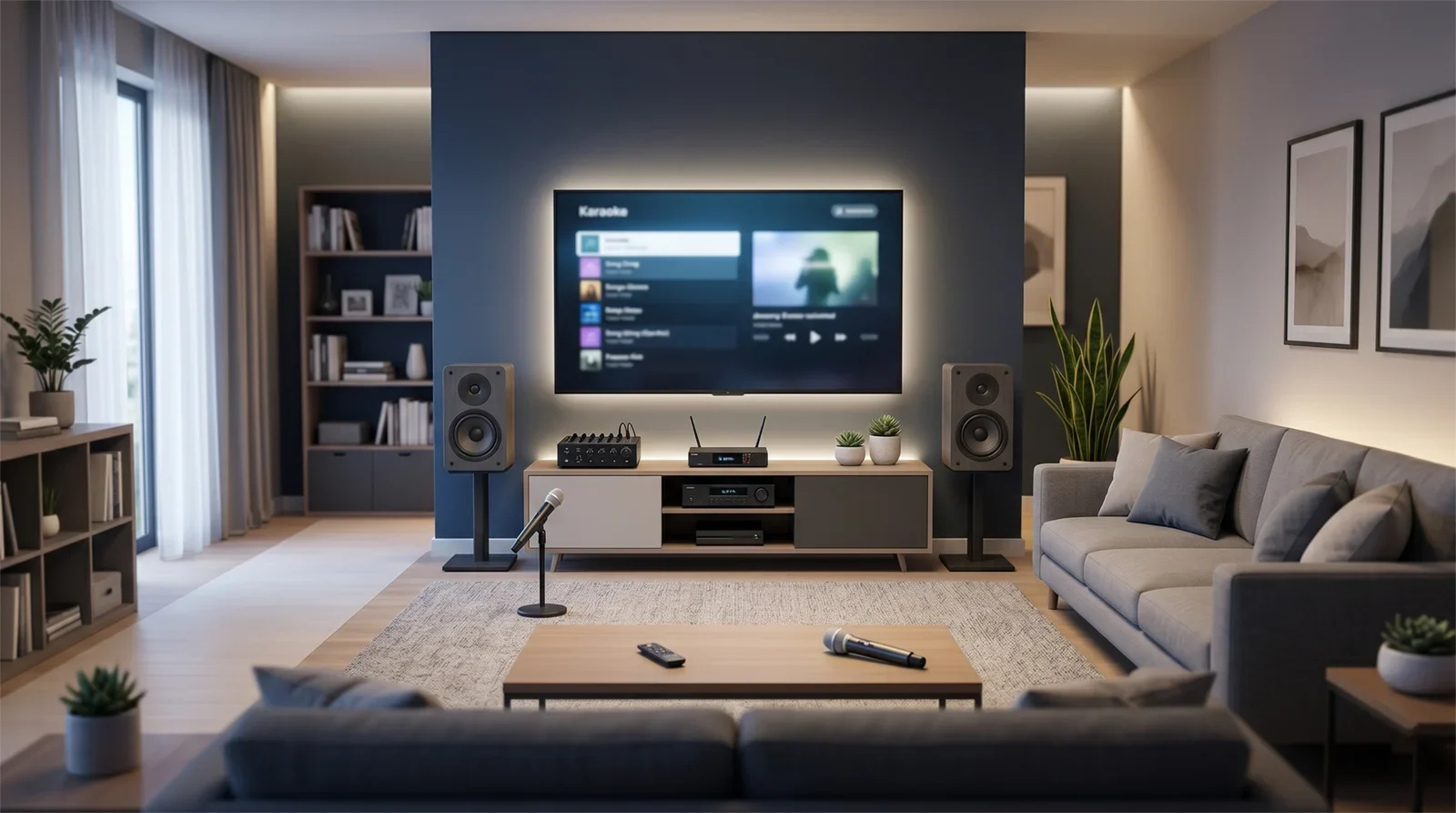
Control Bass, Vibration, and Room Reflections
Bass is often one of the most difficult parts of apartment karaoke to manage. Low-frequency energy and mechanical vibration can travel through floors, walls, furniture, and the building structure in ways that may not seem especially loud inside your own room.
This does not mean the system should have no bass. The goal is controlled bass that supports the music without making the floor, walls, cabinets, or furniture vibrate excessively.
If a speaker is sitting on a loose shelf, lightweight table, or unstable surface, move it to a more secure position. Mechanical vibration from furniture can make the low end feel heavier and more intrusive than necessary.
Soft furnishings such as sofas, curtains, rugs, and upholstered furniture can help reduce some high- and mid-frequency reflections inside the room. They may make vocals feel less harsh and the room less reflective.
However, these materials should not be confused with soundproofing. A rug or curtain can improve the sound inside the room, but it will not prevent low-frequency energy from traveling through a shared wall or building structure.
If the room is very reflective because of glass, hard floors, or bare surfaces, improve the room behavior before assuming you need more equipment or more volume. Sometimes reducing reflections makes karaoke much easier to hear at a lower level.
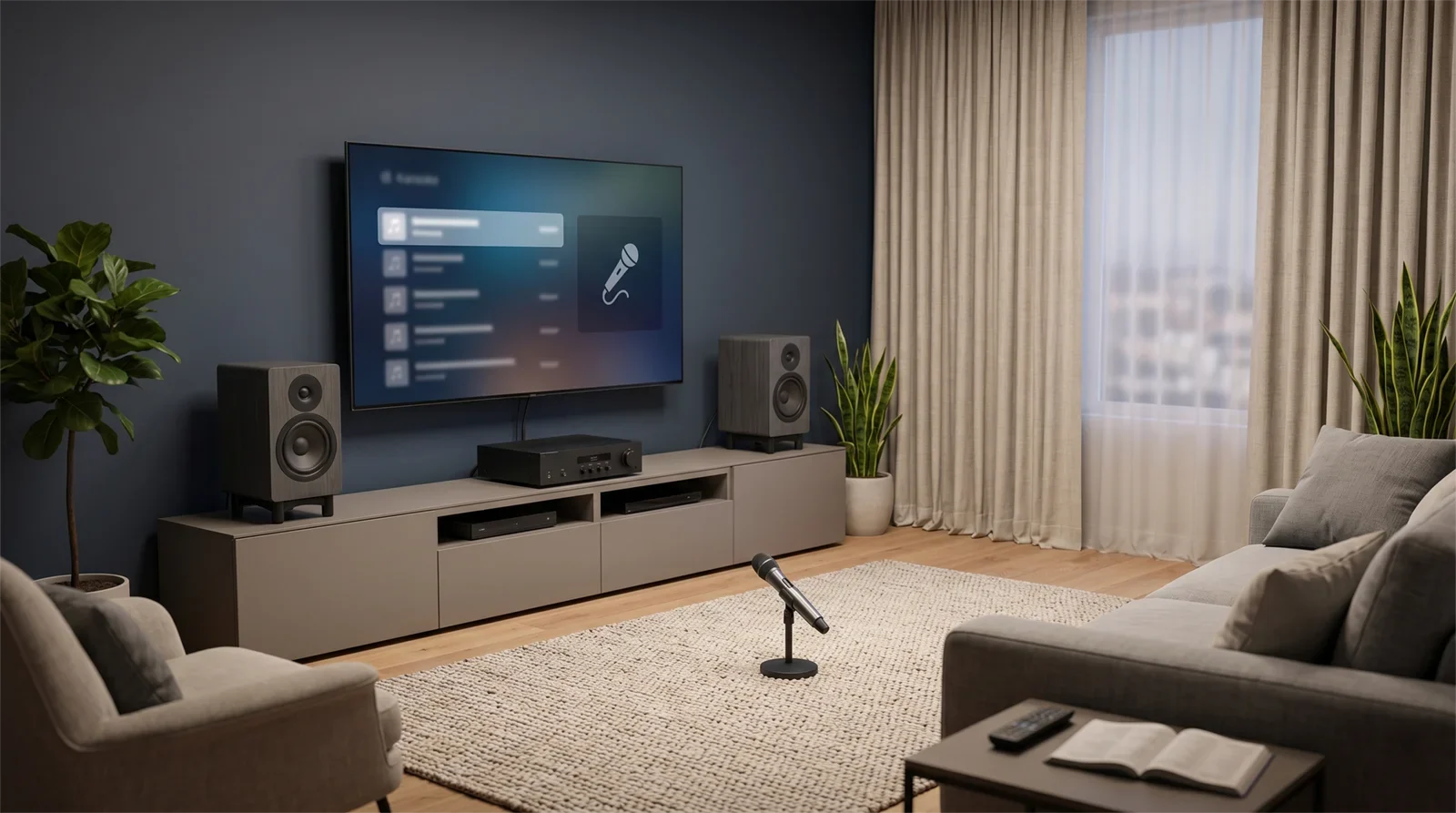
A Practical Setup for Most Apartments
For many apartments, the most practical setup is a compact system organized around the TV, with speakers positioned in front of the singing area, easy-to-use microphones, tidy cables, and a familiar listening level.
The goal is repeatability. Each time you turn the system on, it should behave predictably without requiring major adjustment.
The singing area does not need to take over the entire room. One or two people should be able to stand comfortably in front of the TV without blocking the main walkway or standing too close to the speakers.
The sofa, coffee table, and normal living space should still function normally. Apartment karaoke has to coexist with the room instead of turning the room into a temporary stage every time someone wants to sing.
For sound adjustment, start with moderate music volume. Then raise the microphone until the vocal is clearly audible.
If the vocal is already clear but the room still feels heavy or tiring, do not immediately increase volume. First consider reducing excessive bass, lowering the music slightly, adjusting vocal effects, or changing speaker placement.
A good apartment setup should also have a practical stopping point. As people sing longer, it is easy for the volume to drift upward because everyone becomes accustomed to the sound level. In a shared building, that gradual increase can turn an enjoyable session into a neighbor problem.
When a Compact or Portable System Makes More Sense
Not every apartment needs a full multi-component karaoke system. If the room is small, storage space is limited, neighbors are close, or the family only sings occasionally, a compact or portable karaoke system may be the more practical choice.
A simpler system offers several advantages in an apartment: fewer cables, less equipment to store, faster setup and cleanup, and less temptation to overpower the room.
For many apartment households, the most valuable feature is not extreme output. It is the ability to turn the system on quickly, sing a few songs, enjoy clear vocals, and put everything away without rebuilding the room.
If you usually sing alone, with a small family group, or only occasionally on weekends, do not force a large system into a space that cannot use its capability comfortably.
A smaller system that is clear, controlled, and easy to use can be more enjoyable than a larger system that has to be restrained every time it is turned on.
If you want the simplest possible approach, read Karaoke Setup Using Only a TV and Portable Speaker.
Habits That Make Apartment Karaoke More Neighbor-Friendly
Equipment only solves part of the apartment karaoke problem. The other part is how the system is used.
It helps to have a familiar listening level, a reasonable time window, and a short sound check before each session.
Before singing, test one real song at approximately the level you actually expect to use. Listen for four things:
- Are the vocals clear?
- Is the bass excessive or causing noticeable vibration?
- Does the microphone remain stable without feedback?
- Does the room still feel comfortable for listeners?
If the room already feels strained during the first song, increasing the level later will usually make it harder to control.
During the session, avoid automatically increasing the volume every few songs. This is easy to do because the ear adapts to a listening level over time. What felt loud at the beginning can start to feel normal later.
In an apartment, keeping the level consistent is usually better than continually increasing it for more excitement.
Timing also matters. Shared-wall homes, condos, and apartments have different building rules and neighbor situations, so there is no universal karaoke schedule. Use reasonable hours and consider how much sound is reaching adjacent spaces rather than judging only from inside your own room.
If the household includes older adults, children, or anyone who prefers lower sound levels, include their comfort in the setup decision. A good home karaoke system should work for the whole room, not only the person holding the microphone.
Need help choosing a system for your room, budget, and singing style? Contact Tittac for personalized karaoke guidance.
Frequently Asked Questions
Can I use karaoke in an apartment without disturbing my neighbors?
It is possible to reduce the risk of disturbing neighbors, but no normal karaoke setup can guarantee that sound will not travel to another unit. Prioritize clear vocals, moderate music level, controlled bass, sensible speaker placement, reasonable hours, and stable volume throughout the session.
What usually causes the most disturbance in apartment karaoke?
Bass and structural vibration are often particularly difficult to control because low-frequency energy can travel through floors, walls, furniture, and the building structure. Vocal and music volume still matter, but strong low-frequency energy may be noticeable outside the room even when the system does not seem extremely loud inside.
Should a small apartment use a high-powered karaoke system?
Not simply because more power is available. System size should match the room, desired listening level, speaker sensitivity, listening distance, and the amount of clean headroom needed. In a small shared space, controlled output and clear vocals are usually more useful than choosing equipment mainly for maximum loudness.
Do rugs, curtains, and sofas reduce karaoke noise?
They can reduce some reflections inside the room and make vocals sound less harsh or echoey, but they are not true soundproofing. They have limited effect on low-frequency sound and vibration traveling through the building structure.
When does a portable karaoke speaker make sense for an apartment?
A portable system can make sense when you need a compact setup, fewer cables, easy storage, moderate volume, or only occasional karaoke use. For many apartments, simplicity and control are more important than having a large multi-component system.
What should I check before starting karaoke in an apartment?
Check the actual listening volume, vocal clarity, bass level, vibration, microphone feedback risk, cable placement, and whether the planned singing time is reasonable for the building. For a broader pre-session routine, see Karaoke Setup Checklist Before a Party.