






Mala beads are traditionally used as counting beads for meditation, prayer, mantra, breathwork, or repeated intention practice, and many people also wear them as meaningful jewelry. A mala can be beautiful, but it should not be treated as a casual trend piece with no context. The best way to use or wear one is with simplicity, respect, and a clear understanding of what the beads are meant to support.
Who this guide is for
This guide is for readers who want a practical, respectful introduction to mala beads: what they are, how they are commonly used, how to wear them thoughtfully, and what to consider before choosing one.
How this guide was prepared
Cultural Respect Note
This guide discusses mala beads with cultural respect and caution. Meanings and practices can vary by family, region, lineage, tradition, and personal belief. Tittac presents mala beads as meaningful jewelry and practice-support objects, not as guaranteed sources of protection, luck, wealth, spiritual power, or specific life outcomes.
Quick answer
Mala beads are commonly used as a strand of counting beads for meditation, mantra, prayer, breathwork, or repeated intention practice. Many malas are associated with a traditional 108-bead structure, although bead counts and designs can vary. Some people use malas only during practice, while others also wear them as meaningful jewelry.
If you are new to malas, start simply: choose a strand that feels comfortable in your hand, use one bead for each breath or repeated phrase, and treat the piece with respect. A mala does not need to become a dramatic ritual object, but it should not be reduced to an empty accessory either.
This page is a beginner-friendly practical guide. It is not a full history of mala beads, a complete guide to Buddhist or Hindu practice, or a religious authority statement. It is written to help shoppers understand mala beads with more care before choosing, wearing, or using one.
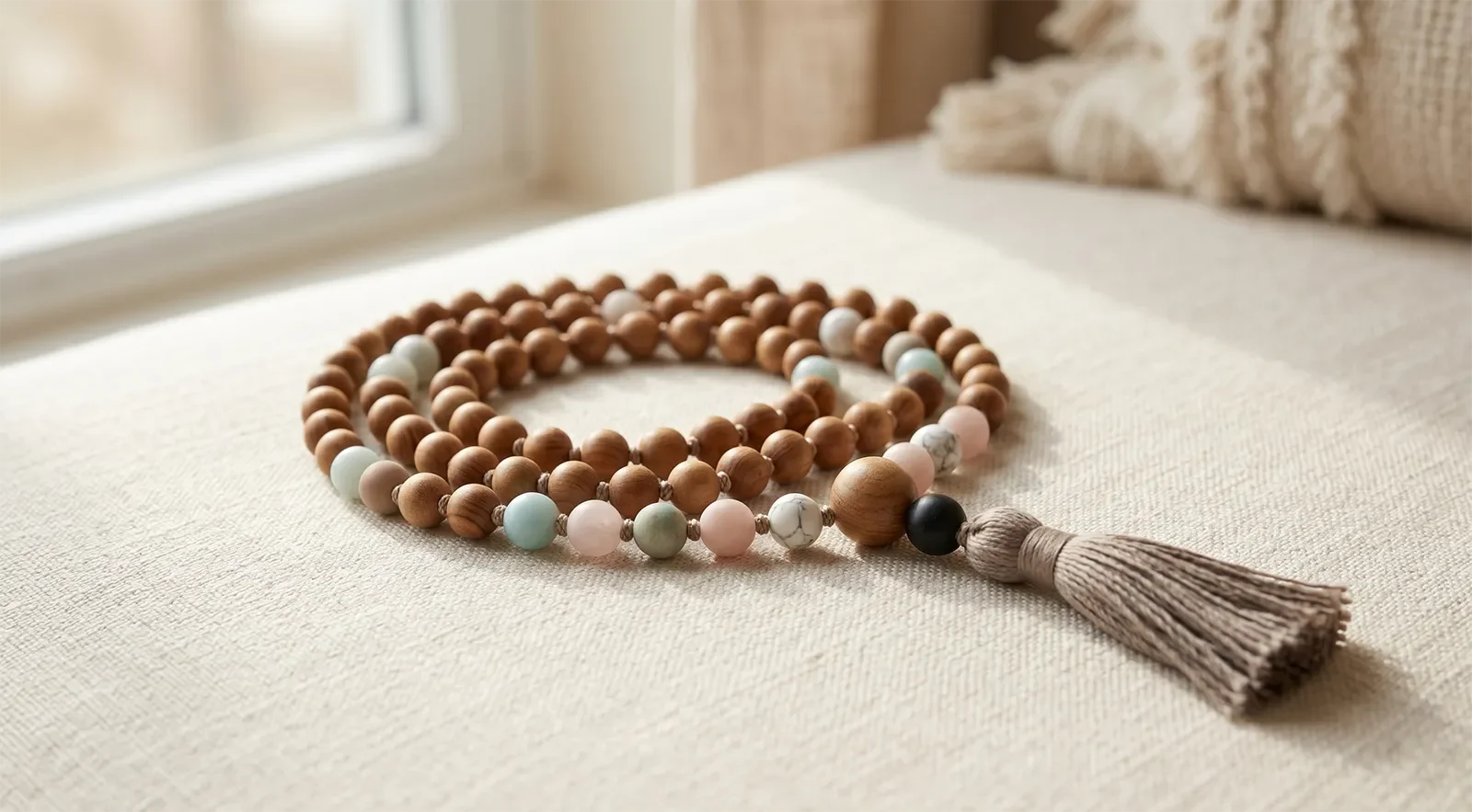
Table of Contents
- What mala beads are
- How mala beads are commonly used
- A simple counting practice for beginners
- How to wear mala beads respectfully
- Do mala beads have to be 108 beads?
- Materials and what to look for
- How to choose a mala for meditation or everyday wear
- Basic care tips
- Common mistakes to avoid
- FAQs
- Related Guides
What mala beads are
A mala is a strand of beads used to support repeated practice. In many contexts, the beads help a person keep count while repeating a mantra, prayer, breath pattern, affirmation, or intention. The strand gives the practice a physical rhythm, allowing the hands to move bead by bead while the mind returns to the chosen focus.
This is what makes mala beads different from ordinary necklaces or bracelets. They can be beautiful and wearable, but their deeper role is practical and symbolic. The beads are not only decoration; they are a structure for attention.
Some people wear malas around the neck. Some wrap them around the wrist. Some keep them in a pouch or on an altar and use them only during practice. The best approach depends on your purpose, comfort, and level of familiarity with the tradition or practice connected to the mala.
If you want the wider category overview, read Types of Healing Jewelry Explained. If you want a broader beginner explanation of meaningful jewelry, read What Is Healing Jewelry?.
How mala beads are commonly used
Mala beads are most often used to support repetition. The repeated unit may be a mantra, prayer, breath, short intention, or meditative phrase. Each bead marks one repetition, helping the practitioner stay present without needing to count mentally.
In beginner-friendly terms, a mala can help with:
- Focus: the hands have something steady to follow.
- Rhythm: each bead gives the practice a gentle pace.
- Consistency: the strand creates a beginning, middle, and end.
- Intention: the mala can be tied to a phrase or quality you want to return to.
- Mindful wear: when worn respectfully, the mala can remind you of your practice during daily life.
A mala can support meditation, but it does not replace meditation. It is a tool for attention, not a shortcut to spiritual depth.
A simple counting practice for beginners
If you are new to mala beads, keep the first practice short and simple. You do not need to begin with a long session or a complicated ritual.
1. Choose one phrase, mantra, or breath pattern
Start with one repeated focus. This may be a traditional mantra from your own practice, a short prayer, a breath pattern, or a simple intention phrase such as “I return to calm” or “I move with steadiness.”
If you want help creating a personal intention, read How to Set an Intention with Healing Jewelry.
2. Hold the mala gently
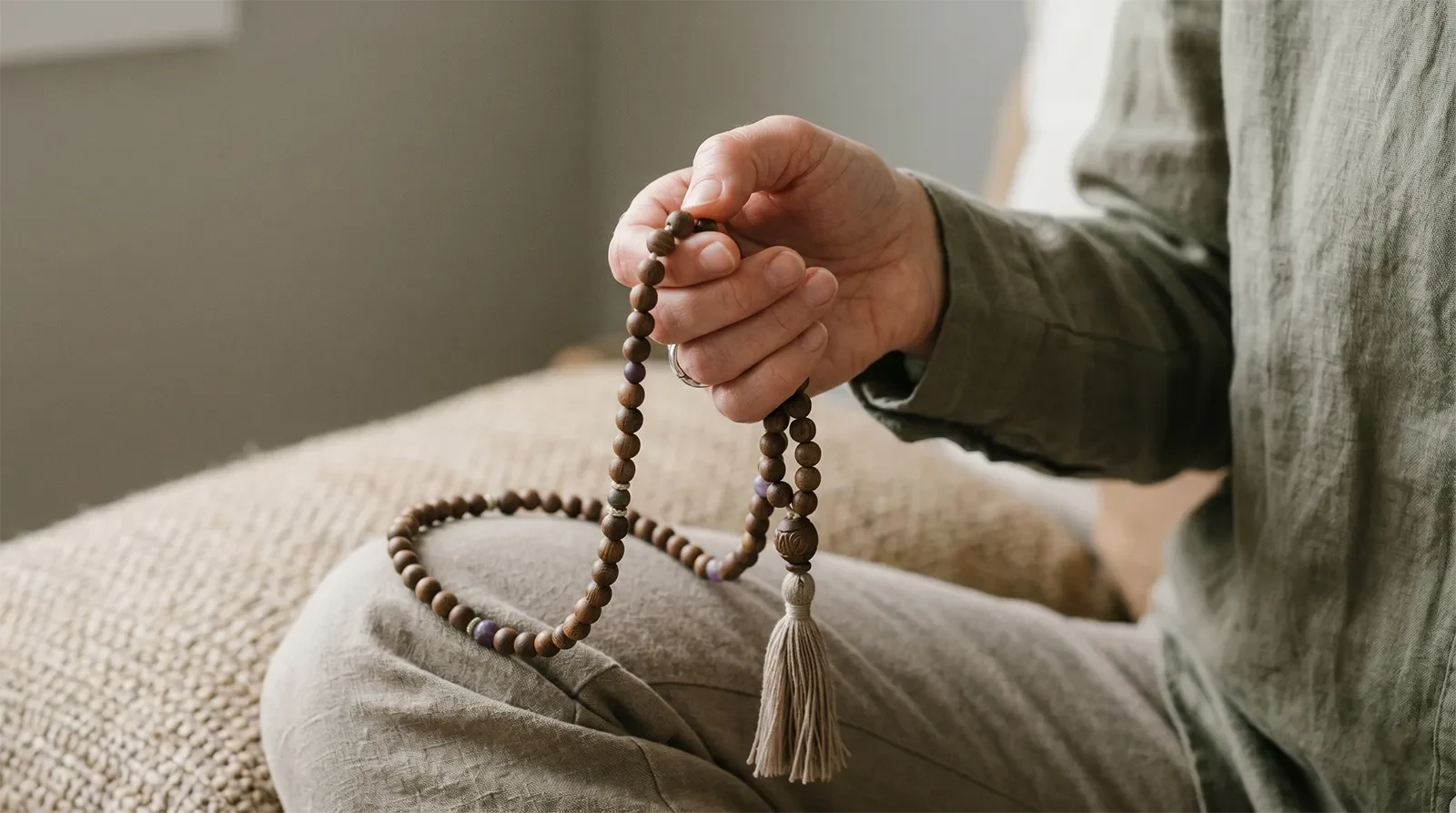
Hold the strand in a way that feels natural and respectful. Move slowly from one bead to the next. The point is not to rush through the strand; the point is to let each bead mark one moment of attention.
3. Repeat once per bead
Use one bead for one repetition. That repetition may be a mantra, a prayer, a breath, or a short phrase. If your mind wanders, return to the next bead without judging yourself.
4. Stop when the practice feels complete
You do not need to finish a full strand every time, especially as a beginner. A shorter practice done consistently is often more useful than a long session you rarely repeat.
5. Close the practice simply
When you finish, pause for a moment before putting the mala away or wearing it again. This closing step helps the practice feel complete instead of rushed.
How to wear mala beads respectfully
Many people wear malas as everyday jewelry, but respectful wear begins with awareness. A mala is not just a necklace with spiritual styling. It is connected to traditions of meditation, prayer, mantra, and repeated practice.
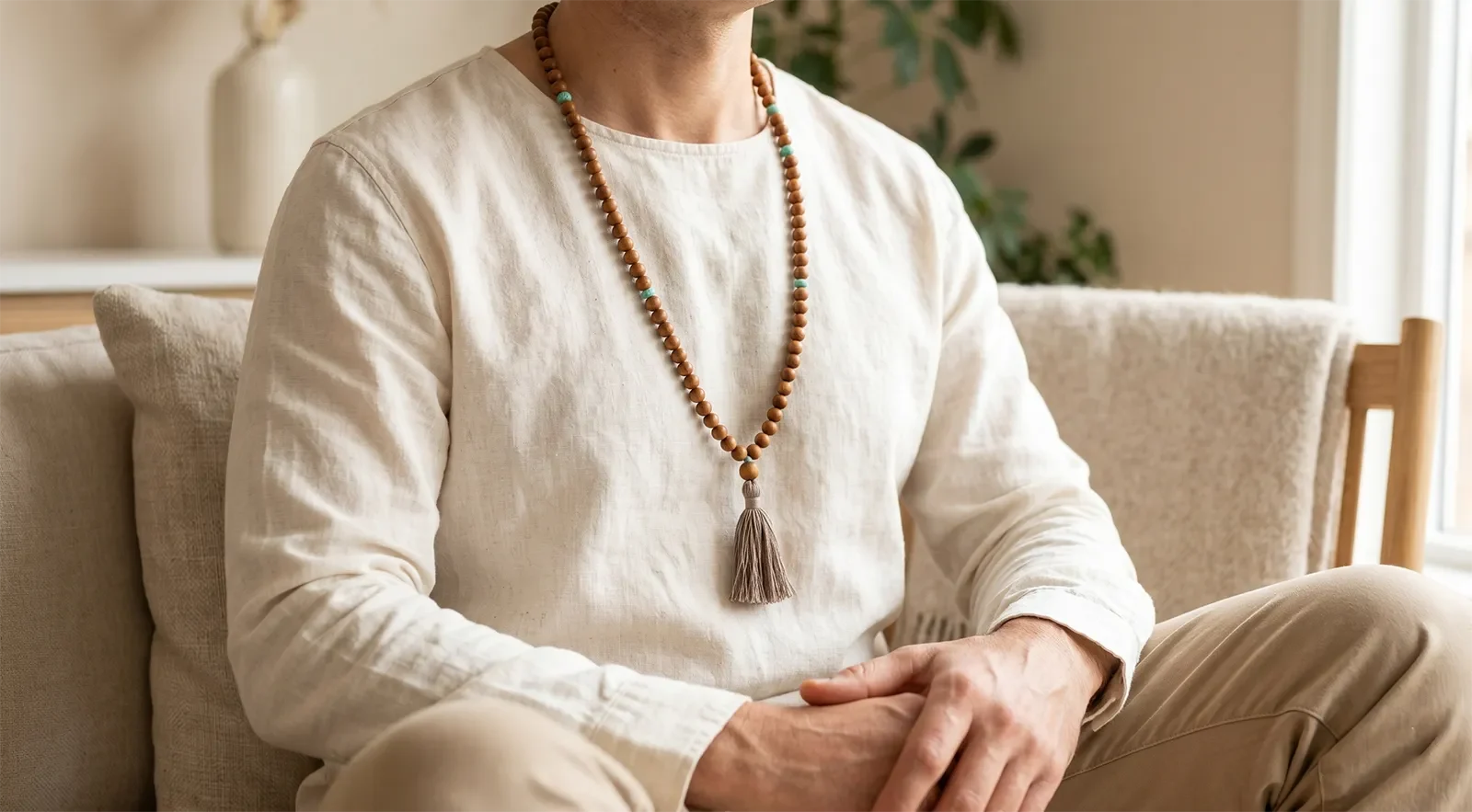
You do not need to be an expert before wearing one, but you should avoid treating the mala as a costume, gimmick, or vague “spiritual look.” Wear it because it has meaning, supports your practice, or reminds you of a quality you are trying to cultivate.
Respectful wear can look simple:
- Understand that malas carry spiritual and cultural context.
- Avoid using sacred language casually if you do not understand it.
- Choose a mala for meaning, comfort, and practice — not only trend appeal.
- Store and handle the strand with care.
- Stay honest about whether you use it for meditation, intention, or symbolic wear.
If your interest is mostly personal or symbolic rather than religious, that is okay. The key is not pretending the mala has no deeper context.
Do mala beads have to be 108 beads?
Many malas are associated with 108 beads, and that number carries significance in several spiritual traditions. However, not every mala-style strand has the same count, and modern designs may include wrist malas, shorter strands, or variations made for everyday wear.
For beginners, the bead count matters less than understanding the purpose of the strand. A mala is meant to support repeated attention. Before getting caught in numbers, ask whether the piece feels comfortable, usable, and meaningful for the kind of practice you want to build.
Materials and what to look for
Mala beads can be made from many materials, including wood, seeds, gemstones, glass, bone-like substitutes, metals, or other bead types. The material affects weight, texture, durability, symbolism, and how the mala feels in the hand.
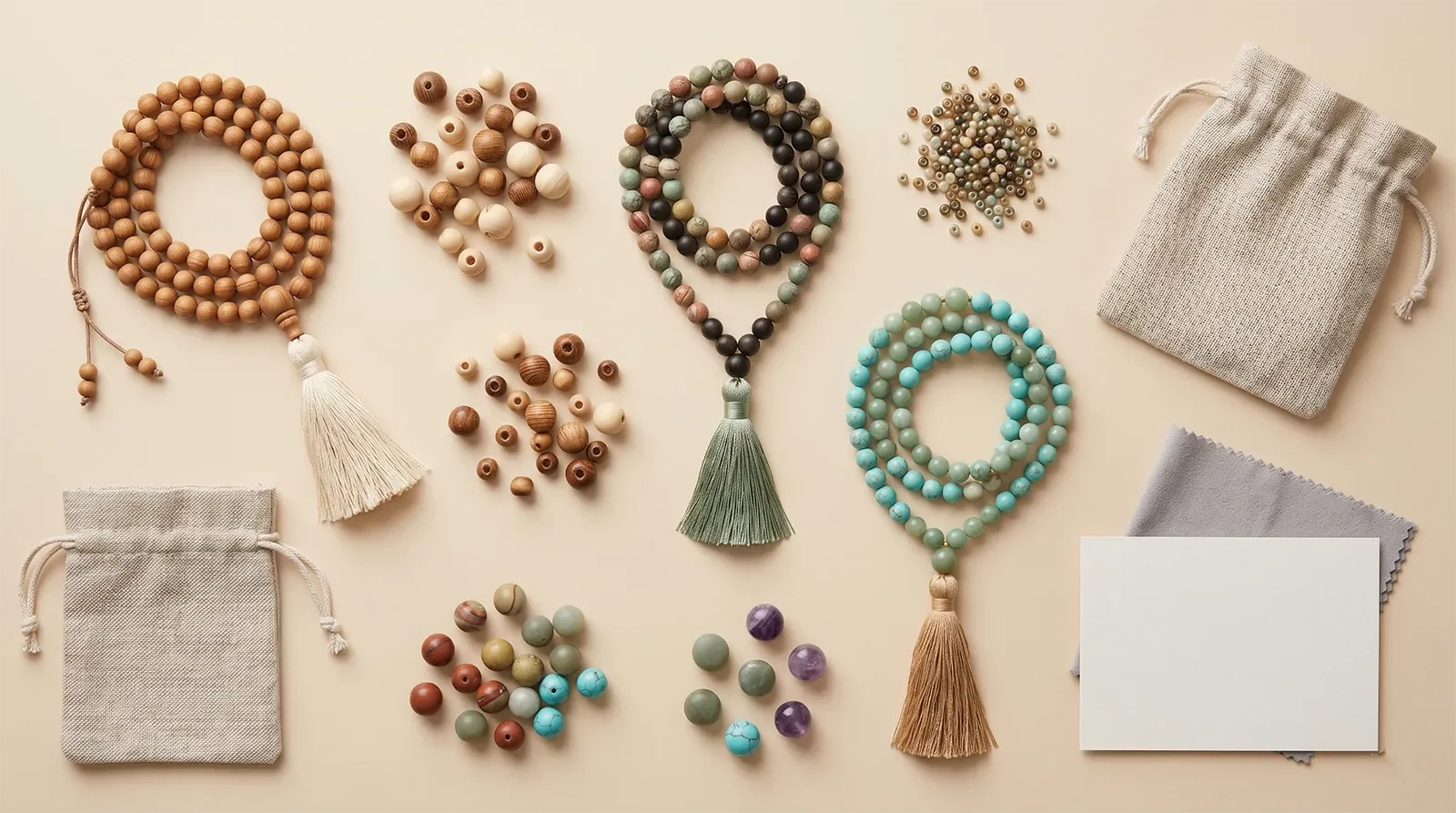
When choosing a mala, pay attention to:
- Hand feel: beads used for counting should feel comfortable and easy to move.
- Weight: a heavy strand may feel grounding to some people and distracting to others.
- Length: if you plan to wear the mala, make sure the length fits your body and clothing style.
- Durability: daily use can stress stringing, tassels, knots, and bead finishes.
- Material care: wood, seeds, gemstones, and plated details may all need different care.
- Symbolic meaning: choose meanings that feel honest to you, not just impressive on paper.
If you want to learn more about common materials and symbolic meanings, read Common Materials in Healing Jewelry & Their Meanings.
How to choose a mala for meditation or everyday wear
The right mala depends on how you plan to use it. A mala for seated meditation may need to feel smooth and easy to count. A mala for everyday wear may need to be comfortable, durable, and easy to style without feeling awkward.
If you want a mala for meditation
- Choose beads that feel good moving through your fingers.
- Avoid materials that feel too slippery, sharp, fragile, or distracting.
- Consider whether the strand length works for seated practice.
- Choose a material or design that supports calm attention.
If you want a mala for everyday wear
- Check the length, weight, and comfort on your body.
- Choose a style that fits your normal clothing, not only a staged outfit.
- Think about whether the material can handle regular wear.
- Wear it with awareness of its practice-based roots.
If you want a mala mainly for intention
- Choose one phrase or quality to connect with the piece.
- Use the mala as a reminder, not a guarantee of results.
- Repeat the intention during a consistent daily moment.
- Let the practice stay simple enough to continue.
For a broader beginner buying framework, see How to Choose Healing Jewelry.
Basic care tips
Mala care depends on the materials, stringing, knots, tassel, bead finish, and how often the strand is handled or worn. A mala used daily for counting may experience more friction and strain than one worn occasionally.
As a simple starting point:
- Keep the mala dry unless you know the materials can handle moisture.
- Store it somewhere clean where it will not tangle or stretch.
- Avoid pulling hard on the strand, tassel, or knots.
- Keep oils, sprays, perfumes, and lotions away from delicate materials.
- Clean gently according to the specific beads and construction.
If you want practical cleaning and storage guidance, use How to Cleanse and Care for Healing Jewelry. If you use symbolic cleansing practices, keep them material-safe and avoid methods that could damage the strand.
Common mistakes to avoid
Treating a mala as only a fashion accessory
A mala can be worn beautifully, but it carries more context than a standard necklace. Respectful wear means understanding that it is connected to practice, repetition, and spiritual tradition.
Buying only for appearance
Appearance matters, but comfort, hand feel, material quality, and purpose matter too. A mala that looks beautiful but feels awkward may not support regular use.
Forcing a complicated practice
Beginners do not need a long routine. A short, consistent practice is better than an elaborate ritual that feels intimidating.
Ignoring material care
Some materials are sensitive to water, sunlight, smoke, oils, or rough handling. Care for the mala according to what it is actually made of.
Using cultural language without understanding it
If you use terms from a specific tradition, take time to learn what they mean. Respect grows from attention, not performance.
FAQs
Are mala beads only for one religion?
No, but they are not context-free. Mala beads are connected to long-standing spiritual and religious traditions, including practices associated with Buddhism, Hinduism, and other meditative or devotional paths. Even when used in a broader modern context, they should be approached with respect.
Can I wear mala beads every day?
Yes, many people do. The main questions are whether the mala is comfortable, whether the materials are suitable for regular wear, and whether you are wearing it thoughtfully rather than treating it as an empty trend piece.
Do I need to meditate to wear a mala?
Not necessarily. Some people wear malas for personal intention or symbolic meaning. However, it is still important to recognize that malas have deeper practice-based roots and should not be treated as ordinary fashion jewelry with no context.
Why do many malas have 108 beads?
Many malas are associated with 108 beads, a number that carries significance in several spiritual traditions. Designs can vary, and beginners do not need to master every layer of meaning before using a mala respectfully.
Can mala beads be used as healing jewelry?
Yes, malas can fit within the healing jewelry category when people use them for intention, reflection, meditation, or symbolic support. Still, a mala has a more specific practice context than many ordinary jewelry formats, so it should not be reduced to a generic wellness accessory.
What is the easiest way to start using a mala?
Choose one short phrase, breath pattern, prayer, or mantra. Move through the beads one by one, repeating the phrase or breath with each bead. Keep the first practice short and steady.
Can I use a mala if I am not religious?
Yes, some people use malas in a non-religious way for mindfulness, intention, or breath practice. The important thing is to stay respectful and avoid pretending the object has no cultural or spiritual background.
How should I store mala beads?
Store them somewhere clean, dry, and protected from unnecessary strain. Avoid tossing them loosely into a bag where the strand, tassel, or beads may catch, stretch, or break.
Choose mala beads with respect and clarity
Mala beads are most meaningful when they are used or worn with respect. Start with one simple practice, choose a strand that feels comfortable and appropriate, and let the beads support attention rather than perform spirituality for appearance alone.