
For most home karaoke buyers, UHF microphones are the safest all-around choice for regular family use, two-microphone singing, and stronger wireless stability. 2.4GHz microphones are better when you want easy pairing and simple plug-and-play convenience. VHF microphones are usually best only for very casual, budget-first karaoke.
Written by Toan Ho — Tittac editorial team.
Who this guide is for: This guide is for home karaoke buyers comparing UHF, VHF, and 2.4GHz wireless microphones for living-room karaoke, family singing, and regular home use.
How this guide was prepared: This guide focuses on practical home karaoke buying factors: wireless stability, ease of pairing, two-microphone use, room activity, budget, long-term value, and how each microphone type feels in real family karaoke sessions.
Wireless microphones make karaoke easier and more natural at home, but UHF, VHF, and 2.4GHz systems do not behave the same way. The right choice depends less on the label and more on how often your family sings, how many microphones you use, and whether you care more about stability or convenience.
For most buyers, this is not a radio-technology lesson. It is a practical buying decision. If you are still comparing the full karaoke setup before choosing microphones, start with How to Choose the Best Karaoke System for Your Home.
Table of Contents
- Quick Answer
- The Basic Difference Between UHF, VHF, and 2.4GHz
- When UHF Microphones Make More Sense
- When 2.4GHz Microphones Make More Sense
- When VHF Microphones Still Make Sense
- UHF vs VHF vs 2.4GHz Microphones
- Real Home-Use Trade-Offs
- Common Buying Mistakes
- How to Choose in 60 Seconds
- Frequently Asked Questions
- Final Recommendation
Quick Answer
Choose UHF microphones if you want the strongest default choice for regular home karaoke, family parties, and two-microphone use. Choose 2.4GHz microphones if you want easier pairing, a cleaner plug-and-play feel, and a simple wireless setup for casual living-room karaoke. Choose VHF microphones only when your use is light, your budget is tight, and your expectations are modest.
For most homes, UHF is the safer long-term recommendation because it usually fits repeated karaoke use better. 2.4GHz is often the better convenience-first choice. VHF can work, but it is usually the compromise option rather than the best upgrade path.
The Basic Difference Between UHF, VHF, and 2.4GHz
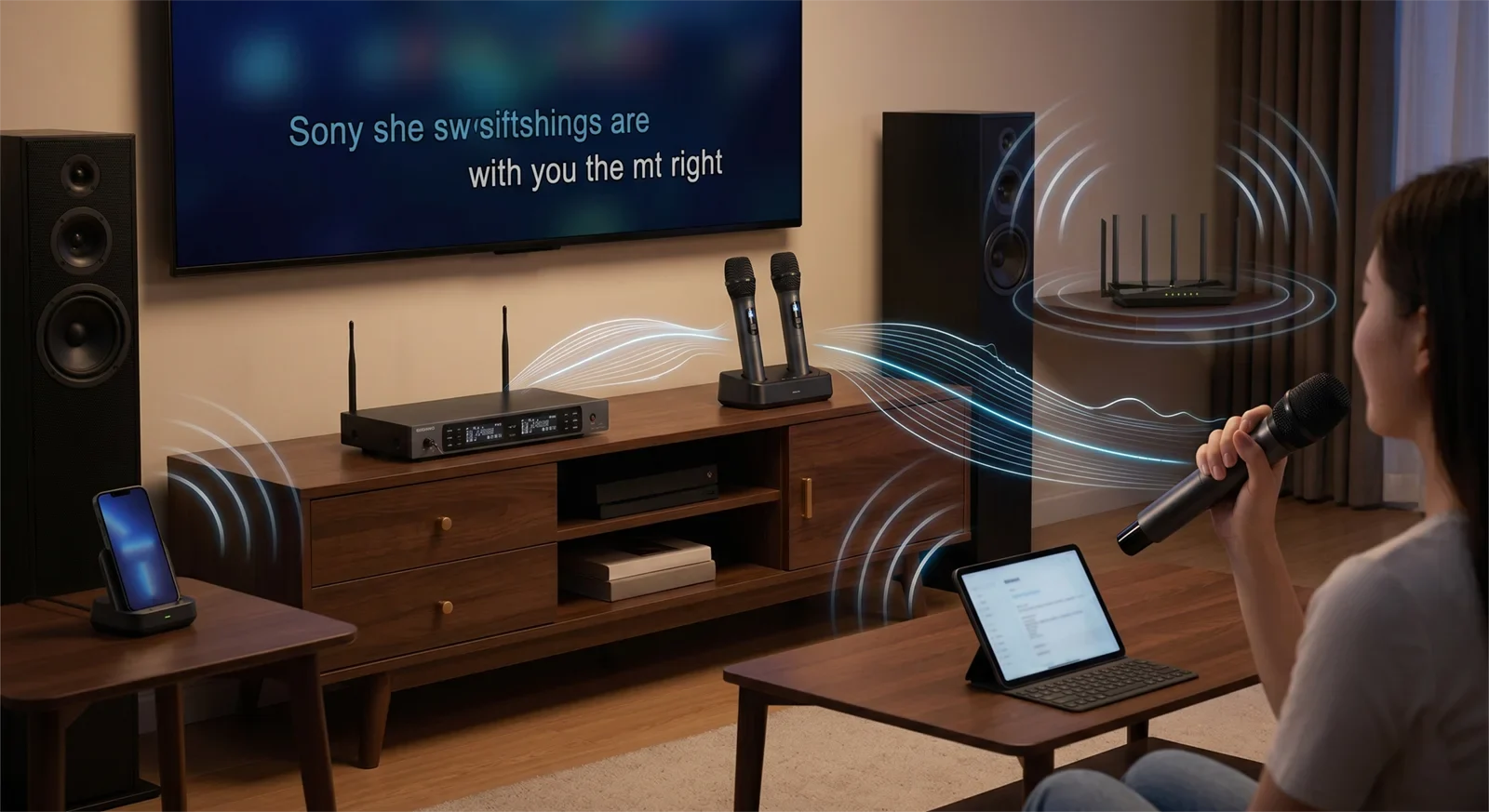
UHF wireless microphones are commonly used for karaoke systems that need dependable performance, especially when two microphones are used often. They are usually the most practical all-around choice for families who sing regularly.
2.4GHz wireless microphones are often designed around simple pairing and easier everyday use. They can feel modern and convenient in smaller or simpler home setups, especially when plug-and-play operation matters more than maximum flexibility.
VHF wireless microphones are usually more basic. They can still work for light home karaoke, but they are harder to recommend when the system will be used often or when buyers want stronger long-term confidence.
The microphone type matters, but it does not decide everything by itself. Receiver quality, microphone build, room layout, wireless activity, distance, battery condition, and how the system is set up all affect the real result.
When UHF Microphones Make More Sense

UHF microphones make the most sense when karaoke is a regular part of home entertainment. If your family sings often, uses two microphones, hosts gatherings, or wants the system to feel dependable every time, UHF is usually the best place to start.
This is why many home karaoke buyers choose UHF as the safer all-around direction. It may not always feel as instantly simple as some 2.4GHz systems, but it usually gives buyers more confidence for repeated use.
UHF microphones are usually a strong fit if you want:
- Regular family karaoke use
- Two-microphone singing
- Better long-term wireless confidence
- A stronger default choice for home karaoke systems
- A microphone setup that can handle more active sessions
If karaoke is more than an occasional activity in your home, UHF is usually the least risky recommendation.
When 2.4GHz Microphones Make More Sense
2.4GHz microphones make sense when convenience is the main priority. They often appeal to buyers who want microphones to pair easily, feel simple to use, and avoid a more technical setup process.
This can be a good fit for casual living-room karaoke, portable or semi-portable setups, and homes where people want the system to work without much adjustment. If the room is simple and the singing routine is casual, 2.4GHz may feel easier to live with.
2.4GHz microphones are usually a strong fit if you want:
- Simple plug-and-play use
- Easy pairing
- A convenience-first microphone setup
- Casual living-room karaoke
- A cleaner everyday workflow
The trade-off is that convenience should not be confused with the best fit for every situation. If your karaoke sessions are frequent, louder, or more demanding, UHF may still be the better long-term choice.
When VHF Microphones Still Make Sense
VHF microphones can still make sense for very casual karaoke, especially when budget matters most and expectations are simple. They may be acceptable for light use, occasional singing, or a basic starter setup.
However, VHF is usually not the best choice for a household that expects karaoke to become a regular activity. Once you start using two microphones often, hosting louder gatherings, or caring more about wireless confidence, VHF becomes easier to outgrow.
VHF microphones are usually a fit only if:
- Karaoke use is very occasional
- The budget is the main deciding factor
- The room setup is simple
- Expectations are modest
- You are not building a long-term karaoke system
VHF is not automatically wrong. It is just usually the weakest long-term recommendation when UHF and 2.4GHz options are available.
UHF vs VHF vs 2.4GHz Microphones
| Microphone type | Best for | Main advantage | Main trade-off |
|---|---|---|---|
| UHF | Regular home karaoke, two-mic use, family parties | Strongest all-around recommendation for stability and repeated use | May require more attention to system quality and setup |
| 2.4GHz | Simple living-room karaoke, convenience-first buyers | Easy pairing and plug-and-play feel | Not always the best fit for more demanding or frequent sessions |
| VHF | Very casual, budget-first karaoke | Lower-cost basic use | Easier to outgrow and usually weaker for long-term home karaoke |
Real Home-Use Trade-Offs
Stability versus convenience
The biggest decision is stability versus convenience. UHF usually wins when the household wants a more dependable long-term microphone setup. 2.4GHz often wins when easy pairing and simple use matter most.
For a family that sings often, stability usually matters more over time. For a household that sings occasionally and wants the system to feel simple, convenience may matter more.
Two-microphone use
If your family uses two microphones often, microphone choice becomes more important. Duets, parent-and-child songs, and group singing all depend on a wireless setup that feels stable and easy to manage.
For repeated two-microphone karaoke, UHF is usually the safest place to start. If your use is lighter and convenience matters more, 2.4GHz can still be reasonable.
Room activity
A quiet, simple room is less demanding than a busy family room. When people are talking, moving, singing louder, and passing microphones around, the microphone system needs more confidence.
In a simple room, 2.4GHz may feel easy and clean. In a busier room or regular family karaoke setup, UHF is usually the stronger recommendation.
Budget versus long-term value
VHF may save money up front, but that does not automatically make it the best value. If the system gets used often, a stronger microphone setup can prevent frustration later.
The better question is not “What is cheapest?” It is “Will this still feel good after months of normal use?” For regular karaoke, UHF or a good 2.4GHz setup usually makes more sense than choosing VHF only to save money.
Common Buying Mistakes
Treating the wireless type as the whole quality ranking
UHF, VHF, and 2.4GHz describe wireless approaches, but the label does not guarantee quality by itself. A well-designed microphone system can outperform a poorly designed one even if the label sounds less impressive.
Use the wireless type to narrow the fit, then judge the actual microphone system by stability, sound, build quality, receiver design, and how well it matches your home.
Choosing convenience when you really need stability
Some buyers choose the easiest option on day one, then realize their family uses karaoke often enough that stronger stability matters more. This is common when the system becomes part of regular weekend singing or family gatherings.
If karaoke is frequent and shared, buy for confidence first. If karaoke is casual and occasional, buying for convenience can make more sense.
Choosing VHF only to save money
VHF can work for light use, but it is often the first option buyers outgrow. If you already know karaoke will be used often, saving money on the microphone path can create frustration later.
Do not choose VHF just because it is available. Choose it only when the use case is truly simple.
Ignoring microphone quality and setup
The wireless type is only one part of the microphone experience. A poor receiver position, weak batteries, low-quality capsules, bad gain settings, or poor microphone technique can still create problems.
If you are choosing microphones as part of a larger system, compare this with How to Choose Wireless Microphones for Karaoke and Why Good Microphones Matter for Karaoke.
How to Choose in 60 Seconds
- Decide how often you sing. Regular karaoke usually points toward UHF. Occasional karaoke may allow more convenience-first choices.
- Count microphones. If two microphones are used often, prioritize stability.
- Look at the room. Simple living rooms can fit 2.4GHz well. Busier family rooms often reward UHF.
- Set the budget honestly. Avoid VHF unless your use is truly light and budget-first.
- Choose by real use. Stability-first buyers should start with UHF. Convenience-first buyers can consider 2.4GHz. Very casual users may accept VHF.
If you only remember one rule, use this: choose UHF for the strongest default home karaoke recommendation, 2.4GHz for simple convenience, and VHF only for very basic use.
Frequently Asked Questions
Is UHF better than VHF for karaoke?
For most regular home karaoke use, UHF is usually better than VHF because it is the stronger all-around recommendation for stability and repeated use. VHF can still work for very casual or budget-first karaoke, but it is easier to outgrow.
Is UHF better than 2.4GHz for karaoke?
UHF is usually better when stability and regular two-microphone use matter most. 2.4GHz can be better when the buyer wants easy pairing, simple setup, and a plug-and-play feel for casual home karaoke.
Are 2.4GHz microphones good for home karaoke?
Yes. 2.4GHz microphones can be good for home karaoke when convenience, easy pairing, and simple living-room use are the main priorities. They are not always the best choice for more demanding or frequent sessions, but they can be a good fit for casual setups.
Is VHF still okay for karaoke?
VHF can still be okay for very light karaoke use, especially when budget matters most. It is usually not the best long-term choice for regular family karaoke, two-microphone sessions, or a system you expect to use often.
Which wireless microphone type is best for family karaoke?
UHF is usually the safest choice for family karaoke because it fits repeated use and two-microphone singing well. 2.4GHz can be a good choice for simpler households that care more about convenience than long-term wireless confidence.
Does UHF, VHF, or 2.4GHz decide sound quality by itself?
No. The wireless type matters, but sound quality also depends on the microphone capsule, receiver quality, gain settings, room layout, batteries, and how the system is used. The label helps narrow the choice, but it is not the whole answer.
Final Recommendation
For most home karaoke buyers, choose UHF if you want the safest all-around microphone choice for regular family use, two-mic singing, and stronger wireless confidence. Choose 2.4GHz if your priority is simple pairing, plug-and-play convenience, and casual living-room karaoke. Choose VHF only if your use is very light and budget matters more than long-term fit.
The real decision is not old versus new or technical versus simple. It is stability versus convenience, and short-term savings versus long-term satisfaction. Choose the wireless microphone type that matches how your household actually sings.
Need help choosing wireless microphones for your karaoke system? Tittac can help compare UHF, 2.4GHz, VHF, microphone count, room size, and full system fit in English or Vietnamese.
Explore Karaoke Buying Guides · See How to Choose Wireless Microphones · Learn How to Fix Common Karaoke Problems