
Phase problems in a home karaoke system often sound like a strange loss of solidity. The bass may feel weaker, the vocal may seem hollow or less centered, and the whole mix can feel oddly incomplete even though every speaker is still making sound. The key clue is not just “bad sound.” It is a pattern of weak, unstable, or missing-feeling sound that does not behave like a normal tone problem.
Who this guide is for: Home karaoke users who hear an odd, hard-to-name problem and want to understand it before assuming the system only needs more bass, different EQ, or new speakers.
How this guide was prepared: This guide was written by focusing on the audible clues phase-related problems can create in normal home karaoke listening, especially weak bass support, hollow vocal focus, and unstable center imaging.
Some karaoke systems sound wrong in a way that is difficult to describe. The bass may feel lighter than expected. The vocal may seem less centered. The whole presentation may feel thin, distant, or strangely unstable, even when nothing sounds obviously broken.
That matters because phase-related problems can hide inside an otherwise normal-looking setup. Users may blame tuning, room sound, speaker quality, or microphone level before recognizing the listening pattern itself. For broader plain-English technical context, see our Karaoke Technical Guides.

Table of Contents
Quick Answer
Phase problems in a home karaoke system usually sound less like a dramatic failure and more like a strange loss of body, center focus, and stability. The bass may weaken, the vocal may feel hollow or less anchored, and the stereo image may stop feeling solid even though the system is still playing. In plain English, phase issues happen when parts of the sound stop reinforcing each other properly and start working against each other instead.
What phase problems actually mean
In simple terms, phase is about timing relationship and alignment. When sound elements line up the way they should, they support each other and feel solid. When they do not line up well, parts of the sound can weaken, blur, or partially cancel each other.
In home karaoke, that can make the system feel less full and less stable without making the problem obvious. The system may still produce sound from every speaker. Nothing may seem fully dead. But the sound no longer combines in a natural, supportive way.
This is why phase problems can be confusing. Instead of one clear failure, the listener hears a combination of clues: weaker bass, hollow vocals, unstable center focus, or a mix that feels less believable than it should.
This page is not a full signal-path repair guide. It is a listening guide first. If you want the broader routing concept in plain English, see Understanding Karaoke Signal Flow Without the Jargon.
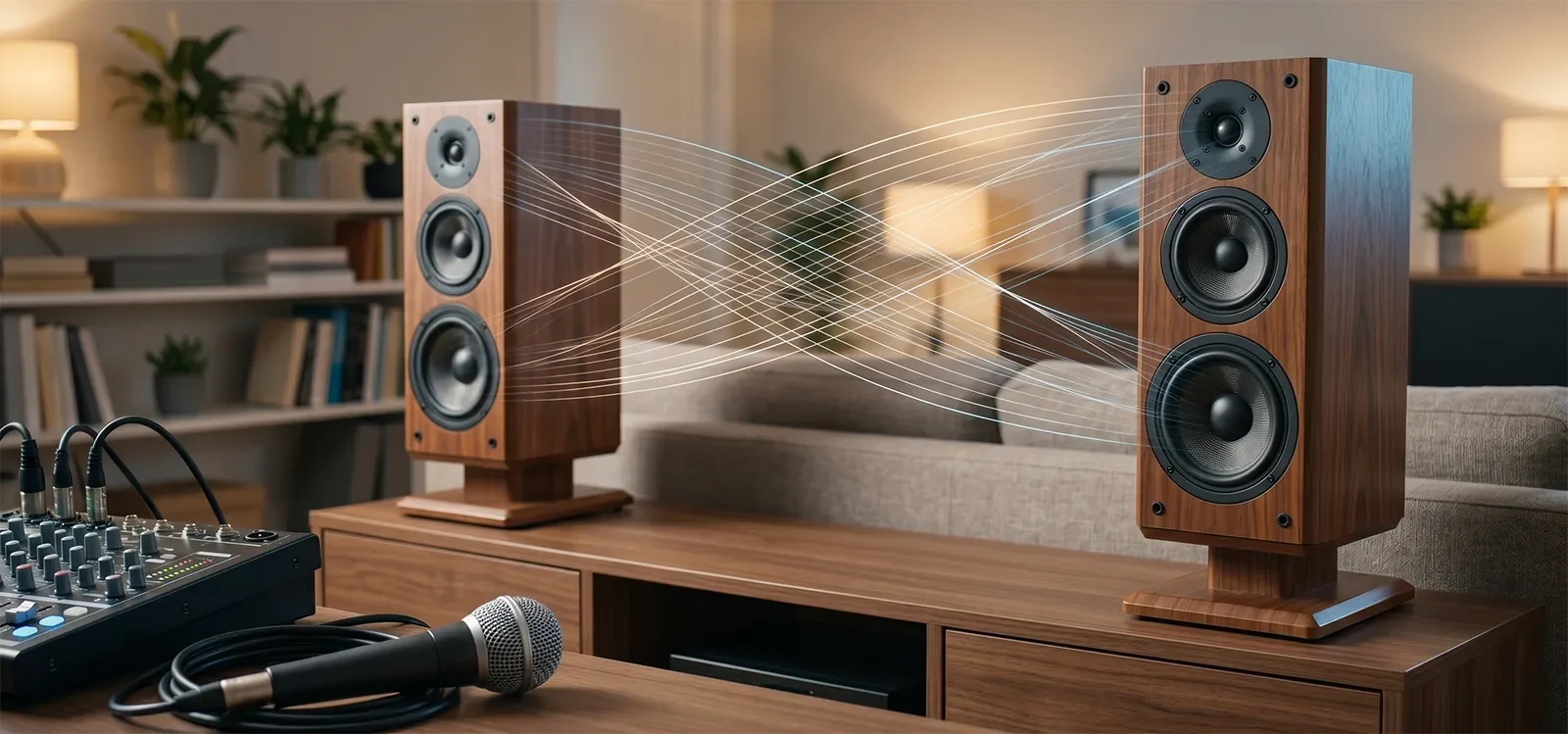
Why phase affects solidity and focus
A healthy karaoke presentation usually feels anchored. The vocal has a believable place, the low end has some weight, and the mix holds together as one coherent sound. When phase gets in the way, that structure can weaken.
The bass may seem lighter than expected, but not in a clean or controlled way. The vocal may be audible, yet somehow hollow or less focused. The stereo image may feel wide or open, but not stable. In listening terms, phase often changes the system from solid to uncertain.
That uncertainty is the important part. A phase issue may not sound like one obvious defect. It may feel like several small things are wrong at once. The system plays, but it does not lock together.
That is why users often describe phase-related problems with words like thin, hollow, distant, strange, or incomplete. Those words are not technical, but they often point toward the same listening pattern: the sound is no longer reinforcing itself in a believable way.
What users actually hear at home
At home, phase problems often sound like the system has lost body without becoming obviously quiet. The bass may weaken in a way that makes the whole mix feel less grounded. The vocal may seem less centered, especially in stereo playback. Some users describe it as hearing the sound but not fully feeling it connect.
Another clue is that the problem can feel uneven. The system may sound more complete from one seat and more hollow from another. Or the vocal may seem to move, blur, or lose its center in a way that does not feel like normal stereo width.
Phase problems do not always announce themselves dramatically. Sometimes they show up as a quiet sense that the system is not filling in the way it should. The sound exists, but the foundation feels weak and the vocal image feels less trustworthy.
That is why phase is worth understanding as a listening-recognition concept. Once you know the pattern, you are less likely to chase the wrong fix too quickly.

Phase problems vs a thin-sounding system
A phase problem can make a karaoke system sound thin, but not every thin-sounding system has a phase issue. This difference matters because the fix may not be the same.
A generally thin system often sounds light because of tonal balance, low listening volume, speaker size, placement, or lack of low-end support. A phase-related problem usually feels more structural. The sound may be weak, hollow, and unstable at the same time.
That is the difference to listen for. Thin sound is mostly about tonal lightness. Phase-related sound often feels like parts of the mix are not joining together correctly. If the issue is mainly low-volume thinness, read Why Some Karaoke Systems Sound Thin at Low Volume.
For phase problems, the clue is the combination: reduced bass support, hollow vocal focus, and a center image that does not feel solid.
Common misunderstandings about phase problems
The biggest misunderstanding is assuming the problem is only weak bass. Phase can create a bass-light impression, but it often brings other clues with it, such as hollow vocal focus or unstable center imaging. That is why “just add more bass” may not solve the real issue.
Another misunderstanding is assuming that if every speaker makes sound, the setup must be fine. A phase-related issue can still exist even when nothing is silent. The problem is not always missing signal. Sometimes the problem is how signals combine.
People also misread phase problems as bad EQ. That can happen because the result may sound thin, strange, or uncomfortable. But if the system feels weak, hollow, and spatially uncertain all at once, the issue may be deeper than a simple tone adjustment.
Phase problems are also easy to confuse with room behavior. Rooms can absolutely change bass and vocal focus, but a phase-related pattern often feels like the system itself is not locking together before the room even has a chance to help.
A practical listening rule
The most useful listening rule is this: if the sound feels weaker, hollower, and less centered all at once, phase may be part of the pattern.
Do not judge from one symptom alone. Weak bass by itself does not prove a phase issue. A thin vocal by itself does not prove it either. The clue is the combination: reduced low-end support, unstable vocal focus, and a mix that feels less solid than it should.
This helps you avoid chasing random explanations too early. Not every weak-sounding system has a phase problem, but phase becomes a more realistic suspect when the sound feels incomplete in a structural way rather than simply dull, bright, thin, or bass-heavy.
The practical takeaway is simple: phase problems are often recognized by their odd combination of clues, not by one dramatic sound defect.
Conclusion
Phase problems in a home karaoke system often sound like a loss of solidity more than a loud, obvious malfunction. The bass may weaken, the vocal may feel hollow or less centered, and the whole mix may seem oddly unstable even though everything still appears to be working.
That is why phase is worth understanding as a listening concept. When you recognize the pattern more accurately, you are less likely to mislabel it as simple weak bass, generic thinness, or random bad tuning.
The key is to listen for the full pattern: weak support, hollow focus, and unstable center image. When those clues appear together, the system may not just need more volume or more EQ. It may need better alignment in how the sound is combining.
Frequently Asked Questions
Do phase problems always sound dramatic in karaoke?
No. Many phase problems sound subtle rather than extreme. The system may still play normally, but the mix can feel weaker, hollower, or less centered than it should. That subtlety is why users often misread the problem as poor tuning or weak bass.
Can phase problems make vocals feel less centered?
Yes. One common clue is that the vocal feels less anchored or less stable in the middle, especially in stereo playback. The sound may still be audible and reasonably clear, yet the center image no longer feels trustworthy.
Is a phase problem the same as a thin-sounding karaoke system?
Not exactly. A phase problem can make a system seem thin, but the listening pattern is usually broader than simple tonal lightness. Phase often adds hollow vocal focus, weak bass support, or unstable spatial behavior. Thin sound is a description of tone. Phase is more about how parts of the sound are combining.
Can a phase issue happen even if both speakers are working?
Yes. A phase-related problem does not always mean a speaker is dead or silent. The system can still produce sound while certain parts of the signal combine poorly. That poor combination can reduce bass support, weaken the center image, or make the mix feel hollow.
Does this article explain how to fix every phase problem?
No. This guide is meant to help you recognize what phase-related problems can sound like. The goal is better listening interpretation first, so you do not start chasing random fixes before naming the pattern more accurately.
Better listening terms lead to better decisions.