
Frequency response can give you a rough clue about how much low-end and high-end range a karaoke speaker or audio system may cover, but it does not tell you how good the system will feel for singing. In home karaoke, the more important question is not whether the published range looks wide. It is whether vocals sound clear, natural, balanced, and comfortable in a real room.
Who this guide is for: Home karaoke users who want to read audio specs more intelligently without assuming a good-looking frequency-response number automatically guarantees better karaoke sound.
How this guide was prepared: This guide was written by comparing how published frequency-response specs relate to real home karaoke listening, vocal clarity, tonal balance, speaker voicing, room interaction, and why similar-looking specs can still lead to very different results.
Frequency response is one of the first specs many buyers notice because it looks simple and technical at the same time. A speaker listed as covering a wide range can seem automatically more capable, more detailed, or more “full range.” But karaoke at home is not judged by numbers alone.
What matters is how the system handles music and vocals together. A spec can tell you something useful, but it cannot fully predict whether the voice will sit naturally in the mix, whether the tone will feel comfortable, or whether the sound will stay enjoyable inside your room. For broader plain-English technical context, see our Karaoke Technical Guides.
Table of Contents
Quick Answer
Frequency response usually tells you the approximate range of frequencies a speaker or audio product is designed to reproduce. It can offer a rough clue about low-end and high-end coverage, but it does not tell you how smooth, balanced, comfortable, or karaoke-friendly the sound will be in real use. Two products can publish similar frequency-response ranges and still sound very different because the spec often leaves out response shape, measurement method, output behavior, speaker voicing, and room interaction.
What frequency response actually means
In plain English, frequency response describes the range of frequencies a product is intended to reproduce. When you see a number such as 50 Hz to 20 kHz, the basic idea is that the speaker or audio device is designed to cover sound from lower frequencies up through very high frequencies.
That information is real and useful, but it is only a starting point. Frequency response does not simply mean “how low” and “how high.” The more important question is how the product behaves across that range. A system may claim a wide range but still sound uneven, thin, harsh, boomy, or unclear depending on how the response is shaped.
This is especially important for karaoke because vocals live in the middle of the listening experience. A system can look impressive on paper but still fail to make voices sound natural and easy to follow. The endpoints of the frequency range do not show you the full vocal character.
So frequency response should be treated as a clue about coverage, not a complete description of how the system will sound.
What the spec can tell you
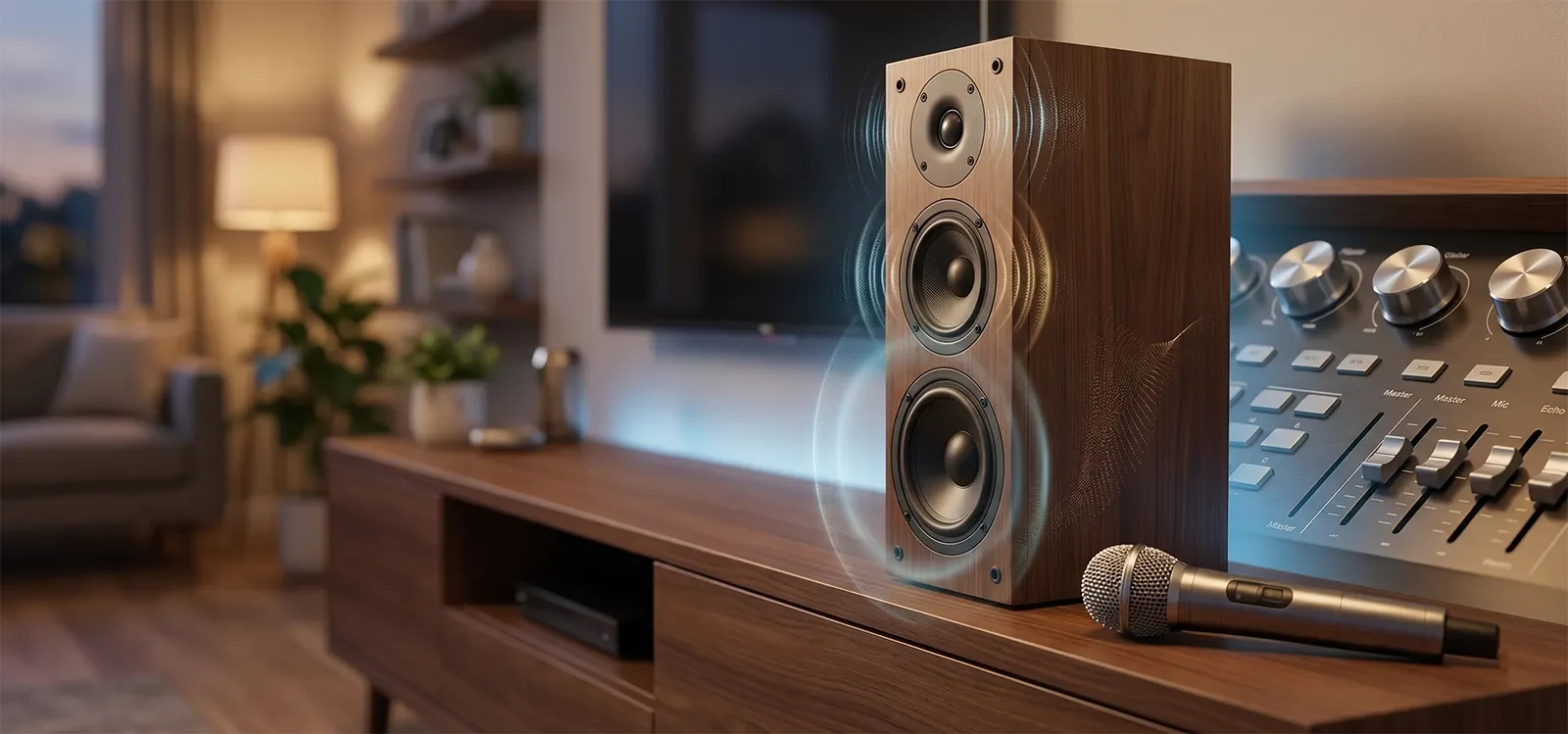
Frequency response can help you understand broad coverage. If a speaker has limited low-frequency extension, it may feel lighter in bass. If a product has broader high-frequency extension, it may suggest more top-end openness. These are fair directional clues.
The spec can also help you avoid unrealistic expectations. A small speaker with limited low-end reach may not deliver the same bass weight as a larger system or a setup with a proper subwoofer. A system with poor high-frequency extension may not feel as open or detailed.
For karaoke, frequency response can also raise useful questions. Will the system have enough body for music? Will the vocal range feel supported? Will the top end feel clear without becoming sharp? The spec does not answer those questions completely, but it can help you know what to listen for.
That is the best use of frequency response: it helps guide your attention. It should not make the final decision for you.
What frequency response cannot tell you
Frequency response cannot tell you whether a karaoke system will sound smooth, natural, or comfortable at home. It also cannot tell you whether vocals will sit clearly in the mix. Those qualities depend on more than the published frequency range.
One reason is that many published specs do not show the response shape. They may list the lowest and highest points but not show whether the sound is even across the middle, upper mids, or treble. Those areas strongly affect vocal clarity, presence, and listening comfort.
The spec may also leave out the measurement method. Without knowing tolerance, measurement distance, output level, room conditions, and how the response was measured, two published ranges can look similar while meaning very different things.
Frequency response also does not explain speaker voicing. Voicing is how a speaker is intentionally shaped to sound. One speaker may be voiced to sound bright and forward. Another may be smoother and warmer. Both may publish similar frequency-response ranges but feel very different in karaoke use. For that separate concept, see What Speaker Voicing Means in Home Karaoke.
Why similar frequency-response specs can sound different
Two products can show similar frequency-response numbers and still sound very different because the headline range does not show the whole sound behavior. It does not show how smooth the response is, how the speaker behaves at real listening levels, or how vocals interact with music through that system.
One system may feel smooth, stable, and forgiving. Another may feel sharp, uneven, or less believable through the vocal range even if the published endpoints look almost the same. The difference can come from response shape, cabinet design, driver behavior, processing, amplifier matching, crossover design, and speaker voicing.
Room interaction makes the gap even larger. A speaker does not operate in isolation once it is placed in a living room, family room, or karaoke space. Walls, floors, ceilings, furniture, and hard surfaces can change bass weight, vocal clarity, and brightness. For that separate topic, see How Room Acoustics Affect Karaoke Sound.
This is why frequency response only partly predicts real karaoke sound. It can hint at range, but it cannot guarantee vocal comfort, tonal balance, or how the system will feel after several songs.
How to read frequency response for home karaoke
When reading frequency response, start by treating it as a broad map, not a final verdict. A wider range may suggest broader capability, but it does not automatically mean better karaoke sound. A narrower range may raise questions, but it does not automatically mean the system will sound bad.
Look at the spec, then ask better listening questions. Do vocals sound easy to follow? Does the music have enough body without covering the singer? Does the high end feel clear without becoming sharp? Does the system stay comfortable at the volume your family will actually use?
Those questions matter more than chasing the widest published range. Karaoke is a vocal-first listening experience. A system that makes voices sound natural and easy to sing with may be more useful than a system with more impressive-looking numbers but poorer balance.
If possible, judge frequency response together with speaker sensitivity, voicing, room behavior, and real listening comfort. Specs become more useful when they are read as part of the whole system instead of treated as a single score.
A practical interpretation rule
The practical rule is simple: use frequency response to understand broad coverage, then stop before turning it into a full sound verdict.
A wide frequency-response range can be a good sign, but it does not prove that vocals will be clear. A smaller published range can raise a fair concern, but it does not automatically mean the system will feel bad at home. The number is useful only when you understand its limits.
For home karaoke, the better question is not “What does this spec prove?” but “What does this spec hint at?” That small shift leads to smarter expectations. It keeps you from assuming that a product page number can settle questions about vocal comfort, tonal personality, or real-room performance.
Frequency response is worth reading. It just works best as a clue, not as a conclusion.
Conclusion
Frequency response can tell you something useful about general frequency coverage, which makes it worth checking. But it cannot fully tell you how smooth, balanced, comfortable, or karaoke-friendly a system will feel once real vocals, real music, and real room conditions are involved.
That is why two products with similar frequency-response claims can still sound very different at home. The spec is informative, but it is incomplete. In karaoke, it helps most when it keeps your expectations realistic instead of overconfident.
The best way to use frequency response is to read it, understand what it suggests, then judge the system by what matters most: clear vocals, comfortable tone, balanced music, and a singing experience that feels natural in your room.
Frequently Asked Questions
Does a wider frequency-response range always mean better karaoke sound?
No. A wider range may suggest broader extension, but it does not guarantee better vocal clarity, smoother mids, or a more comfortable singing experience. Frequency response is useful as a directional clue, but it is not a full sound-quality score for home karaoke.
Why can two products with similar frequency-response specs still sound different?
Because the published range often leaves out important context. It may not show response smoothness, measurement method, tolerance, output behavior, speaker voicing, or room interaction. Two products can claim similar endpoints yet still feel very different in tonal balance, vocal comfort, and real karaoke use.
Can frequency response tell me if a system will sound good for vocals?
Only in a limited way. It may hint at general coverage, but it cannot fully predict how natural, present, or comfortable vocals will feel. Vocal performance depends on more than extension alone, including voicing, response shape, processing, speaker placement, and the listening environment.
Is frequency response still worth checking on karaoke product pages?
Yes, as long as you treat it as one clue rather than a final answer. It can help you read spec sheets more realistically and avoid extreme assumptions. It becomes most useful when you understand both what the number can tell you and what it cannot settle by itself.
What matters more than frequency response for home karaoke?
Vocal clarity, tonal balance, speaker voicing, room interaction, microphone quality, and system tuning often matter more than the published frequency-response range alone. A karaoke system should be judged by how comfortable and natural it feels when people actually sing through it.
Spec sheets become more useful when you stop expecting them to answer everything.
Read how professionals tune karaoke systems for a more practical way to judge real sound